Showing posts with label ULA. Show all posts

Sunday, July 31, 2016

Beautiful Atlas V Launch

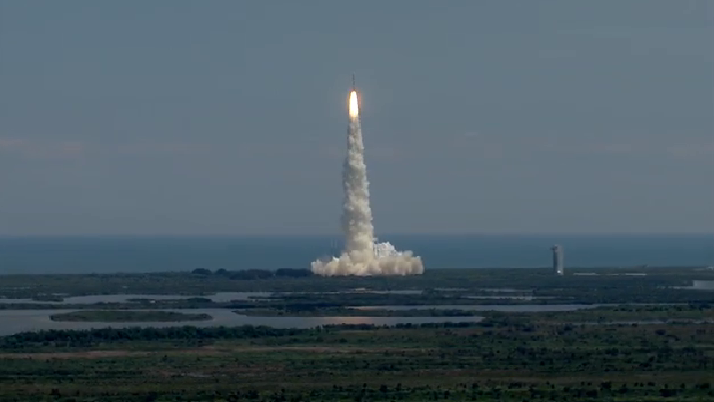
Atlas V carrying a Defense Department satellite roars from pad LC-41.
 
There are so many rocket launches around the world these days that I primarily like to cover the manned mission variety. But some launches just catch my eye, like this one. Atlas and ULA just keep a busy pace with successful satellite launches from Cape Canaveral. This one lifts off on a beautiful Thursday into the Florida sky, the 64th launch of the Atlas V rocket and the 135th of the Atlas program. 
Another view of the launch. On board is the NROL-61 spy satellite.
 
The National Reconnaissance Office (NRO) maintains the supervision of our country's fleet of satellites that monitor security situations around the world, especially keeping an eye on those countries that are hostile to America. For the United Launch Alliance, the company that manages many of the satellite launches (and previously, shuttle launches), this flight was the 23rd launch for the NRO. The NRO has also used Delta rockets for some of its missions.
You can read more about this satellite at NASASpaceflight.com at: https://www.nasaspaceflight.com/2016/07/atlas-v-launch-nrol-61-reconnaissance-satellite/


Friday, April 11, 2014

Atlas V Blast-off Restarts Florida Launches

Mission NROL-67 blasts off from SLC-41 in Cape Canaveral. All pics in this post are from ULA.

Yesterday at 1:45 PM EDT an Atlas V carrying a spy satellite lifted off without problems for an eastern flight across the Atlantic Ocean and up into geosynchronous orbit. With this successful launch, and no reported problems from the recently repaired Range radar, the launch schedule from Florida can resume. The next flight is on April 14, when SpaceX launches the Falcon rocket with its Dragon resupply spacecraft to the ISS.

Atlas V on pad SLC-41.

It was a beautiful day for a launch, and congratulations to the ULA (United Launch Alliance) team that has launched two Atlas V missions across the country from each other within about a week's time.

Ground view of the Atlas V.

View from across the inlet. Cape Canaveral and the Kennedy Space Center are surrounded by a beautiful wildlife refuge. The white tower to the left of the pad is the rocket gantry complex.

Another aerial view that really shows how the pad is surrounded by water. The Freshwater parts also include alligators!

Liftoff!

The Atlas V goes supersonic. The solid rocket boosters give a tremendous push.

With their fuel expended, the boosters are jettisoned and the rocket continues to climb using its core fuel. 

Thursday, April 10, 2014

US Cargo Missions to ISS to Resume

SpaceX Falcon rocket with Dragon cargo spacecraft at Complex SLC-40. 

The main radar installation that supports launches from both the Kennedy Space Center and the Cape Canaveral Air Force Station suffered a fire a few weeks ago. It turns out that the radar, operated by the 45th Space Wing of Patrick Air Force Base, required major surgery to repair. As a consequence, launches scheduled from the east coast of Florida were delayed. Today that delay will end, hopefully, with the launch of an Atlas V carrying a classified military satellite. Following today's launch, SpaceX will be clear to launch its Dragon cargo spacecraft to the ISS on April 14th.

Atlas V launch last Thursday from Vandenberg AFB.

Today's Altas V launch was itself dependent on a successful launch of another Atlas V mission last week from Vandenberg AFB in California. That mission, carrying an Air Force weather satellite, started a 7 day turnaround for support crew elements and a review of the launch data. Once the data had been cleared, and the support crew from the United Launch Alliance (ULA) had transferred over to  Florida to work on the launch of the new updated Atlas V 541, which can launch heavier payloads than the earlier Atlas V versions. Today's mission carries a secret spy satellite for the National Reconnaissance Office. 

Progress spacecraft approaches the ISS.

In the meantime, the glitch that occurred on the recent Russian Soyuz launch to the ISS seems not to have repeated with the launch this week of a Progress robotic cargo spacecraft to the station. Using the navigational shortcut trajectory, the Progress M-23M (P55) spacecraft successfully arrived to dock with the station after a six hour flight on Wednesday April 9th. A previous Progress spacecraft, Progress M-22M (P54), undocked from the ISS on Monday. Filled with garbage and waste, the craft will remain in orbit for 11 days while engineers on the ground conduct some final experiments, then it will burn up in the atmosphere. The current Progress is docked at the Russian-built Pirs module.

Tuesday, September 3, 2013

Rocket launch updates

Long March 4C rocket blasts off from Jiuquan, China.

The last couple of weeks have seen the usual flurry of rocket launches from around the world. These satellite launches rarely make TV coverage, but are an important sign of the strength of space programs around the world. They demonstrate how reliant we are upon the space technology that lies behind our way of life in the 21st century.

Launch of  a Long March rocket from Jiuquan.

Yesterday China launched a Long MArch 4C rocket from its Jiuquan Satellite launch center. Three satellites, expected to be secret spy satellites, were placed into orbit.  The Jiquan Center is the same facility from where the Chinese Manned Missions take place. NASA Spaceflight.com has a great article on this launch at : http://www.nasaspaceflight.com/2013/09/long-march-4c-launches-yg17-mission/

Russian Zenit S2B rocket. Credit: Ria Novosti.

On Sunday September 1st, the Russian Zenit rocket returned to duty, placing an Israeli communications satellite into space. This rocket is the land-based version of the Zenit Sea-launched version. The last Zenit launch from its sea-based space center failed, destroying an Intelsat satellite. This launch took place from Baikonur launch facility in Kazakhstan.

The heavy-lift Ariane 5 blasts off. Credit: Ariannespace.

Last Thursday the European Space Agency launched an Ariane 5  heavy lift rocket from its space center in French Guiana on the coast of South America. The two satellites were successfully placed into orbit. One was a European communications satellite, the other a military satellite for India.

The powerful Delta-4 rocket on the pad at Vandenberg AFB, California. 
Credit: ULA & Spaceflight Now.

Last Wednesday morning saw the launch of the Delta-4 rocket under the direction of the United Launch Alliance. Launch site was the Vandenberg Air Force Base pad in California. The mission placed a National Reconnaissance spy satellite into space. 

Japanese Epsilon rocket on the pad at Uchinoura facility. Credit: JAXA.

Things didn't work out very well for the expected launch of the Japanese Epsilon rocket on August 27. The Epsilon is a new rocket, expected to place the SPRINT-A satellite into orbit. The SPRINT-A is an observatory which will study the planets in our solar system. An unexpected malfunction caused the countdown to terminate with 19 seconds left. Engineers are working on the problem. Keep an eye on Space.Com for updates: http://www.space.com/22540-japan-aborts-epsilon-rocket-launch.html

Monday, May 27, 2013

Delta IV lifts WGS-5 to orbit

Delta IV launch from LC-47. ULA picture.

Wideband Global SATCOM-5 was sent into orbit Friday to become part of the US military's network of communications satellites giving worldwide networking communications to ships, planes, and groundfighters wherever they may be.

The United Launch Alliance is the spin-off company owned 50-50 by Boeing and Lockheed that provides launch services for the US government. That includes the military, NASA, and our spy agencies. Using the Launch Complex 37 pad at Cape Canaveral, ULA prepped and launched the Delta IV rocket at 6:27 pm MDT Friday May 24th. It was the 71st ULA launch in a 77-month period. It was the second launch for the government in 9 days, the last being a launch of an Atlas rocket (covered in the previous post). 

Great coverage of the flight at SpaceFlight Now: http://www.spaceflightnow.com/delta/d362/#.UaNuSc3E6nG

Monday, February 11, 2013

Recent Rocket launches

Atlas V LANDSAT lifts off from Vandenberg AFB, CA.

Well my rocketing into 2013 hit a bit of a speed bump as things got very busy at work, and it's sometimes hard to have the drive for blogging when you've been at the computer all day anyway. HOwever, lots of interesting things happening so let's start with today's great visuals from the launch of the LandSat Earth Observation Satellite from Vendenberg AFB. Once again the Atlas V does a fantastic job lifting the payload into orbit. SpaceRef did a good deed by linking to UStream and NASA on their site.

Atlas V on the pad just about an hour before launch. Beautiful day for rocketeering.

Payload section carrying the LandSat Earth Observation Satellite. almost 3 minutes to lift off.

More distant view of the Gantry rolled away from the pad. Venting of fuel fumes continues. The hills prove this is not Florida!

Liftoff!

As the flight continued, NASA provided computer graphics of the rocket's status and orientation. Small inset picture shows its location over the Pacific ocean heading away from Southern California. The fairings of the payload have jettisoned, exposing the satellite to the vacuum of space.

After MECO (main engine cut-off) the thrusters were used to re-orient the craft prior to a secondary burn which would place the satellite into its designated orbit. Good Job, ULA (United Launch Alliance) and NASA!

Different launch, different site. For comparison, this is the Atlas V launch site in Florida. On the Atlas V is the TDRS communication satellite launched January 31. Notice the lightning rods...

Baikonur. Soviet 2.1a rocket with a payload of 6 Globalstar Communications satellites ready for launch. It blasted off on February 6. There are now 24 Globalstar sats in orbit providing world-wide communications coverage for its customers. RIA Novosti image.

SPACEFLIGHTNOW.com has some great images of the recent Arianne space mission, which launched two satellites for international interests. You can see the liftoff images and satellite pics here: http://www.spaceflightnow.com/ariane/va212/130207launch/#.URmNLRxG63a

The SEALAUNCH company had a setback this month with a failed launch of their Zenit-3SL rocket. You can read the information at: http://www.spaceflightnow.com/sealaunch/is27/130201failure/#.URmN_xxG63Z

There were two Progress cargo mission events this last weekend, and I'll post a separate blogpost on that situation shortly.

Sunday, July 1, 2012

Rocket Summer

Up, up and away for the Delta-4. Credit: ULA.

For rocket lovers, we live in a wonderful time for rocket watching. Every summer is a rocket summer. On July 29 rocket fans watched United Launch Alliance and the US Air Force launch a satellite for the National Reconnaissance Office (NRO). Blasting off from Cape Canaveral Air Force Station (adjacent to the Kennedy Space Center), the Delta-4 Heavy lifted a classified NRO satellite (NROL-15) into orbit. 

Liftoff from LC-37. Credit: ULA.

The Delta-4 Heavy is the most powerful variant of the Delta family of rockets (scroll down to the article on the Atlas-5 launch for the graphic display of the Delta family of rockets). It's even more powerful now, with this latest launch featuring new versions of the RL-68 rocket engines, the RL-68A's. These new engines feature an additional 36-39,000 pounds of thrust for a total of 797,000 pounds of thrust. The distinguishing feature of the Delta-4 Heavy is the addition of the two side boosters, which are liquid-fueled instead of the commonly-seen solid rocket boosters. 

With this Delta-4 Heavy launch, it means we've seen recently a launch of the Delta-4, the Atlas-5, the Long March variant for Shenzhou-9, with upcoming launches of the Soyuz and another Atlas-5 in July.

Rocket Motor Two tests in the desert. Credit: Virgin Galactic.

And it's not just rocket flights, either. There's plenty of rocket engine testing going on in the race for commercial rocket development. Virgin Galactic is preparing for the first tourists flights into sub-orbit, and continuing testing of the Rocket Two engine at their facilities in the Mojave desert.

ATK fires up in the Utah desert. Credit: ATK

ATK continues working feverishly to advance the Liberty rocket system. In northern Utah at their facility near Brigham City, ATK fired the GEM-60 solid rocket motor which will power the first stage of Liberty. Liberty is expected to fly in 2014.

Liberty rocket and capsule. Art by ATK.

In fact, it's not just rocket engines that fly the machines, it's computers as well. ATK has recently completed a technical review of its program software with NASA, fulfilling another step in the long checklist of items towards launch. ATK expects to have two unmanned launches in 2014 and 2015, with the first crewed launch in 2015. Other companies will have to press onward quickly to match this schedule, should ATK manage to maintain this pace.

Wednesday, June 20, 2012

Down and Up

X-37 in the hangar after landing. Credit: Boeing/USAF

Last Saturday the US Air Force's super secret (well, not too super secret) X-37 space plane touched down at Vandenberg Air Force Base in southern California. Although the USAF will not tell us what it's classified mission was, we do know that this fantastic machine has been in space for a year and three months! It's clear to see that the SPace Shuttle is not quite dead yet, as the design lives on in this remarkable spacecraft. Even the heat tiles and structure colors are similar. The tail is a little different... oh, well. This beauty blasted off from Cape Canaveral, Florida in March 2011 on top of an Atlas 5 rocket (more on that rocket below). During its mission many space fans pondered its purpose and secret mission. Maybe someday we'll find out, but we can reasonably be assured that part of its mission was testing the craft itself in low Earth maneuvers. This is the second X-37 to fly, the first one made a 244-day mission in 2010. That spaceplane will soon be off on another mission.

Blastoff This morning from Cape Canaveral. Credit: ULA

The National Reconnaissance Office (NRO) sent another classified satellite up into orbit on board an Atlas 5 rocket. This classified mission is designated NROL-38, and some spacewatchers have guessed it may be a communications satellite which will be used to coordinate transmissions from other secret satellites. An educated guess, since there are lots of smart people watching these missions. For me the best part of this mission is that it's the 50th successful launch of the Evolved Expendable Launch Vehicle Program, or EELV. Besides the Atlas 5, the Delta 4 rocket  has helped to make this series an important NASA transportation system as well as for the Air Force and NRO. The Atlas 5 is calculated to be used for the test launches of the Orion capsule being developed by Lockheed and NASA in a couple of years.

Atlas 5 on the left, Delta 4 on the right.  Credit: ULA.

Wednesday, May 9, 2012

Atlas V launch is 30th flight

Liftoff from LC-41. Credit: ULA.

On Friday, an Atlas V carrying the classified USAF satellite lifted off from Launch Complex 41 at the Cape Canaveral space center. The launch is the 30th flight of the Atlas V rocket, and the 60th rocket launch managed by the United Launch Alliance corporation. The satellite will provide secure high-frequency communications for the US military.

The Atlas V is under serious study by NASA as a possible carrier for the Boeing CST-100 capsule, and is also scheduled for testing the NASA Orion capsule in 2017 before the SLS system is ready.

Good view of the Atlas V on the pad.

Friday, January 20, 2012

Delta IV lifts SATCOM to orbit

Delta IV components. Credit: NASASPaceflight.com

Here we go... For the first U.S. launch of a satellite this year, United Launch Alliance (ULA) sent a Delta IV rocket into the Florida skies from Launch Complex SLC-37B at the Cape Canaveral Air Force Station. Forty minutes later, the WGS-4 satellite separated from its stage and began orbiting. The Wideband Global Satcom 4 is a military satellite, first in a series of ten that will form a Defense Satellite Communications System. Other countries included in this defense system include Australia, New Zealand, and Canada.

ULA operates Delta launches from Pad B of launch complex SLC (Space Launch Complex) -37.

SLC-37 at Cape Canaveral Air Force Station.

Historically, SLC-37 (originally LC-37) was used to test the first Saturn 1 and thereafter launched over a half dozen Saturn 1 and Saturn 1B rockets during the Apollo program. All of these Saturn rockets were unmanned, but were part of the testing required to make sure the equipment was ready to put astronauts into space and on their way to the Moon. Later, during the 1970's the complex was demolished. The complex was later rebuilt to launch DElta and Atlas advanced rockets for government missions. The Delta IV and Atlas V are in consideration as launch vehicles for the upcoming Orion space capsule.


Closer view of SLC-37B. I took this photo while standing at Launch Pad 34, location of the infamous fire onboard Apollo 1. Inside the tower can be seen a Delta rocket being readied. Photo taken in May 2011.


Last Apollo mission to lift off from LC-37B, was Apollo 5. This was an unmanned mission on a Saturn 1B rocket, designed to lift a test version of the Lunar Module into orbit without a crew.

Apollo 5 test mission patch.