Showing posts with label Communications Satellites. Show all posts

Monday, April 6, 2015

50 Years Ago: First Commercial Communications Satellite

INTELSAT 1, nicknamed "Early Bird."

On April 6, 1965, NASA launched a Delta D rocket from Cape Canaveral carrying the world's first communications satellite developed for geosynchronous orbit. INTELSAT 1 was built by Hughes Aircraft Company for COMSAT. Although it was designed to be in service for 18 months, it actually kept working for 4 years. Although it was shut down after it was used in broadcasts of the Apollo 11 coverage, the satellite is still in orbit. 

Launch of the Delta D with INTELSAT 1.

INTELSAT 1 was the first communications satellite to use almost immediate contact between Europe and America and included television, telephone, and fax transmissions. 

Technicians working on INTELSAT 1.

Tuesday, May 27, 2014

Sea Launch Success and Rocket News

Sea Launch mobile launch platform. Credit: Ria Novosti.

Time to get an overview of recent rocket launches from around the world. We'll start with today's successful launch of a Zenit-3SL rocket from the SeaLaunch floating pad from the Pacific Ocean. Sea Launch is a multi-national corporation owned by companies from Norway, Russia, Ukraine, and the United States. DEspite the current political and military crisis occurring between Ukraine and Russia, the project has gone ahead and lifted a EutelSat 3B Communications satellite into space. This was the 36th rocket launch for the company. Its last launch on February 1st ended badly as the rocket crashed into the sea soon after take-off. The cause has been pin-pointed to a faulty hydraulic oil pump.


Proton-M rocket ready for Launch from Kazakhstan. Credit: RiaNovosti.

From today's Sea Launch success, let's turn back to May 16th and the latest Russian launch embarrassment. A Proton-M rocket carrying an Express-AM4R GPS/communications satellite failed to place its payload into orbit as the second stage failed. The satellite would have been Russia's most capable comsat in space. News reports have indicated that pieces of the craft crashed near a Chinese city. The failure comes just after Russian President Putin made jokes about NASA's problems. The Proton series has experienced a number of failures since its first launches.

Delta IV lifts into the sky from Cape Canaveral. Credit: Florida Today.

The United Launch Alliance (ULA) performed a great launch of the Delta IV rocket on May 16th. Lifting off from Pad LC-37 at Cape Canaveral, the rocket placed an updated GPS satellite into orbit. The $245 million satellite will be the 31st to join the constellation of American GPS satellites. 


Atlas V on the Pad at Cape Canaveral. Credit: NASAspaceflight.com.

A week after the Delta launch, ULA performed a launch of the Atlas V rocket from Cape Canaveral's LC-41. The payload was a classified military satellite. The Atlas V uses a Russian-built RD-180 rocket engines, and the current political stand-off between Russia and the US over Russia's invasion of the Crimea has caused a potential stoppage of supplies of this engine. Russian President Putin has determined that the RD-180 is not to be used by the US for any military missions and there may be further interrupting of missions to the ISS after 2020. ULA has previously used the Delta II rocket for some military applications, but it has been discontinued with one possible flight remaining. The Delta IV launch vehicle may become the military go-to launcher if the Atlas V becomes limited to commercial flights only, but no final determination has been made.

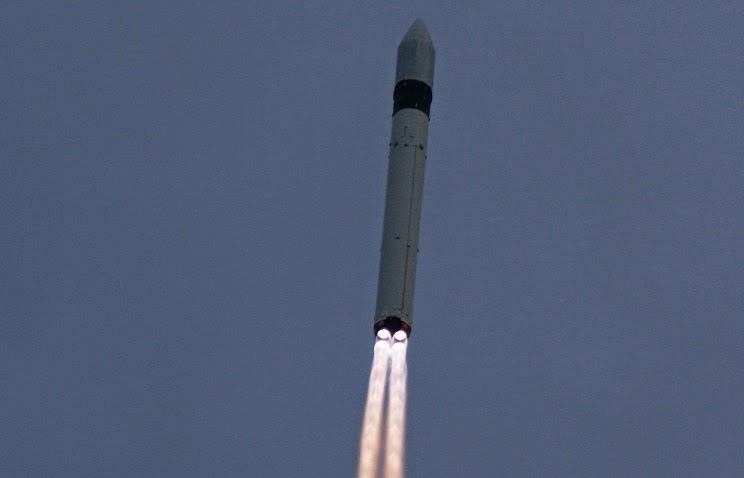
Rokot blasts off from  Plesetsk Cosmodrome. Credit: ITAR-Tass.

On the 23rd, the Russians also launched a military mission. Lifting off from the Plesetsk Cosmodrome, the Rokot booster lifted the Bris-M upper stage into high altitude before placing 3 Russian military satellites into their orbits. The Rokot is a lighter vehicle, and I'm not aware if it can lift satellites designed to work with the troublesome Proton-M rocket.

Rokot ascending. Credit: ITAR-Tass.


Japan's H2A lifts off from Tanegashima Space Center. Credit: KYODO/The Japan Times.

Finally we get to the Far East, where the Japan Aerospace Exploration Agency (also known as JAXA) launched a heavy H-2A rocket carrying the Advanced Land Observing Satellite-2. This spacecraft is designed to map regions of the Earth that suffer natural disasters and emergencies. It will also be used to study tropical rain forests, ice packs and other geological features affected by natural and man-made disasters.

Perhaps it can located trouble before the next Godzilla attack (Just kidding, no offense!).


Tuesday, January 14, 2014

2014 Starts with Space Success

Falcon 9 rocket lifts off from Cape Canaveral. Credit: SpaceX

The space business is booming literally and figuratively as a volley of rocket launches started off the new year. SpaceX continues its onward march of successful launches on Jan.6, lifting the Thaicom 6 communications satellite into orbit. The mission took off from Launch Complex 40 at Cape Canaveral on behalf of Thailand, placing the craft in a geosynchronous orbit to provide communications coverage overThailand, parts of Africa, and a part of Arabia. This mission is a success also because previous Thaicom missions had been launched by Ariannespace on the French-built Arianne rocket. This is SpaceX's second successful launch of a craft into a geosynchronous orbit.

Overhead view of LC-40 in Florida.

History note: Launch Complex 40 at the Cape Canaveral station was originally home to launches of the Titan rocket series. Previous famous missions launched from there include the Mars Observer mission (which failed when its spacecraft failed to enter orbit of Mars), and the Cassini-Huygens mission to Saturn and its moon Titan. The original launch tower was scrapped when SpaceX leased the site from the government. LEarn more about the SpaceX launch at NASA SPaceFlight.com:

Cygnus Cargo ship approaches the ISS.

NASA Spaceflight.com also provided great reporting on the launch of Orbital Science's latest cargo mission to the International Space Station. The OS Antares rocket original suffered a launch delay until January 9, due to extreme radiation concerns from a solar wind blast that hit the Earth's magnetic field. Once that had passed, the Antares was launched from the Wallop Island launch facility in Virginia. The Cygnus robotic craft was carefully guided in orbit to the ISS by ground engineers until its arrival on Saturday the 11th, followed by a grappling by the station's robotic arm just after midnight on Sunday morning. Now berthed at the station's Harmony Docking Node, the crew has begun the process of unloading the supplies.

India's GSLV-D5 rocket on launch pad. (Times of India).

On the International front, India launched a GSL-D5 rocket from the Satish Dhawan Space Center.  The rocket placed a GSAT-14 satellite into geosynchronous orbit. The rocket has had some difficulties including a couple of recent failures, so this launch has definitely boosted the confidence of the Indian space program.


Friday, May 31, 2013

Malfunction... Malfunction...

Orbital debris surrounds the Earth. Credit: Google Earth.

Just a month ago, Ecuador launched its first satellite using a Chinese rocket. Now, it seems it has met with disaster. With help from the US-based Joint Operations Center, scientists have been able to piece together data, tracking, and timing to conclude that the small satellite has probably hit a tumbling, spent Soviet-era rocket booster. The JOC monitors all space orbiting objects and debris. With their fine attention to details, they help NASA plot safe trajectories and warn the ISS when a piece of debris is likely to pass into their safety zone.


Logo for the Ecuadorian satellite.

The Pegaso satellite was Ecuador's first and only satellite, and was a proud moment of achievement for the nation. It was a nano-satellite, cube-shaped weighing only 2.6 pounds. Its purpose was to take pictures from orbit and play the national anthem so radio operators could practice space communications. Not much of a satellite compared to the big advanced models usually launched, but for EXA, the Ecuadorian Space Agency, and the people of Ecuador, a proud achievement. Their scientists speculate that there may still be hope it can be contacted and stabilized, but they should no doubt be looking forward for their next mission.

GOES-13. Credit: Boeing.

Bad luck isn't just for Ecuador. It happens to American equipment, too. The weather satellite GOES-13, operated by NOAA (National Oceanic and Atmospheric Administration), has lost control of both of its main instruments. The satellite was tasked with providing weather coverage of the American East Coast. Fortunately, because of the importance of weather coverage, a "spare" or backup satellite had already been launched in 2006 and placed in "storage mode" just in case something like this happened. With the re-activation of the backup satellite, weather coverage is assured.

Monday, May 27, 2013

Delta IV lifts WGS-5 to orbit

Delta IV launch from LC-47. ULA picture.

Wideband Global SATCOM-5 was sent into orbit Friday to become part of the US military's network of communications satellites giving worldwide networking communications to ships, planes, and groundfighters wherever they may be.

The United Launch Alliance is the spin-off company owned 50-50 by Boeing and Lockheed that provides launch services for the US government. That includes the military, NASA, and our spy agencies. Using the Launch Complex 37 pad at Cape Canaveral, ULA prepped and launched the Delta IV rocket at 6:27 pm MDT Friday May 24th. It was the 71st ULA launch in a 77-month period. It was the second launch for the government in 9 days, the last being a launch of an Atlas rocket (covered in the previous post). 

Great coverage of the flight at SpaceFlight Now: http://www.spaceflightnow.com/delta/d362/#.UaNuSc3E6nG

Sunday, May 19, 2013

Rockets Red Glare

Atlas V launches from Pad LC-41.

Rocket fans live in a wonderful time of launches. On Wednesday May 15, United SPace ALliance launched an Atlas V rocket carrying the GPS 2F-4 satellite into orbit. The 31st part of the GPS system is safe in space. It's the 4th in a series of GPS satellites with entirely new upgrades and systems.  Of the course the marvelous Atlas V launch went fantastically well. You can see a whole gallery of photos from the launch thanks to SpaceFlight Now, at: http://www.jpl.nasa.gov/news/news.php?release=2013-163


ESA's Vega rocket blasts off.

The European Space Agency launched the second successful flight of a Vega rocket from French Guiana on May 14th. The Vega is a lighter rocket than the famous Arianne V. This one easily placed three satellites in orbit to help with communications and science experiments.


Proton rocket lifts off from Kazakhstan.

International Launch Services (ILS) lifted the Eutelsat 3D communications satellite into orbit on May 15. Russian rocket observers are happy to see the 3rd successful flight of a Proton rocket since a failure in December. ILS is a company jointly owned by USA and Russian partners. They lease launch space from the Baikonur facility in Kazakhstan and use the Proton rocket for satellite delivery services.

If you are a rocket fan, you definitely want to watch all the great rocket news found at SpaceFlight Now: http://spaceflightnow.com/

There's an upcoming flight of a Delta 4 rocket scheduled for this Wednesday, due to blast off from Cape Canaveral. On board will be an Air Force Wideband Global SATCOM, built by Boeing and destined to support our military's communication network.

Payload for the Delta 4 on the move to assembly.

Thursday, May 9, 2013

50 Years Ago: Telstar 2

Telstar art. Telstar 2 looked almost identical to Telstar 1.

Fifty years ago on May 7, 1963, NASA launched another Telstar communications satellite into orbit. Built by AT & T at Bell Laboratories, the sphere-shaped satellite weighed 176 kg and was lifted up on a Delta rocket. The two Telstar satellites helped us make tremendous advances in broadcasting signals around the world and advancing our communications systems. I found an interesting read on the business end of Telstars at Gunter's Space Page: http://space.skyrocket.de/doc_sdat/telstar-1.htm


Delta rocket at Cape Canaveral, Launch complex 17B.

Launch Complex 17B, much later, with a Delta II vehicle on the pad.

The Delta rocket used for the launch was the Thor-Delta, derived from the Thor-Able series. The Thor-Delta was also the first of the Delta series. The Delta series of rockets have done a tremendous service for our nation, and evolved into the modern Delta family of rockets. The Deltas were launched from Launch Complex 17B (currently inactive) at the Cape Canaveral Air Force Station next to the Kennedy Space Center. You can get close to the site on the tour bus. Currently, Delta II launches are done from Vandenberg Air Force Base in California. The Delta IV rocket, a heavier lift vehicle, can launch from both Vandenberg and SLC37. I managed to get a picture of this launch tower while on the tour a couple of years ago.

I believe this one is LC37-B.

Monday, February 11, 2013

Recent Rocket launches

Atlas V LANDSAT lifts off from Vandenberg AFB, CA.

Well my rocketing into 2013 hit a bit of a speed bump as things got very busy at work, and it's sometimes hard to have the drive for blogging when you've been at the computer all day anyway. HOwever, lots of interesting things happening so let's start with today's great visuals from the launch of the LandSat Earth Observation Satellite from Vendenberg AFB. Once again the Atlas V does a fantastic job lifting the payload into orbit. SpaceRef did a good deed by linking to UStream and NASA on their site.

Atlas V on the pad just about an hour before launch. Beautiful day for rocketeering.

Payload section carrying the LandSat Earth Observation Satellite. almost 3 minutes to lift off.

More distant view of the Gantry rolled away from the pad. Venting of fuel fumes continues. The hills prove this is not Florida!

Liftoff!

As the flight continued, NASA provided computer graphics of the rocket's status and orientation. Small inset picture shows its location over the Pacific ocean heading away from Southern California. The fairings of the payload have jettisoned, exposing the satellite to the vacuum of space.

After MECO (main engine cut-off) the thrusters were used to re-orient the craft prior to a secondary burn which would place the satellite into its designated orbit. Good Job, ULA (United Launch Alliance) and NASA!

Different launch, different site. For comparison, this is the Atlas V launch site in Florida. On the Atlas V is the TDRS communication satellite launched January 31. Notice the lightning rods...

Baikonur. Soviet 2.1a rocket with a payload of 6 Globalstar Communications satellites ready for launch. It blasted off on February 6. There are now 24 Globalstar sats in orbit providing world-wide communications coverage for its customers. RIA Novosti image.

SPACEFLIGHTNOW.com has some great images of the recent Arianne space mission, which launched two satellites for international interests. You can see the liftoff images and satellite pics here: http://www.spaceflightnow.com/ariane/va212/130207launch/#.URmNLRxG63a

The SEALAUNCH company had a setback this month with a failed launch of their Zenit-3SL rocket. You can read the information at: http://www.spaceflightnow.com/sealaunch/is27/130201failure/#.URmN_xxG63Z

There were two Progress cargo mission events this last weekend, and I'll post a separate blogpost on that situation shortly.

Thursday, October 18, 2012

Recent Satellite Launches from Around the World

Technician works on the Orbcomm satellite. Credit: Sierra Nevada Corp.

The big focus for space enthusiasts lately has been the remarkable mission of SpaceX's Dragon capsule to the ISS. While the station resupply effort went well, the secondary payload on the Falcon 9 rocket ended in failure.  Due to a malfunctioning engine, other engines on the Falcon rocket overcompensated and burned longer than planned, resulting in the wrong orbital placement of the OrbComm satellite. Built by the Sierra Nevada Corporation, Orbcomm was an engineering test vehicle to help establish a new network of communication satellites. This example was a prototype, designed to test how the system would react in its orbital environment. There are 18 small satellites planned for the system, all due to be launched on Falcon 9 rockets. Unfortunately, the wrong orbit placement caused the Orbcomm to fail its mission and it de-orbited. NASA and SpaceX engineers are investigating the failure while company executives plan a way to continue this mission.

Meanwhile, there have been other launches around the world.

Delta 4 launch from pad 37 at Cape Canaveral, October 4. On board was the GPS 2F-3 satellite. This was a replacement satellite for an older one in the GPS system we all rely on.  The satellite reached its intended orbit just fine. Credit: Pat Corkery/ULA.

A Russian Soyuz rocket lifted off from the European Space Agency's French Guiana launch site on October 12. It carried a pair of satellites for the Galileo navigation system, which affects many drivers, airplanes, and ships around the world. Successful placement of satellites. Credit: ESA.

On Sunday October 14, China launched a Long March 2C rocket from the Taiyuan space facility. It carried two Shijuan-9 engineering test satellites into space to study new satellite test equipment. This photo is of a previous Long March launch. Credit from Chinese News Agency.

A Russian Proton blasted off from the Baikonur site in Kazakhstan on Sunday October 14. It carried an Intelsat telecommunications satellite into orbit. Credit: Krunichev.

Tuesday, July 10, 2012

50 Years Ago: TELSTAR-1 and the New Age of Communications

NASA art of TELSTAR-1 in space.

Today marks the 50th anniversary of a great leap forward in world communications, the launch of TELSTAR-1 from Cape Canaveral on July 10, 1962. TELSTAR-1 was not the first communications satellite; that was ECHO-1A sent up on May 13, 1960. But ECHO was a reflective-passive device; signals were bounced, or reflected, off the spherical surface and received on Earth beyond the horizon. TELSTAR broke new ground. To begin with, TELSTAR was the first privately sponsored space launch effort. The satellite was built at Bell Telephone Laboratories, and included transponders which relayed television or telephone channels back to the ground, another first. Third, the launch was the 10th successful blast-off of the Thor-Delta rocket system. Other Thor-Delta launches had included ECHO-1, TIROS weather satellites, EXPLORERs 10 and 12, ARIEL-1, and OSO-1.

A TELSTAR satellite under construction.

Weighing about 170 pounds, TELSTAR was powered by small solar panels which generated about 14 watts of energy. It would eventually transmit the first public television and telephone signals (including the first Fax!) and would also transmit the first transAtlantic television signal.

Thor-Delta rocket.

TELSTAR-1 was sent into space from Launch Complex 17, pad B, on a Thor-Delta rocket. Its orbit was elliptical, or egg-shaped, and the satellite circled the Earth every 2 hours and 37 minutes. It continued in operation until February the next year, but TELSTAR-1 still orbits the Earth to this day. The end of TELSTAR-1 was premature, because it was exposed to higher amounts of radiation than it normally would have encountered from the Van Allen radiation belt. The day before its launch, the US Air Force had launched a nuclear weapon into space to test the effects of the blast on potential enemy rockets. Further space nuclear tests, including a Soviet explosion in October 1962, eventually degraded the electronics.

To realize the significance of this launch, you only have to think of how many times each day you call someone cross-country, watch television on your satellite channels, or receive the Internet on your computer. Yes, a lot of towers and cables are involved locally, but the transmission of channels and frequencies to those localities is done through satellite communications. Also consider how much of our nation's defense depends upon secure transmission of coded signals to our troops and installations around the world. And it all started 50 Years Ago. We live in a world our ancestors barely dreamed about.

UPDATE: NASA History Office noted the anniversary today on its Twitter account (@NASAhistory) and provided this link to a wonderful short news film from the day which shows TELSTAR's construction, launch,and the first images transmitted. Wonderful little film, thanks, NASA!
http://ia600401.us.archive.org/27/items/1962-07-12_A_Day_in_History/1962-07-12_A_Day_in_History_512kb.mp4