Showing posts with label Proton. Show all posts

Tuesday, May 27, 2014

Sea Launch Success and Rocket News

Sea Launch mobile launch platform. Credit: Ria Novosti.

Time to get an overview of recent rocket launches from around the world. We'll start with today's successful launch of a Zenit-3SL rocket from the SeaLaunch floating pad from the Pacific Ocean. Sea Launch is a multi-national corporation owned by companies from Norway, Russia, Ukraine, and the United States. DEspite the current political and military crisis occurring between Ukraine and Russia, the project has gone ahead and lifted a EutelSat 3B Communications satellite into space. This was the 36th rocket launch for the company. Its last launch on February 1st ended badly as the rocket crashed into the sea soon after take-off. The cause has been pin-pointed to a faulty hydraulic oil pump.


Proton-M rocket ready for Launch from Kazakhstan. Credit: RiaNovosti.

From today's Sea Launch success, let's turn back to May 16th and the latest Russian launch embarrassment. A Proton-M rocket carrying an Express-AM4R GPS/communications satellite failed to place its payload into orbit as the second stage failed. The satellite would have been Russia's most capable comsat in space. News reports have indicated that pieces of the craft crashed near a Chinese city. The failure comes just after Russian President Putin made jokes about NASA's problems. The Proton series has experienced a number of failures since its first launches.

Delta IV lifts into the sky from Cape Canaveral. Credit: Florida Today.

The United Launch Alliance (ULA) performed a great launch of the Delta IV rocket on May 16th. Lifting off from Pad LC-37 at Cape Canaveral, the rocket placed an updated GPS satellite into orbit. The $245 million satellite will be the 31st to join the constellation of American GPS satellites. 


Atlas V on the Pad at Cape Canaveral. Credit: NASAspaceflight.com.

A week after the Delta launch, ULA performed a launch of the Atlas V rocket from Cape Canaveral's LC-41. The payload was a classified military satellite. The Atlas V uses a Russian-built RD-180 rocket engines, and the current political stand-off between Russia and the US over Russia's invasion of the Crimea has caused a potential stoppage of supplies of this engine. Russian President Putin has determined that the RD-180 is not to be used by the US for any military missions and there may be further interrupting of missions to the ISS after 2020. ULA has previously used the Delta II rocket for some military applications, but it has been discontinued with one possible flight remaining. The Delta IV launch vehicle may become the military go-to launcher if the Atlas V becomes limited to commercial flights only, but no final determination has been made.

Rokot blasts off from  Plesetsk Cosmodrome. Credit: ITAR-Tass.

On the 23rd, the Russians also launched a military mission. Lifting off from the Plesetsk Cosmodrome, the Rokot booster lifted the Bris-M upper stage into high altitude before placing 3 Russian military satellites into their orbits. The Rokot is a lighter vehicle, and I'm not aware if it can lift satellites designed to work with the troublesome Proton-M rocket.
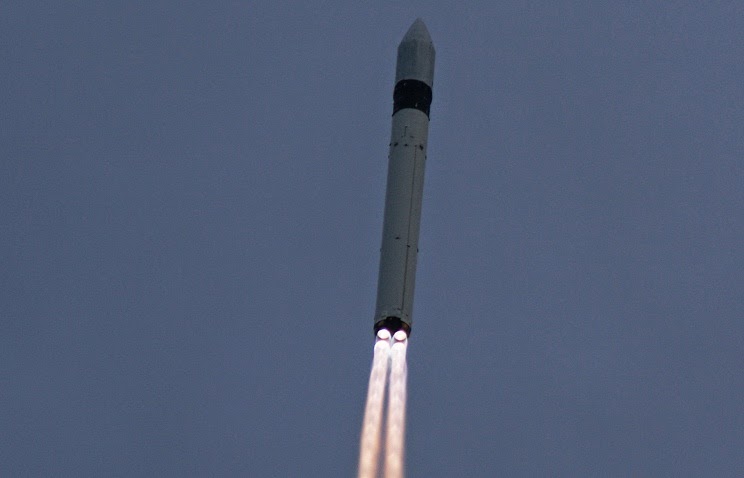
Rokot ascending. Credit: ITAR-Tass.


Japan's H2A lifts off from Tanegashima Space Center. Credit: KYODO/The Japan Times.

Finally we get to the Far East, where the Japan Aerospace Exploration Agency (also known as JAXA) launched a heavy H-2A rocket carrying the Advanced Land Observing Satellite-2. This spacecraft is designed to map regions of the Earth that suffer natural disasters and emergencies. It will also be used to study tropical rain forests, ice packs and other geological features affected by natural and man-made disasters.

Perhaps it can located trouble before the next Godzilla attack (Just kidding, no offense!).


Tuesday, October 1, 2013

NASA Shutdown, Space Still Open

Government shutdown? Well, kind of.

Political maneuverings in our nation's capital have resulted in a "government shutdown." The mainstream media is awash in dire threats of layoffs, harm to the economy, senior citizens in danger, and essential services taken off line. NASA, as a government agency, is part of the shutdown. So what does that mean for space operations? According to NASA's information releases, "During a shutdown, most NASA operations would cease and most employees would be furloughed, with the exception of operations and personnel needed to protect life and property." Like the FAA and TSA, mission control in Houston will continue to function and assist the Expedition 37 crew aboard the ISS, and essential satellites and communications systems will continue to operate. According to Jeff Faust of SpacePolitics, several hundred employees remain on duty, though there is some worry that should the shutdown be prolonged, launch dates could be affected. He notes that the Kennedy Visitor Center in FLorida will remain open, as it is run by a private industry, although the parts of the tour that enter NASA facilities will be closed.

And that brings up an important point. It may have started small, but there is a growing effort to bring space operations out of government administration and placed into the hands of private enterprise. With that note, we can look at a couple of important milestones this week.

Falcon Improved lifts off from Vandenberg. Credit: SpaceX.

Private space ventures like SpaceX continue to operate. Just last Sunday, SpaceX launched the Falcon 9.1 rocket from the Vandenberg AFB in California. The new rocket features engines that are less expensive to manufacture and greater performance. This launch was used to place a Canadian technology test satellite into orbit. As the US military will not be affected by the government shutdown (except for private contractors), military launch facilities remain open and military space assets continue to operate. SpaceX is working on other launch facilities. They are creating a new launch pad in Texas, and are in negotiations with NASA to lease the older Pad 39 B site which was used for Apollo and Shuttle operations but is no longer needed.

Proton launch from Baikonur. Credit: RIA Novosti.

And don't forget, America is just one player in the space game. International space operations continue as normal. On Monday, Russia launched a new Proton-M rocket for the first time since July's failure. The troubled system has some worried that difficulties could endanger the launch of the new Russian module to the ISS. The July Proton failure resulted in the loss of three Glonass GPS satellites, and was quickly followed by news of a scandal in the program. It was also determined that the crash was due to the faulty upside-down placement of three sensors in the rocket. This Monday's launch placed a communications satellite.

It's not likely that the NASA shutdown will last very long, as both political parties in Washington will be searching for a way out of the mess. Let's hope all goes well and no disasters occur during the "slowdown."

Tuesday, July 2, 2013

Russian Proton M Rocket Explodes

After beginning to tumble, the rocket fuel tanks burst into flame. Credit: Russian TV.

After a week of space successes, the Russian space program suffered a setback Monday with the loss of a Proton-M rocket and its three global positioning navigation satellites. Launched from the Baikonur space center in Kazakhstan, the rocket lifted off OK but quickly developed a veer away from the flight path and started a tumble. As the rocket broke apart under the aerodynamic stress, the fuel exploded moments before the entire assembly crashed into the ground, creating a huge fireball.

Because the rocket broke up first, a large cloud of its rocket fuel, which is toxic to humans, moved with the wind towards the nearest town. Residents were warned to stay inside and close all windows and doors.

Reporter James Oberg notes that this type of rocket is scheduled to deliver a new module to the ISS later this year. The Russians might want to make sure this doesn't happen again...
http://www.nbcnews.com/science/russian-rocket-takes-nosedive-after-launch-kazakhstan-6C10511650


A cloud of smoke marks the impact site. Credit: RiaNovosti


Sunday, May 19, 2013

Rockets Red Glare

Atlas V launches from Pad LC-41.

Rocket fans live in a wonderful time of launches. On Wednesday May 15, United SPace ALliance launched an Atlas V rocket carrying the GPS 2F-4 satellite into orbit. The 31st part of the GPS system is safe in space. It's the 4th in a series of GPS satellites with entirely new upgrades and systems.  Of the course the marvelous Atlas V launch went fantastically well. You can see a whole gallery of photos from the launch thanks to SpaceFlight Now, at: http://www.jpl.nasa.gov/news/news.php?release=2013-163


ESA's Vega rocket blasts off.

The European Space Agency launched the second successful flight of a Vega rocket from French Guiana on May 14th. The Vega is a lighter rocket than the famous Arianne V. This one easily placed three satellites in orbit to help with communications and science experiments.


Proton rocket lifts off from Kazakhstan.

International Launch Services (ILS) lifted the Eutelsat 3D communications satellite into orbit on May 15. Russian rocket observers are happy to see the 3rd successful flight of a Proton rocket since a failure in December. ILS is a company jointly owned by USA and Russian partners. They lease launch space from the Baikonur facility in Kazakhstan and use the Proton rocket for satellite delivery services.

If you are a rocket fan, you definitely want to watch all the great rocket news found at SpaceFlight Now: http://spaceflightnow.com/

There's an upcoming flight of a Delta 4 rocket scheduled for this Wednesday, due to blast off from Cape Canaveral. On board will be an Air Force Wideband Global SATCOM, built by Boeing and destined to support our military's communication network.

Payload for the Delta 4 on the move to assembly.