Showing posts with label Russian spaceflight. Show all posts

Saturday, August 18, 2018

Russian Cosmonauts go for a walk

Cosmonaut Sergey Prokopyev releases a tiny nano-satellite into space. NASA TV.

On Wednesday August 15, Russian cosmonauts Sergey Prokopyev and Oleg Artemeyev opened the hatch on the Pirs module just after midnight and stayed out for over seven hours. They completed the tasks of installing the German-made Icarus experiment outside the Pirs module, and also hand-launched four nano-satellites that had been built by Russian science students. 

The Icarus experiment will track the migrations and movements of animals that have been tagged with tiny transmitters. Scientists will study how animal populations have modified their migrations and movements while encountering changes in their environments.

 Artemyev, left, and Prokopyev in a practice for the upcoming spacewalk. Credit: Roscosmos.

This was Artemyev's third spacewalk, and the first EVA for Prokopyev. The next ISS spacewalk will be in September.


Saturday, February 25, 2017

ISS: Busy Traffic Week


 Current Spacecraft positions on the ISS. Credit: NASA.

It was a very busy week for the crew of Expedition 50 on the International Space Station. In between station maintenance, science experiments, and preparations for future work, the crew needed to be on their toes dealing with all the intracacies of arriving robotic spacecraft.

Launch Pad 39B with the SpaceX Falcon rocket. Launch Control and the Vehicle Assembly Building seen in the background. SpaceX.

Events started with a roar on Sunday. From the historic LC-39B pad, SpaceX launched Dragon 10, their unmanned cargo spacecraft, on a mission to take supplies to the ISS. The launch went very well, and Dragon began its 2 day voyage to rendezvous with the station. 

First launch from Pad 39B since the retirement of the shuttle in 2011.

In a historic first, the Dragon 10 lifted off from its pad on the Falcon rocket as the first commercial rocket to launch from the famous pad 39, where decades earlier the astronauts flew the mighty Saturn Vs to the Moon in project Apollo, and then later when the space shuttles began their routine missions into low Earth orbit. This pad site has been modified from the shuttle operations to accept more commercially-operated designs. It is currently leased to SpaceX, which previously had been using the Pad 40 on the Cape Canaveral Air Force station. That pad was damaged in a Falcon Explosion in September of 2016. It is expected that future manned SpaceX flights will also take place from 39B.
Separation of Dragon-10 from the second stage. SpaceX.
 
In a further demonstration of their rocket prowess, the controllers of SpaceX carefully guided the first stage of the Falcon back through the atmosphere to a safe, upright landing at the landing pad on Cape Canaveral. The first stage will be examined, refurbished, and re-used on a future flight to help save funding. 
Dragon-10 approaches the pickup point.
 
Docking with the ISS proved to have some difficulties. As the spacecraft made its first approach to the ISS, a fault in the GPS tracking triggered an orbit of docking approach and the spacecraft was backed away from the station while engineers investigated the problem. A work-around was configured, and a second attempt the next day was successful. Astronauts Shane Kimbrough and Thomas Pesquet used the robotic arm to grapple and then dock the Dragon temporarily at the Node-2 docking port. They used cameras to record the outer condition of the Dragon for engineers to study later. Then the craft was moved to the Common Berthing Module.
Meanwhile, back in Russia...
 
In a nice daytime blastoff, the Russian space agency launched a Progress resupply spacecraft into orbit from the Baikonur facility. Known both as MS-05 and as Progress 66, the Soyuz-U rocket used a different third stage motor design than was used on the previous Progress MS-04 mission. That motor suffered a catastrophic failure in the oxidizer turbopump, which shredded the engine and lost the spacecraft in flight.
 
 Picture-perfect liftoff of the Soyuz-U rocket with Progress 66 aboard. Spaceflight Now.
 
After an 8-minute flight and stage separations, the Progress 66 ship was on its way to the station. The flight plan for this mission again called for a 2-day orbit path, giving engineers plenty of time to test and verify all functions carefully. The S-band uplink navigation system was able to complete its flight-certification, the last step in preparations to begin using the latest Progress design in the preferred single day orbital approach flight plan.
 
Progress 66 approaching the ISS, with its solar panels making a symmetrical wing-like appearance.
 
On Friday, the Progress 66 spacecraft reached its rendezvous point with the station and engineers carefully guided the vehicle into its docking position. The spacecraft completed its flight at the Pirs module docking port. This makes the 68th successful Progress mission to the ISS, delivering supplies and experiments to the station.
The next supply mission expected is the Cygnus mission on March 19.
 

Thursday, July 23, 2015

Crew Change on ISS

Liftoff of Soyuz TMA-17M from Baikonur launch site. NASA TV.

 Since the landing of Expedition 43, the International Space Station crew has been reduced to only three occupants: Commander Genady Padalka (Roscosmos), and year-long residents Mikhail Konienko (Roscosmos) and Scott Kelly (NASA), who make up the core of Expedition 44. Blasting off from the Russian space center at Baikonur, the Soyuz FG booster sent the Soyuz spacecraft into a short-duration orbital path to the ISS. After deployment, it was learned that the Soyuz spacecraft could only deploy one of the craft's twin solar panels.

Previous non-deployment of solar panel, this one was TMA-14M.
 
The Soyuz docked with the ISS, and the action must have jarred something loose as the ISS crew noted that the panel had then deployed. The same event conclusion happened to a previous mission, on Soyuz TMA-14m.
On his way: Astronaut Kjell Lindgren rides the cramped cockpit of a Soyuz spacecraft. The little R2D2 toy at the top of the picture hangs from the control panel during ascent, indicating the acceleration force.
 
The Russian mission control at the Korolev Space Center in Moscow monitors the second stage separation.

Russian cosmonauts in the center and left side of the capsule. Having reached zero-G, the R2D2 toy floats aimlessly near the control panel.
 
Transfer complete. The crew of TMA-17M (in front, L-R: Kimiya Yui (Japan), Oleg Kononenko (Russia), and Kjell Lindgren (NASA), join Expedition 44.


Thursday, May 14, 2015

50 Years Ago: Soviet Luna 5 crashes into the Moon

Soviet Union's Luna 5 Moon probe.

Back in May 1965, the Russians were also trying their hand at lunar reconnaissance before sending humans to the Moon. The Luna program was a huge program of launches to send robotic explorers to the Moons orbit or to land on the surface. More than 24 missions were successful. Failures were kept in secrecy or relabeled. Luna 2 became the first man-made object to reach the surface of the Moon when it impacted on the surface in September 1959. Luna 3 sent the first pictures to Earth of the Moon's far side. Luna 5 was supposed to be the first probe to safely land on the surface.

Soviet illustration of how the lander would have been deployed. This did not succeed until Luna 9.

On May 12, 1965 the Soviet propaganda arm declared to the world that Luna 5 had successfully impacted the lunar surface in the area of the Sea of Clouds and that many important pictures had been taken. Western space experts correctly guessed that the mission had failed, and that the Soviets had been attempting to make a soft landing.  On May 13, The Soviet leadership must have decided that honesty was a preferred course to take. They announced that the mission failure may have occurred because of the late firing of landing thrusters, pointing out that the 2.5 second radio delay in that distance would have prevented ground controllers from taking corrective action.

Today we know that the craft had suffered from uncontrolled spinning after a mid-course correction on the way to the Moon. The main landing engine failed to fire because of a ground-control error.

Saturday, May 9, 2015

Progress M-27M Burns Up

The re-entry of Progress M-27M would have appeared similar to this re-entry of one of Europe's ATV cargo ships.

After a troubled launch when Russian flight controllers determined that the robotic cargo spacecraft Progress M-27M was spinning out of control, the decision was made to try to safely de-orbit the craft and let it burn up in the atmosphere. There was just enough communication left working to get the ship to re-enter the Earth's atmosphere and self-destruct. Any pieces of the craft that survived the breakup and fire would have splashed down in an empty Pacific area.

Previous Progress in orbit near ISS.

It's a sad ending for the 150th Progress mission to the International Space Station. Now Russian mission planners are preparing a revised schedule of launches and landings for other spacecraft.

Thursday, April 30, 2015

Russian Progress Spaceship Loses Control

Earlier Progress spaceship in orbit.
 
Just a few days earlier, on Sunday, Progress M-25M deorbited and burned up in the atmosphere. The Pirs docking module was cleared for the upcoming docking of Progress M-27M. Unfortunately, that's not going to happen.  On Tuesday April 28, the spacecraft was lifted up into orbit on a Soyuz 2-1A rocket on a path to get the robotic cargo ship to the ISS in a short six hour flight. According to Russian mission controllers, the spacecraft separated from the rocket OK and engineers prepared for a series of thruster burns that would move the Progress toward the station. 

Earlier Progress on approach to the ISS. Good view of the docking hatch.
 
Apparently engineers detected glitches in the communications with the craft. It seems that the solar panels did deploy, but some of the communications antennas suffered problems or were not deployed. Confirmation was made that the craft was spinning out of control, and several attempts to regain control over the last two days did not work. Russian Mission Control has declared a Loss of Mission. Their next task will be to try to deorbit the craft safely and burn it up in the atmosphere.

Saturday, March 28, 2015

Soyuz Launch to ISS Reinforces Expedition 43

Soyuz Launch from Baikonur Cosmodrome.

Another crew for the ISS lifted off yesterday after midnight in Kazakhstan. Soyuz mission TMA-16M (NASA designation Soyuz 42- or is it the other way around?) lifted off at 1:42 p.m. MDT, carrying Soyuz commander cosmonaut Gennady Padalka and Mikhail Kornienko (both from Roscosmos, the Russian Space Agency), and astronaut Scott Kelly. They docked with the space station about 6 hours later.

Crew of TMA-16M (L-R): Scott Kelly, Gennady Padalka, Mikhail Kornienko in front of Soyuz training simulator in Star City.

Currently on board the station are Expedition 43 commander Terry Virts (NASA), and Flight Engineers Samantha Cristoforetti (ESA) and Anton Shkaplerov (Roscosmos). When they return home in May, Gannady Padalka will become the next Expedition commander. While he will himself leave the station some time in September, Kelly and Kornienko will remain on board as part of a special project studying the effects of living in space for one entire year.

Already at the station: another Soyuz (closer to camera) and a Progress resupply ship.

Wednesday, March 18, 2015

50 Years Ago: Soviet Cosmonaut Walks in Space

Hero of the Soviet Union Alexei Leonov.

Fifty years ago on March 18, 1965 the Soviet Union again pulled ahead of the United States in the Great Space Race. From Baikonur in the province of Kazakhstan, a forerunner of the Soyuz rocket lifted off carrying the two-man Voskhod 2 capsule. Aboard the spacecraft were cosmonauts Alexei Leonov and Commander Pavel Belyayev. The Voskhod 2 had been modified for this flight with the addition of a special airlock in preparation for the first EVA, or Extra-Vehicular-Activity (spacewalk).

Comparison of the Voskhod 1 and version 2 with undeployed airlock.

Once the spacecraft reached orbit, the special airlock was inflated so that the outer hatch was moved a distance from the descent module. In the EVA plan, a cosmonaut would pressurize the extended airlock, then enter the airlock, named Volga. The hatch to the cabin would then be closed, and the airlock depressurized. This was necessary because the Voskhod controls and avionics were air-cooled, and would not function properly if the cabin were depressurized.

Illustration of the EVA elements.

In the actual event, post-flight statements from the Soviet government that the EVA went perfectly turned out not to be true. After leaving the airlock, Leonov floated to the end of his umbilical hose, and his pressure suit began to "balloon" and stiffen due to over pressurization. Finding it very difficult to move freely, he was unable to activate a switch on his suit that would allow him to take pictures from a chest-mounted camera. He was also unable to control his movements enough to retrieve an exterior-mounted camera recording his EVA. After 12 minutes he finally managed to re-enter the airlock, but had entered head-first, not according to procedure. He became stuck trying to turn around, and finally solved the problem by risking "the bends" by lowering his suit pressure so that he could bend. Supposedly, Leonov could have been ejected with the airlock if he could not recover and the commander would return alone. The EVA was so difficult that doctors later reported that Leonov could have suffered from heatstroke, and he admitted later that he was sweating profusely so much that water "sloshed" in his spacesuit. Fortunately, he did manage to return, repressurize the airlock, and then re-enter the cabin.

Leonov outside the airlock entrance.

Before re-entry, the airlock was jettisoned. Unlike the earlier Vostok capsules, the Voskhod had no escape method and so instead of parachuting to ground after re-entry, the crew would ride the descent module to a harder landing with retro-rockets just before touchdown. The crew did land safely despite a problem with the descent module not separating cleanly from the service and instrument sections. They landed in the Ural mountains area so far from their rescue teams that they had to spend the night in their capsule, while wolves were heard outside.

Leonov, second from right, in Salt Lake City in 2005.

These days, Alexei Leonov is a great promoter of space exploration, a businessman, and is an artist as well. In 2005 he attended the XIX COngress of the Association of Space Explorers held in Salt Lake CIty, UT. As part of the ceremonies, our Space Center staff was able to participate and later meet with the astronauts from around the world. I took the picture above of Leonov standing with cosmonauts from the former Soviet Union, and of course I got his autograph.

Thursday, October 30, 2014

Cygnus Loss Comes During Busy Week of Traffic for ISS

Dragon cargo spacecraft attached to ISS CanadArm robotic arm. About to let go and drift free of the station before de-orbiting. Credit: SpaceX.

Tuesday's spectacular destruction of the Orbital Science Antares rocket and Cygnus spacecraft happened during a busy week of transitions at the International Space Station. The crew of Expedition 41 had seen an eventful October so far with three spacewalks. The crew has begun preparations for an eventual rearranging of the station's docking modules, readying for the time when commercial spacecraft will be arriving with regular ferry flights transferring astronauts between Earth and the station. New experiments are arriving, old ones are being returned to Earth of discarded, garbage is being removed, and supplies building up.

The Dragon spacecraft floats down via parachute to a watery recovery off the coast of Baja California. Credit: SpaceX

Currently there is a regular fleet of unmanned spacecraft that come and go at the ISS bringing supplies or removing equipment and garbage. The only one that actually returns to Earth is SpaceX's Dragon. On Saturday, the Dragon undocked from the station loaded with returning equipment and science experiments and samples, and made a safe splashdown in the Pacific Ocean for a speedy recovery.

A Russian Progress cargo ship undocks and moves away from the ISS. This one happens to be an earlier Progress 35 mission.

On Monday, while the Cygnus "Deke Slayton" spaceship waited for liftoff (which was scrubbed Monday due to an intruding boat near the launch site), The Progress 56 mission spacecraft undocked from the ISS loaded with garbage and waste. It would burn up in the atmosphere upon re-entry. The departure cleared the way for a new ship to dock at the Pirs module.

Spacecraft docked at the ISS on October 27. Cr: NASA.

After the departure of the Progress 56 craft, there remained two Soyuz crew spaceships and the European Space Agency's ATV-5 cargo ship. Recently, the ATV-5 engines were used to move the station away from a potential collision with space debris.

Then the Cygnus flight was cancelled, unexpectedly.

Pad 0A at Wallops Island, Virginia. Wreckage of the spacecraft is being examined and cleared.

It will take weeks to analyze what exactly happened to the Antares rocket. There is, of course, damage to the pad, the buildings and equipment around the pad, and to a nearby sounding rocket launcher as well.

And then it was back to business!

Soyuz rocket lifts off with the Progress 57 mission.

Early Wednesday, the Russian space agency launched a Soyuz 2-1A rocket from Baikonur in Kazakhstan. This rocket variant replaces the usual Soyuz-U, and uses new engine types. The launch was good, and the Progress M-25M spacecraft (designated Progress57 by NASA) headed into orbit on a six-hour trip to the ISS.

Progress approaches the station.

Progress slowly approaches towards the Pirs module.

Progress almost ready to dock.

Exactly six hours after launching, the Progress spacecraft docked with the ISS bringing supplies of fuel, air, water, propellant, and scientific equipment. Progress 57 will stay docked for the next 6 months. The Progress 56 spacecraft, still in orbit, will be performing ground-controlled engineering tests in orbit until commanded to de-orbit and burn up in the atmosphere.

Sunday, August 17, 2014

ISS Summer Summary

ISS robotic arm just prior to releasing the Cygnus resupply ship. The dotted-line object is the side view of the Cygnus' solar panels, seen exactly edge-on.

It may not be the calendar end to summer, but students all over the USA know good and well that their summer vacation is over and they are heading back to school. And I am finished this year with company business travel, so it's time to get back to commenting on the rubble in space seen from my Space Bunker in Utah. Since my last post at the end of July, what's up with mankind's outpost in Earth Orbit?

Just hours ago, the Cygnus robotic cargo spacecraft burned up in re-entry into the Earth's atmosphere. It's been a busy 6 weeks of comings and goings for Expedition 40 up on the International Space Station. Back in June, both the SpaceX and Orbital launches had been postponed. ANd the new Russian Angara rocket had suffered a launch glitch on the 27th. On July 1st  a launch of a NASA Delta 2 was scrubbed when a problem developed with a sound-suppression system. At least India had success with the launch of a Polar-orbit rocket carrying 5 satellites.

The next day NASA's Delta 2 took off and launched a carbon-dioxide research rocket into space. And the rockets kept on flying. The Russians were next.

The Rokot lifts off from Plesetsk with 3 communications satellites. RIA Novosti.

The Russians had a series of launches starting with the launch of a light-carrier class Rokot from the Plesestk space center on July 4th. Then on the 9th, a Soyuz rocket lifted off from Baikonur with a weather satellite and a couple other payloads. Finally, the new Angara rocket had a successful launch.

Angara on the pad at Plesetsk. RIA Novosti.

The first flight of the Angara on July 9th from Plesetsk lifted a dummy payload into space to test the rocket systems. The Angara is meant to supplement the Soyuz rocket type launches and relieve the burden of launches only a Soyuz can perform, though it is not man-rated. To show off the demand for the Soyuz rocket, another one was launched on the 10th from the French space Center in French Guiana placing 4 communications satellites into orbit. 

Antares lifts off.

On July 13, Orbital Sciences launched its Antares rocket from its facility on Wallops Island, Virginia to place the Cygnus cargo craft on a path to the ISS. Close behind, SpaceX launched a Falcon rocket placing 6 ORBCOMM satellites into orbit on the 14th. On Wednesday, the Cygnus cargo craft docked with the ISS.

Docking for the Cygnus with help from the CanadArm robotic arm.

Carrying food, oxygen, and supplies from Earth, the Cygnus also delivered 32 micro-satellites which will be released over time by the crew of Expedition 40. The Cygnus was docked by engineers on Earth this time using the robotic arm after astronaut Commander Steve Swanson captured the craft, and secured to the Harmony module of the station. The craft is named SS Janet Voss in commemoration of the astronaut who passed away in 2012.

The launches continued. A Soyuz carried a biological research satellite into space on July 20. On the 22nd, a Russian Progress Robot cargo ship was undocked from the ISS to make a place for an upcoming resupply mission. The Progress ship was then directed to deorbit and crash into the Pacific.

A Progress cargo craft approaches the ISS. 

On Wednesday the 23rd, a new Progress craft was launched from Baikonur and arrived at the ISS six hours later. The M-24M carried supplies for the station. Once unloaded, it will eventually be filled with trash and undocked later.

Delta 4 does the job, launching into a clear blue sky. SpaceFlight Now.

On Monday the 28th, a Delta 4 carried the GSSAP classified secret satellite into orbit. The satellite, though developed in secret, will be used to do research on possible collisions in space and any potential enemy military weapons developments in space.

European control room engineers monitor the docking of the ATV to the ISS. ESA.

On Tuesday the 29th, the European Space Agency (ESA) launched the 5th and last of the ATV robot cargo ships to the ISS. It was lifted on the Ariane 5 rocket from the French space center in French Guiana, South America. It was the 60th successful launch of the Ariane 5, a remarkable achievement.

And the rockets kept flying. On August 1st an Atlas 5 blasted off from Cape Canaveral, carrying a GPS navigational satellite. On August 5th SpaceX launched a Falcon 9 rocket carrying the AsiaSat 8. On the same day, the ESA announced a remarkable success: the Rosetta space probe rendezvoused with comet 67P/Churyumov-Gerasimenko. Instead of just passing close by, the probe has matched its speed and direction and will travel with the comet, studying it from close up.

Radar imaging of the comet nucleus. ESA.

The ATV finally docked with the ISS on Tuesday the 12th. It was berthed at the Russian Zvesda module, and astronauts began unloading the cargo ship. Although it is the last of the ATV series of cargo craft, the technology from this version will be used to design and build the service module for NASA's future Orion spaceship.

Long March rocket action. Xinhua news.

China got back into the space scene on August 9th, launching a Long March 4C rocket from the Jiuquan Satellite Launch Center in Gansu Province. It carried a remote-sensing satellite. A few days later on the 12th, another Atlas 5 took off, this time from Vandenberg AFB in California, carrying its own remote-sensing satellite, the WorldView 3.
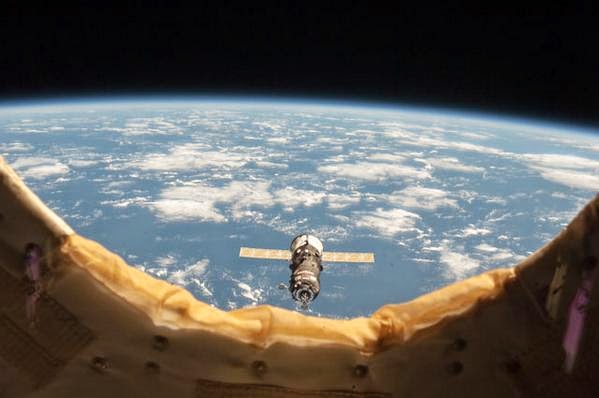
View from the ISS, Cygnus released from the station, seen just right of center.

And that brings us to the last couple of days. Orbital's CRS-2 mission was over, and the Cygnus craft undocked on Friday. The ground engineers gave the craft remote directions to de-orbit and burn up this morning as it re-entered the atmosphere.

A previous Cygnus craft disintegrates and burns up over the Pacific.

Orbital has 6 more cargo missions under the current contract, and will no doubt receive further contracts in this successful series. And with the morning's fireworks provided by Cygnus, we get back to the business of watching the business of working in space.