Showing posts with label Progress. Show all posts

Wednesday, July 4, 2018

Another Dragon, Another EVA for ISS

NASA Astronaut Ricky Arnold moves out of the airlock for his third EVA this year. NASA credit.
 
June was pretty busy for the crew of Expedition 56. With all of the maintenance and experiments performed by the six-person crew, you'd think they were busy enough! But no, they also had to prepare for a spacewalk and to make preparations for a new Dragon Cargo ship. On June 14, astronauts Drew Feustel (Expedition 56 commander) and Ricky Arnold (flight engineer) performed a6 hour 49 minute EVA to install improved HD camera equipment on the outside of the station.
 
Expedition 56 commander Drew Feustel led the 6th EVA of the Year.
 
The two spacewalkers  installed the HD cameras to help improve the view of the upcoming Dragon crewed ship docking and future Boeing Starliner crew vehicle dockings. In addition to the cameras, they moved some grab handles and performed some maintenance outside the Japanese KIBO module.


Dragon cargo spacecraft grappled by the CanadArm2 robotic arm. 
 
Following liftoff on Friday, and a three-day orbital chase, another Dragon cargo ship arrived at the ISS and was captured by robotic arm on Monday July 2. Astronauts Ricky Arnold, backed up by Drew Feustel, maneuvered the craft to dock at the US-built Harmony module. It carried science equipment, supplies, and biological experiments. Dragon is scheduled to stay at the station for about a month.
Parking is getting pretty limited up there.
 
With the arrival of Dragon, the ISS ports look pretty full. There are two Soyuz crew vehicles, a Cygnus cargo ship, a Dragon cargo ship, a Russian Progress cargo ship, and the inflatable Bigelow BEAM module attached to docking ports. Soon, however, we can expect further US-built crew ships (Dragon2 and Boeing Starliner) to be arriving for testing. This will make parking very interesting at the ISS!

Sunday, November 5, 2017

October was a Busy Month for Expedition 53

Astronaut Mark Vande Hei on EVA during one of the first two spacewalks in October. (NASA)

While science experiments and observations continue onboard the International Space Station, so does the unending resupply and maintenance of equipment. This month saw the crew perform three spacewalks working on the robotic arm, and a supply mission docking from Russia.
Astronauts Randy Bresnik and Mark Vande Hei making it look easy.

The spacewalk series was interrupted by the Progress docking, so let's start with the October 5th EVA. Expedition 53 Commander Randy Bresnik and astronaut Mark Vande Hei  began the triple EVAs with a 6 hour and 55 minute walk to replace one of two Latching End Effectors (LEEs) on the robotic CanadArm2. The LEEs are designed to grapple objects before moving them. The astronauts also worked on some module insulation and cables.


The next EVA took place October 10th, again with Bresnik and Vande Hei. Over 6 hours and 26 minutes, they worked to lubricate the newly installed LEE, and then replaced a camera system on the end of the arm.

Russian Progress cargo spacecraft approaches the station near an already-docked Soyuz.

Before the astronauts could complete their 3rd EVA of October, Russia attempted to launch Progress 68P to the station to deliver supplies. The launch was scrubbed on October 12, due to faulty  equioment on the launch pad at Baikonur in Kazakhstan. The problem was quickly fixed and a second attempt to launch was more successful on October 14. Instead of flying a shortened 6-hour flight to the ISS, ground controllers used a older 2-day approach plan for the craft. It arrived at the ISS on October 16th. The craft (also known as Progress MS-07) docked at the Russian-made Pirs module. 

Astronauts Mark Vande Hei and Pauolo Nespoli (ESA) help Joe Acaba move into the airlock.
 
The final EVA of October took place on the 20th, and lasted 6 hours and 49 minutes. They attached another camera to the CanadArm2, and completed some minor work. The EVA made the 5th spacewalk for Randy Bresnik and the 3rd for Joe Acaba,
The next major event for Expedition 53 will be a launch of Orbital ATK's Cygnus supply mission.

Saturday, December 3, 2016

Two Re-entries: One Good, One Bad.

A Cygnus resupply vehicle grappled with the ISS robotic CanadArm.
 
There have been two fiery re-entries in the ISS program lately. One went well, the other did not. On November 27, the Cygnus OA-5 cargo spacecraft re-entered the atmosphere and burned up (along with a lot of space station trash) over the Pacific Ocean. On its way out, it performed some vital services. After undocking from the ISS to make room for future cargo deliveries, the Cygnus performed a test of the fire system aboard the spacecraft, with the goal to observe how fires behave in a zero0G environment. After the succesfull test, ground engineers operated the ship to a new high altitude Cygnus record of 500 kilometers, and then launched a series of four LEMUR cubesats. Two days llater the engineers guided Cygnus to its end.
Fiery breakup of an earlier Cygnus mission.
 
Night launch of a Progress supply mission.
 
Things did NOT go as planned for a Russian resupply mission to the ISS station. On Thursday December 3, Progress MS-04 blasted off from Baikonur with supplies for the astronauts in ISS. It was the 4th use of the revamped Progress series of robotic cargo ships. As engineers are still verifyiing safety tests with the new Progress and Soyuz variations, the plan was to continue using the 2-day orbital approach technique to the station rendezvous. Something went wrong during the third stage separation. Observers noted the fiery re-entry and crash over southern Russia. This marks the 3rd Progress failure in 65 launches.
 

Sunday, July 31, 2016

ISS Now at 5 Docked Spacecraft

The situation before the latest Dragon arrived. Dragon is now docked at the Harmony module.
 
It has been a busy July at the International Space Station, with one ship leaving and three ships arriving. It started at the beginning of July with the undocking of Progress M-62 from the Pirs module. Also designated Progress spacecraft MS-1, it was the first Progress mission using the new MS series of cargo ships. After undocking, engineers performed computer and navigation exercises with the craft to test the new systems which are also found on Soyuz spacecraft. Progress 62 was deorbited and burnt up in re-entry the next day.
Then on July 7, Soyuz MS-01 lifted off from Baikonur with the remaining crew of Expedition 48. This Soyuz was the first of the new, and ultimate, Soyuz space capsule modifications. It docked with the ISS on July 9 at the Rassvet module. These two flights were reported earlier this month.

Soyuz MS-01 docked at the Rassvet port.
 
The next two flights were unmanned cargo space missions. Uniquely, this was the first time that two robotic spacecraft were in pursuit of the ISS at the same time, and actually docked within a day and a half of each other.  First came the Russians.
Cargo flight Inbound.
 
Progress 64 (NASA designation) is the third of the new Progress MS vehicles (Russian designation MS-03), and was launched on July 16th. It docked at the open Pirs module on July 19th, taking the "Long Route" 2-day orbital chase to give engineers more test flight time, rather than fly the now normal 6 hour flight path.
Gotcha! Dragon is captured with the robotic arm.
 
The latest to arrive is the Dragon, mission CRS-9. It was launched by SpaceX from Cape Canaveral at pad LC-40 on July 18th. It docked at the US-built Harmony module on July 19. Significantly, it carries some important medical experiments, and especially the new Spacedock adaptor which will enable other spacecraft with the adapter standard to dock at the same port. 
That made for 3 spacecraft dockings within 11 days, a very good achievement for the crew of Expedition 48!

Sunday, July 3, 2016

Progress 62 Completes Redock Test then Leaves the ISS forever.

Progress 62 as photographed by Tim Peake before he returned to Earth.
 
Russian engineers are continuing efforts to improve the remote piloting of the Russian-designed spacecraft. Progress spacecraft, though similar to Soyuz manned spacecraft in most aspects, are designed to be remote-controlled by computer and by ground controller input. Occasionally, however, there may come a surprise when the Kurz digital navigation system fails. And that's when the engineers want the ISS Russian cosmonauts to step in and "manually" control the craft. "Manual" control actually means radio control from the station, as there are no cosmonauts in the robotic cargo deliver Progress vehicles.
View of Progress 62 from the Pirs Module.
 
On Friday July 1st, a test was done to the Progress vehicle to see if new upgrades to the manual docking system were working properly. The spacecraft had already been filled with waste and garbage from the ISS, and was ready for this weekend's disposal trip to Earth. Cosmonauts Oleg Skripochka and Alexey Ovchinin used the remote workstation in the Russian Zvesda Module to control the ship. It correctly undocked from the Pirs module, then moved to a position about 600 feet from the ISS. After a half hour of monitoring and testing, they brought the craft back to redock with station.  According to a report from NASA Spaceflight.com though, there were unusual movements of the spaceship during the redocking procedure. Engineers will be studying the downfeed to assess what may have caused it.
Progress 62 (also designated MS-01) floating above the Earth.
 
Progress 62 is also the first MS supply ship. The MS series is an upgrade of the progress design, allowing for small satellites to be launched from a new compartment and sporting new navigation and computer guidance features. With the test complete, its mission was accomplished and on Saturday the craft left the ISS for the last time. After backing away from the station to avoid thruster particle contamination, ground controllers guided the craft into a fiery deorbit over the Pacific Ocean where it burned up.

Tuesday, April 5, 2016

Many Flights at Spaceport: ISS

Crowded spaceport. Credit: NASA.
 
Expedition 47 is off to a great start as multiple flights of cargo ships arrive at the station to refuel, resupply, and deliver experiments to the ISS. The goal was to deliver three unmanned cargo ships to the station in three weeks, and prepare to add an expandable module to the station assembly.
Night launch of the Atlas 5 carrying an Orbital ATK Cygnus cargo ship.
 
The race started when United Launch Alliance launched an Atlas 5 from the Florida Cape Canaveral Air Force Station. It lifted an Orbital ATK Cygnus cargo spacecraft, named the S.S. Rick Husband (named after the Columbia shuttle commander killed during re-entry), to an orbital rendezvous with ISS. On board the Cygnus was 7,500 pounds of supplies and experiments. One of the experiments includes detailed observations and analysis of meteors plunging into the Earth's atmosphere.
Cygnus S.S. Rick Husband on approach to station.
 
The cargo ship docked with the station on Saturday, March 26th. Astronaut Tim Kopra used the CanadArm2 to grapple the craft and attach it to the station. The craft is expected to stay at the station for about a month, then depart with 3000 pounds of trash on board. Before it burns up in re-entry, it will release a number of small Cube-Sats.
Progress 61 departs. A very expensive trash can, but necessary for the continued operations on the space station.
 
On March 30, the Russians got very busy. Progress 61, another unmanned cargo ship, was undocked from its position on the Zvesda module and maneuvered away from the station. It had already had its cargo unloaded and was refilled with garbage and unneeded equipment. Its berth would be needed for another cargo ship. Progress 61 is slated to burn up over the Pacific on April 8th, after ground controllers perform some tests. Also on the 30th, the Progress 63 ship was prepared for launch.
Progress 63 at the pad before launch.
 
 On March 31, Russia launched the Progress 63 spacecraft from its launch site in Baikonur. This Progress vehicle was an improved Progress MS, which includes communication and engineering upgrades which will be installed on all future Progress and Soyuz spacecraft. To give the ground controllers time for testing, the Progress 63 was sent into orbit for a 2-day trip to the rendezvous point rather than the current 6-hour typical flightpath.

Progress 63 reaches the ISS.
 
The docking with Progress 63 took place on April 2nd. It occupied the port at the end of the Zvesda module, which had just been vacated by Progress 61. On board the robotic craft was 3 tons of fuel, oxygen, and supplies for the crew. With its arrival, the Expedition 47 crew now has five spacecraft attached to the station: Two manned Soyuz craft (Soyuz 45 and 46), two Russian cargo ships (Progress 62 and 63), and the unmanned Cygnus spacecraft. It's about to get busier.

Earlier last month: The Bigelow Expandable Module is loaded onto the SpaceX Dragon cargo ship.
 
On this coming Friday, April 8, SpaceX will launch another of its Dragon unmanned cargo spaceships to rendezvous with the ISS. On board will be 6,900 pounds of hardware, supplies and science instruments. After a two-day flight, it will dock with the Harmony module. Significantly, it will carry the Bigelow Expandable Activity Module, or BEAM, that will be attached to the US-built Tranquility module for testing over the next two years. Also traveling on the Dragon are some passengers: 20 Mice! The Rodent Research-3 experiment will focus on microgravity effects on bone-loss and tissue effects of flying in zero-gravity.


Wednesday, December 23, 2015

Russian Cargo Ship Reaches ISS

The Progress cargo ship looks very much like a manned Soyuz spacecraft. This one is Progress M-27M.
 
Taking off from Baikonur on Monday, the Progress 62 robotic cargo ship entered Earth orbit and began a two-day flight to the International Space Station. Rather than follow the now-typical 6 hour short cut rendezvous flight to the ISS, ground controllers guided the ship into the longer flight to make room for Monday's unplanned EVA by NASA astronauts to move the Mobile Transport cart to a safe location on the truss.

Progress 62 indicated two new mission equipment upgrades. The Progress ship is the first of a new MS series of supply ships, that include en external compartment for launching micro satellites, and an improved system for protection from micro-meteoroids and debris strikes. The Russian (Roscosmos) designation for this mission is Progress MS431.

Soyuz 2-1A rocket booster. Credit Roscosmos.
 
The second upgrade is in the rocket itself. It can get confusing when the manned spacecraft is named Soyuz, but so too is the rocket. In this case the mission launched atop  a Soyuz 2-1A rocket. First flown in 2004, it was designed to eventually replace all rockets used for manned and unmanned missions flown by previous Soyuz and Molniya variants. It has been used for manned Soyuz missions so far, but is now being used by Progress missions.

Monday, August 17, 2015

Spacecraft Shuffle at ISS

Progress 58 as it looked when docking on February 17.
 
On August 14, the crew of Expedition 44 began the process of rearranging the location of several Russian spacecraft docked to the station. The first step was to undock the Progress 58 cargo spacecraft from the Zvesda service module. The robotic craft had been emptied of its supplies and refilled with garbage and disposable materials. Three hours after backing away from the station, ground controllers in Moscow gave commands to start the de-orbit burn, aiming the spaceship for an atmospheric re-entry destruction over the Pacific Ocean.

Russian Progress 58 camera view while still docked at the end of the Zvesda module. In the lower left corner you can see another cargo ship, Progress 60, and though hidden you can make out the solar panels of the Soyuz TMA-16M crew spacecraft. Russian TV signals usually are overlayed with data as you see in this view.
 
With the departure of Progress 58 (Russian designation M-26M), the crew will next prepare for relocating the Soyuz TMA-16M spacecraft to the now open docking port at the end of Zvesda. The plan is to use that new open docking port for receiving the upcoming flight of a Soyuz with a crew transfer on September 2nd. In October, another Progress supply ship is scheduled, and will replace the Progress 60 craft docked to the station currently.
Greetings from the cosmonauts outside the ISS. I just wanted to include this excellent staged greeting by cosmonauts Genady Padalkin and Mikhail Kornienko taken during their EVA last Monday, August 10th. The spacewalk was the only Russian-planned trip outside the station for the year.

Saturday, May 9, 2015

Progress M-27M Burns Up

The re-entry of Progress M-27M would have appeared similar to this re-entry of one of Europe's ATV cargo ships.

After a troubled launch when Russian flight controllers determined that the robotic cargo spacecraft Progress M-27M was spinning out of control, the decision was made to try to safely de-orbit the craft and let it burn up in the atmosphere. There was just enough communication left working to get the ship to re-enter the Earth's atmosphere and self-destruct. Any pieces of the craft that survived the breakup and fire would have splashed down in an empty Pacific area.

Previous Progress in orbit near ISS.

It's a sad ending for the 150th Progress mission to the International Space Station. Now Russian mission planners are preparing a revised schedule of launches and landings for other spacecraft.

Thursday, April 30, 2015

Russian Progress Spaceship Loses Control

Earlier Progress spaceship in orbit.
 
Just a few days earlier, on Sunday, Progress M-25M deorbited and burned up in the atmosphere. The Pirs docking module was cleared for the upcoming docking of Progress M-27M. Unfortunately, that's not going to happen.  On Tuesday April 28, the spacecraft was lifted up into orbit on a Soyuz 2-1A rocket on a path to get the robotic cargo ship to the ISS in a short six hour flight. According to Russian mission controllers, the spacecraft separated from the rocket OK and engineers prepared for a series of thruster burns that would move the Progress toward the station. 

Earlier Progress on approach to the ISS. Good view of the docking hatch.
 
Apparently engineers detected glitches in the communications with the craft. It seems that the solar panels did deploy, but some of the communications antennas suffered problems or were not deployed. Confirmation was made that the craft was spinning out of control, and several attempts to regain control over the last two days did not work. Russian Mission Control has declared a Loss of Mission. Their next task will be to try to deorbit the craft safely and burn it up in the atmosphere.

Wednesday, February 18, 2015

Departures and Arrivals at the ISS

ATV-5 firing thrusters for maneuvering. 

The International Space Station has seen a flurry of cargo spaceships coming and going in the last week. On February 14th, the Georges Lemaître (ATV-5) undocked from the ISS and prepared for a fiery re-entry through the Earth's atmosphere on Sunday. This had been the 5th robotic European cargo spaceship to service the station, arriving in August 2014. Delivering over 2,600 kg of cargo, supplies, and propellant to the station, it had also been the heaviest spacecraft to fly into orbit with the Ariane rocket. DUring its stay at the station, it had activated its motors in November to push the ISS out of the way of a dangerous piece of debris (possibly from a Chinese space experiment). With its supplies removed, the spacious cargo area was filled with trash, broken items, and waste for burn up with the craft on Sunday.

Progress spacecraft head-on view. Solar panels extend to the sides, and communications and ranging equipment sticks out from the hull.

Progress 58, designated by the Russians as M-26M, blasted off on a SOyuz rocket from the Baikonur Cosmodrome on Tuesday the 18th. Following a six-hour rapid ascent trajectory, the spacecraft rendezvoused with the station and docked at the Zvesda module a short time later. Docking took place at the same port just recently vacated by the ATV-5. Progress brings up about 2,300 kg of supplies, including water essential for the life support and running of the station. Expedition 42 crew members will begin unloading the spacecraft once atmosphere pressures and spacecraft systems have been checked out and normalized.

View of ISS from Progress spacecraft.

Progress 58 spotted from the ISS as it approached the station from below.

Thursday, October 30, 2014

Cygnus Loss Comes During Busy Week of Traffic for ISS

Dragon cargo spacecraft attached to ISS CanadArm robotic arm. About to let go and drift free of the station before de-orbiting. Credit: SpaceX.

Tuesday's spectacular destruction of the Orbital Science Antares rocket and Cygnus spacecraft happened during a busy week of transitions at the International Space Station. The crew of Expedition 41 had seen an eventful October so far with three spacewalks. The crew has begun preparations for an eventual rearranging of the station's docking modules, readying for the time when commercial spacecraft will be arriving with regular ferry flights transferring astronauts between Earth and the station. New experiments are arriving, old ones are being returned to Earth of discarded, garbage is being removed, and supplies building up.

The Dragon spacecraft floats down via parachute to a watery recovery off the coast of Baja California. Credit: SpaceX

Currently there is a regular fleet of unmanned spacecraft that come and go at the ISS bringing supplies or removing equipment and garbage. The only one that actually returns to Earth is SpaceX's Dragon. On Saturday, the Dragon undocked from the station loaded with returning equipment and science experiments and samples, and made a safe splashdown in the Pacific Ocean for a speedy recovery.

A Russian Progress cargo ship undocks and moves away from the ISS. This one happens to be an earlier Progress 35 mission.

On Monday, while the Cygnus "Deke Slayton" spaceship waited for liftoff (which was scrubbed Monday due to an intruding boat near the launch site), The Progress 56 mission spacecraft undocked from the ISS loaded with garbage and waste. It would burn up in the atmosphere upon re-entry. The departure cleared the way for a new ship to dock at the Pirs module.

Spacecraft docked at the ISS on October 27. Cr: NASA.

After the departure of the Progress 56 craft, there remained two Soyuz crew spaceships and the European Space Agency's ATV-5 cargo ship. Recently, the ATV-5 engines were used to move the station away from a potential collision with space debris.

Then the Cygnus flight was cancelled, unexpectedly.

Pad 0A at Wallops Island, Virginia. Wreckage of the spacecraft is being examined and cleared.

It will take weeks to analyze what exactly happened to the Antares rocket. There is, of course, damage to the pad, the buildings and equipment around the pad, and to a nearby sounding rocket launcher as well.

And then it was back to business!

Soyuz rocket lifts off with the Progress 57 mission.

Early Wednesday, the Russian space agency launched a Soyuz 2-1A rocket from Baikonur in Kazakhstan. This rocket variant replaces the usual Soyuz-U, and uses new engine types. The launch was good, and the Progress M-25M spacecraft (designated Progress57 by NASA) headed into orbit on a six-hour trip to the ISS.

Progress approaches the station.

Progress slowly approaches towards the Pirs module.

Progress almost ready to dock.

Exactly six hours after launching, the Progress spacecraft docked with the ISS bringing supplies of fuel, air, water, propellant, and scientific equipment. Progress 57 will stay docked for the next 6 months. The Progress 56 spacecraft, still in orbit, will be performing ground-controlled engineering tests in orbit until commanded to de-orbit and burn up in the atmosphere.

Sunday, August 17, 2014

ISS Summer Summary

ISS robotic arm just prior to releasing the Cygnus resupply ship. The dotted-line object is the side view of the Cygnus' solar panels, seen exactly edge-on.

It may not be the calendar end to summer, but students all over the USA know good and well that their summer vacation is over and they are heading back to school. And I am finished this year with company business travel, so it's time to get back to commenting on the rubble in space seen from my Space Bunker in Utah. Since my last post at the end of July, what's up with mankind's outpost in Earth Orbit?

Just hours ago, the Cygnus robotic cargo spacecraft burned up in re-entry into the Earth's atmosphere. It's been a busy 6 weeks of comings and goings for Expedition 40 up on the International Space Station. Back in June, both the SpaceX and Orbital launches had been postponed. ANd the new Russian Angara rocket had suffered a launch glitch on the 27th. On July 1st  a launch of a NASA Delta 2 was scrubbed when a problem developed with a sound-suppression system. At least India had success with the launch of a Polar-orbit rocket carrying 5 satellites.

The next day NASA's Delta 2 took off and launched a carbon-dioxide research rocket into space. And the rockets kept on flying. The Russians were next.

The Rokot lifts off from Plesetsk with 3 communications satellites. RIA Novosti.

The Russians had a series of launches starting with the launch of a light-carrier class Rokot from the Plesestk space center on July 4th. Then on the 9th, a Soyuz rocket lifted off from Baikonur with a weather satellite and a couple other payloads. Finally, the new Angara rocket had a successful launch.

Angara on the pad at Plesetsk. RIA Novosti.

The first flight of the Angara on July 9th from Plesetsk lifted a dummy payload into space to test the rocket systems. The Angara is meant to supplement the Soyuz rocket type launches and relieve the burden of launches only a Soyuz can perform, though it is not man-rated. To show off the demand for the Soyuz rocket, another one was launched on the 10th from the French space Center in French Guiana placing 4 communications satellites into orbit. 

Antares lifts off.

On July 13, Orbital Sciences launched its Antares rocket from its facility on Wallops Island, Virginia to place the Cygnus cargo craft on a path to the ISS. Close behind, SpaceX launched a Falcon rocket placing 6 ORBCOMM satellites into orbit on the 14th. On Wednesday, the Cygnus cargo craft docked with the ISS.

Docking for the Cygnus with help from the CanadArm robotic arm.

Carrying food, oxygen, and supplies from Earth, the Cygnus also delivered 32 micro-satellites which will be released over time by the crew of Expedition 40. The Cygnus was docked by engineers on Earth this time using the robotic arm after astronaut Commander Steve Swanson captured the craft, and secured to the Harmony module of the station. The craft is named SS Janet Voss in commemoration of the astronaut who passed away in 2012.

The launches continued. A Soyuz carried a biological research satellite into space on July 20. On the 22nd, a Russian Progress Robot cargo ship was undocked from the ISS to make a place for an upcoming resupply mission. The Progress ship was then directed to deorbit and crash into the Pacific.

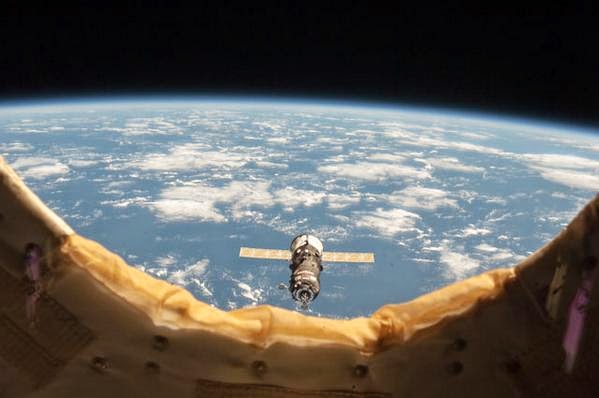
A Progress cargo craft approaches the ISS. 

On Wednesday the 23rd, a new Progress craft was launched from Baikonur and arrived at the ISS six hours later. The M-24M carried supplies for the station. Once unloaded, it will eventually be filled with trash and undocked later.

Delta 4 does the job, launching into a clear blue sky. SpaceFlight Now.

On Monday the 28th, a Delta 4 carried the GSSAP classified secret satellite into orbit. The satellite, though developed in secret, will be used to do research on possible collisions in space and any potential enemy military weapons developments in space.

European control room engineers monitor the docking of the ATV to the ISS. ESA.

On Tuesday the 29th, the European Space Agency (ESA) launched the 5th and last of the ATV robot cargo ships to the ISS. It was lifted on the Ariane 5 rocket from the French space center in French Guiana, South America. It was the 60th successful launch of the Ariane 5, a remarkable achievement.

And the rockets kept flying. On August 1st an Atlas 5 blasted off from Cape Canaveral, carrying a GPS navigational satellite. On August 5th SpaceX launched a Falcon 9 rocket carrying the AsiaSat 8. On the same day, the ESA announced a remarkable success: the Rosetta space probe rendezvoused with comet 67P/Churyumov-Gerasimenko. Instead of just passing close by, the probe has matched its speed and direction and will travel with the comet, studying it from close up.

Radar imaging of the comet nucleus. ESA.

The ATV finally docked with the ISS on Tuesday the 12th. It was berthed at the Russian Zvesda module, and astronauts began unloading the cargo ship. Although it is the last of the ATV series of cargo craft, the technology from this version will be used to design and build the service module for NASA's future Orion spaceship.

Long March rocket action. Xinhua news.

China got back into the space scene on August 9th, launching a Long March 4C rocket from the Jiuquan Satellite Launch Center in Gansu Province. It carried a remote-sensing satellite. A few days later on the 12th, another Atlas 5 took off, this time from Vandenberg AFB in California, carrying its own remote-sensing satellite, the WorldView 3.

View from the ISS, Cygnus released from the station, seen just right of center.

And that brings us to the last couple of days. Orbital's CRS-2 mission was over, and the Cygnus craft undocked on Friday. The ground engineers gave the craft remote directions to de-orbit and burn up this morning as it re-entered the atmosphere.

A previous Cygnus craft disintegrates and burns up over the Pacific.

Orbital has 6 more cargo missions under the current contract, and will no doubt receive further contracts in this successful series. And with the morning's fireworks provided by Cygnus, we get back to the business of watching the business of working in space.