Showing posts with label Military satellites. Show all posts

Tuesday, May 27, 2014

Sea Launch Success and Rocket News

Sea Launch mobile launch platform. Credit: Ria Novosti.

Time to get an overview of recent rocket launches from around the world. We'll start with today's successful launch of a Zenit-3SL rocket from the SeaLaunch floating pad from the Pacific Ocean. Sea Launch is a multi-national corporation owned by companies from Norway, Russia, Ukraine, and the United States. DEspite the current political and military crisis occurring between Ukraine and Russia, the project has gone ahead and lifted a EutelSat 3B Communications satellite into space. This was the 36th rocket launch for the company. Its last launch on February 1st ended badly as the rocket crashed into the sea soon after take-off. The cause has been pin-pointed to a faulty hydraulic oil pump.


Proton-M rocket ready for Launch from Kazakhstan. Credit: RiaNovosti.

From today's Sea Launch success, let's turn back to May 16th and the latest Russian launch embarrassment. A Proton-M rocket carrying an Express-AM4R GPS/communications satellite failed to place its payload into orbit as the second stage failed. The satellite would have been Russia's most capable comsat in space. News reports have indicated that pieces of the craft crashed near a Chinese city. The failure comes just after Russian President Putin made jokes about NASA's problems. The Proton series has experienced a number of failures since its first launches.

Delta IV lifts into the sky from Cape Canaveral. Credit: Florida Today.

The United Launch Alliance (ULA) performed a great launch of the Delta IV rocket on May 16th. Lifting off from Pad LC-37 at Cape Canaveral, the rocket placed an updated GPS satellite into orbit. The $245 million satellite will be the 31st to join the constellation of American GPS satellites. 


Atlas V on the Pad at Cape Canaveral. Credit: NASAspaceflight.com.

A week after the Delta launch, ULA performed a launch of the Atlas V rocket from Cape Canaveral's LC-41. The payload was a classified military satellite. The Atlas V uses a Russian-built RD-180 rocket engines, and the current political stand-off between Russia and the US over Russia's invasion of the Crimea has caused a potential stoppage of supplies of this engine. Russian President Putin has determined that the RD-180 is not to be used by the US for any military missions and there may be further interrupting of missions to the ISS after 2020. ULA has previously used the Delta II rocket for some military applications, but it has been discontinued with one possible flight remaining. The Delta IV launch vehicle may become the military go-to launcher if the Atlas V becomes limited to commercial flights only, but no final determination has been made.

Rokot blasts off from  Plesetsk Cosmodrome. Credit: ITAR-Tass.

On the 23rd, the Russians also launched a military mission. Lifting off from the Plesetsk Cosmodrome, the Rokot booster lifted the Bris-M upper stage into high altitude before placing 3 Russian military satellites into their orbits. The Rokot is a lighter vehicle, and I'm not aware if it can lift satellites designed to work with the troublesome Proton-M rocket.
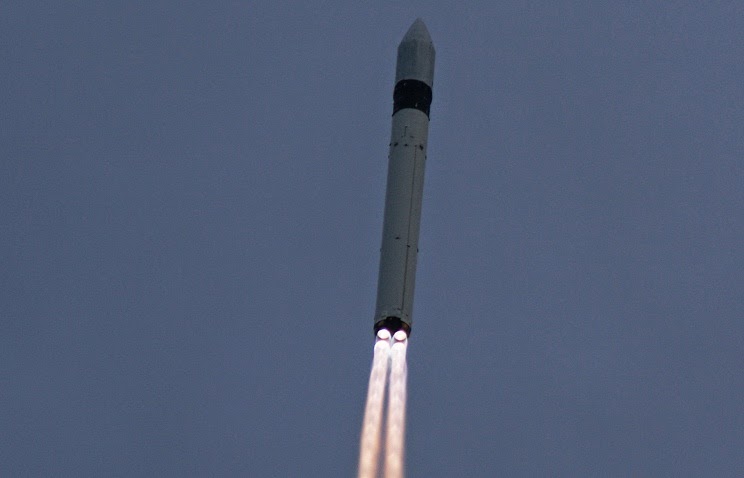
Rokot ascending. Credit: ITAR-Tass.


Japan's H2A lifts off from Tanegashima Space Center. Credit: KYODO/The Japan Times.

Finally we get to the Far East, where the Japan Aerospace Exploration Agency (also known as JAXA) launched a heavy H-2A rocket carrying the Advanced Land Observing Satellite-2. This spacecraft is designed to map regions of the Earth that suffer natural disasters and emergencies. It will also be used to study tropical rain forests, ice packs and other geological features affected by natural and man-made disasters.

Perhaps it can located trouble before the next Godzilla attack (Just kidding, no offense!).


Sunday, May 19, 2013

Rockets Red Glare

Atlas V launches from Pad LC-41.

Rocket fans live in a wonderful time of launches. On Wednesday May 15, United SPace ALliance launched an Atlas V rocket carrying the GPS 2F-4 satellite into orbit. The 31st part of the GPS system is safe in space. It's the 4th in a series of GPS satellites with entirely new upgrades and systems.  Of the course the marvelous Atlas V launch went fantastically well. You can see a whole gallery of photos from the launch thanks to SpaceFlight Now, at: http://www.jpl.nasa.gov/news/news.php?release=2013-163


ESA's Vega rocket blasts off.

The European Space Agency launched the second successful flight of a Vega rocket from French Guiana on May 14th. The Vega is a lighter rocket than the famous Arianne V. This one easily placed three satellites in orbit to help with communications and science experiments.


Proton rocket lifts off from Kazakhstan.

International Launch Services (ILS) lifted the Eutelsat 3D communications satellite into orbit on May 15. Russian rocket observers are happy to see the 3rd successful flight of a Proton rocket since a failure in December. ILS is a company jointly owned by USA and Russian partners. They lease launch space from the Baikonur facility in Kazakhstan and use the Proton rocket for satellite delivery services.

If you are a rocket fan, you definitely want to watch all the great rocket news found at SpaceFlight Now: http://spaceflightnow.com/

There's an upcoming flight of a Delta 4 rocket scheduled for this Wednesday, due to blast off from Cape Canaveral. On board will be an Air Force Wideband Global SATCOM, built by Boeing and destined to support our military's communication network.

Payload for the Delta 4 on the move to assembly.

Wednesday, March 20, 2013

New Eyes in the Skies

Beautiful liftoff of the Atlas-5 rocket from Cape Canaveral. Picture from Spaceflightnow.com

The Atlas-5 is the Energizer Bunny of rockets. This launch yesterday from Launch Complex 41 at Cape Canaveral marks the 4th launch in just 4 months of this class of booster. The next launch will be in May, marking 5 launches in just 6 months. Also, the Atlas-5 series seems to be remarkably free from major malfunctions. Each of the last 4 launches went off during their first opening of the launch windows.

Yesterday's launch placed a new SBIRS GOES2 spy satellite into orbit, This satellites main purpose is to alert the US military of any military missile launches. Considering the continuing missile advancements of Iran and North Korea, it's only common sense to keep a VERY close eye on these belligerent countries which continue to breathe out threatenings of destruction for the United States and Israel.

Great article on the satellite and the Atlas-5 rocket at Spaceflight Now: http://www.spaceflightnow.com/atlas/av037/#.UUnAkBzzeGO

Wednesday, June 20, 2012

Down and Up

X-37 in the hangar after landing. Credit: Boeing/USAF

Last Saturday the US Air Force's super secret (well, not too super secret) X-37 space plane touched down at Vandenberg Air Force Base in southern California. Although the USAF will not tell us what it's classified mission was, we do know that this fantastic machine has been in space for a year and three months! It's clear to see that the SPace Shuttle is not quite dead yet, as the design lives on in this remarkable spacecraft. Even the heat tiles and structure colors are similar. The tail is a little different... oh, well. This beauty blasted off from Cape Canaveral, Florida in March 2011 on top of an Atlas 5 rocket (more on that rocket below). During its mission many space fans pondered its purpose and secret mission. Maybe someday we'll find out, but we can reasonably be assured that part of its mission was testing the craft itself in low Earth maneuvers. This is the second X-37 to fly, the first one made a 244-day mission in 2010. That spaceplane will soon be off on another mission.

Blastoff This morning from Cape Canaveral. Credit: ULA

The National Reconnaissance Office (NRO) sent another classified satellite up into orbit on board an Atlas 5 rocket. This classified mission is designated NROL-38, and some spacewatchers have guessed it may be a communications satellite which will be used to coordinate transmissions from other secret satellites. An educated guess, since there are lots of smart people watching these missions. For me the best part of this mission is that it's the 50th successful launch of the Evolved Expendable Launch Vehicle Program, or EELV. Besides the Atlas 5, the Delta 4 rocket  has helped to make this series an important NASA transportation system as well as for the Air Force and NRO. The Atlas 5 is calculated to be used for the test launches of the Orion capsule being developed by Lockheed and NASA in a couple of years.

Atlas 5 on the left, Delta 4 on the right.  Credit: ULA.

Wednesday, May 9, 2012

Atlas V launch is 30th flight

Liftoff from LC-41. Credit: ULA.

On Friday, an Atlas V carrying the classified USAF satellite lifted off from Launch Complex 41 at the Cape Canaveral space center. The launch is the 30th flight of the Atlas V rocket, and the 60th rocket launch managed by the United Launch Alliance corporation. The satellite will provide secure high-frequency communications for the US military.

The Atlas V is under serious study by NASA as a possible carrier for the Boeing CST-100 capsule, and is also scheduled for testing the NASA Orion capsule in 2017 before the SLS system is ready.

Good view of the Atlas V on the pad.

Monday, April 9, 2012

A Plethora of Rocket Launches

Delta IV launch from Vandenberg AFB.

Did I say "Plethora?" Yes, I did. While we go about our busy lives working, going to school, etc., the spacefaring countries continue to launch rocket after rocket. I love it. Just in the last week, the USA, China and Russia each launched a satellite into space, adding to the vast population of robotic servants in orbit of the Earth. I mostly focus on events dealing with human space exploration, but I do enjoy learning about the world's rocket market. Last week, The Airforce had a Delta IV launch from Vandenberg Air Force Base in California, lofting a classified satellite for the NAtional Reconnaissance Office (NRO). Most likely a spy satellite.

Long March 3b. Credit: China Great Wall Industry Corporation. Or if you really want to be precise, Thank you America for the technological advances.

On Saturday March 31, China used a Long March 3b rocket to orbit a commercial communications satellite called Apstar 7. This television and Internet satellite will serve customers in the African and Pacific areas.


Proton-K/DM-2 rocket.

On Friday MArch 30, Russia launched a Proton-K/DM-2 rocket from Baikonur Cosmodrome. The payload was a military Early Warning satellite designed to alert Russia if anyone launches military missiles against them. An interesting point about the rocket: It is the last of the Proton-K types to be used. The new version designated Proton-M has been in use since 2001.

Happy to see so many successful rocket launches. Russia had an unfortunate series of rocket failures lately, so it seems all went well in March.

Friday, February 24, 2012

Blast off! Atlas 5 lifts Navy Satellite

Atlas lifts off from LC-41. Credit: SpaceFlight Now.

The MUOS 1 Mobile Communications Satellite was lifted into orbit Friday afternoon from Cape Canaveral at 3:15 pm MST. The US Navy will use the satellite to improve communications between ships and naval ground forces. MUOS 1 is built by Lockheed.


MUOS satellite graphic, credit Lockheed.

This was the 200th launch of the Centaur second-stage rocket system, which carries the satellites from the first stage Atlas rocket to an orbit before releasing the payload. Congratulations Centaur!

The Atlas 5 rocket is a joint project between Lockheed Martin and Boeing, under the organization of United Space Alliance. This rocket is under consideration of being man-rated to carry the new CST-100 crew capsule, currently being developed. This combination would be used to ferry astronauts to the ISS and back to Earth. It is also a possible launcher for the Dream Chaser, under development by Sierra Nevada Space Systems. The DreamChaser resembles a lifting-body design.


Dream Chaser- Atlas 5 configuration computer model. Credit Sierra Nevada Space Systems.

No doubt we'll be seeing more of the Atlas-5 in the competition for low-Earth-orbit capsules. In the meantime the Atlas 5 is very successful at delivering payloads into space. One of the spacecraft launched by an Atlas 5 is the New Horizon explorer, currently more than halfway to the dwarf planet Pluto! Another interesting payload is the Air Force's new X-37B unmanned robot shuttle, which is still on a mysterious mission in orbit.