Showing posts with label Delta IV. Show all posts

Wednesday, April 1, 2015

One Week, Eight Rockets!

Delta IV launches from Cape Canaveral. NASA/ULA.

In one week, all the major space-faring nations managed to launch payloads into Earth orbit. It started off on March 25th with the United Launch Alliance (US) conducting the launch of a Delta IV rocket from Florida's Cape Canaveral Launch Complex 37B. On board was the GPS-IIF-9 navigational satellite. From that point, the blast-offs just kept on coming.

On Thursday, a Russian Dnepr rocket lifted off from Dombarovsky in South-west Russia near Kazakhstan. It carried a Kompsat-3A research satellite for the South Korean Research Institute. The Dnepr is a repurposed ICBM missile.

On Friday, Japan launched an H-IIA rocket from the Tanegashima Space Center. It placed an information-gathering satellite into orbit.

On Friday night, Soyuz TMA-16M lifted off from the Baikonur astrodome with crewmembers for Expedition 43 on the International SPace Station. Inside the SOyuz capsule, the picture caught astronaut Scott Kelly giving a thumbs-up as the spacecraft heads towards a rendezvous. Six hours later the spacecraft arrived safely. Kelly and cosmonaut Mikhail Kornienko will be staying on board the station for an entire year, studying the effects of long-duration spaceflight. The commander of the Soyuz mission was Gennady Pedalka, making a return to the space station. He will be the first commander of four separate crews on the ISS.

Also on Friday, European agency Arianespace conducted a launch from French Guiana, firing a Soyuz rocket carrying twin Galileo satellites as part of the GNSS Navigation System.

On Saturday, a launch occurred at India's Satish Dhawan Space Center in India. The satellite is another navigation link in the Indian Regional Navigation Satellite System.

The next launch took place on Monday, when China launched a Long March 3C to place a first in a new series of navigational satellites in orbit.

Back to Russia. From the Plestsk space center, Russia launched 3 Gonets-M communication satellites into orbit on board a Rokot missile. It is speculated that a 4th satellite, a secret military craft, was launched from the same flight.

Space activities have been very busy lately!


Sunday, December 7, 2014

Images from the Orion Flight

Delta IV Heavy perched on pad LC37 at Cape Canaveral. On Thursday there had been higher winds than desired, and the launch was definitely scrubbed when there was a problem with one of the Core fuel valves. Liftoff reset for the next day.

Friday morning. Although overcast, conditions are fine and the launch proceeds. Excess fuel fumes burn off at the left.

Liftoff! View from the Kennedy Space Center visitors area, looking out towards the Atlantic Ocean. The Delta IV clears the tower and heads out over the ocean.

Last view of the Delta IV just before it enters the overcast layer. All engines performing as expected.

Once in the clouds, NASA TV selected between on-vehicle camera or the mission control computer simulation screen.

View from the onboard camera. You can see one of the boosters on one side and the flames at its bottom. The camera is placed on the capsule edge. Camera lens is a fish-eye lens.

Booster separation. Bright sunlight glare off the white paint of the booster. Only the core center engine is now operating.

Main engine is about to be shutdown, designated MECO (Main Engine Cut-Off). The rocket has passed Bermuda.

MECO, and the main stage has been jettisoned. 


The second stage engine is activated, heading the craft toward its first elliptical-shaped orbit.

The fairings surrounding the mock-up of the service module are jettisoned, and unseen to the camera the escape tower and capsule covering are blasted forward and away from the craft.

After the first elliptical orbit, the second stage fires again to push the craft into a highly arched ellipse which will bring the capsule back to Earth at a high-G descent to simulate the speed at which a returning capsule would reach the atmosphere from a manned mission.

The capsule has separated form the second stage and mock service module, and performs some orientation tests.

The capsule rotates to its final ready position for entering the Earth's orbit at about 8 G's.

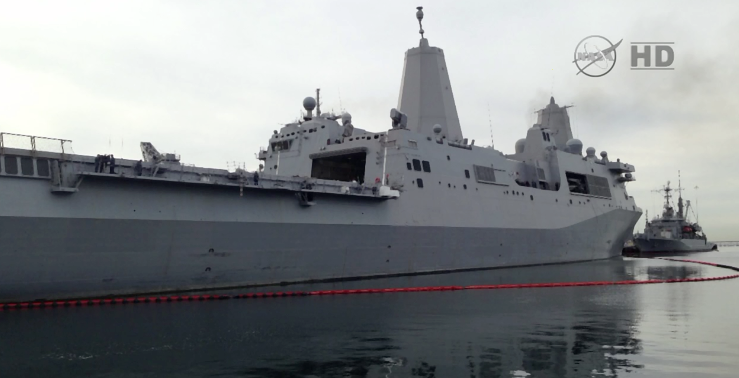
In the Pacific, off the coast of Baja California, the US Navy stands by with the recovery ship USS Anchorage. A drone circles the expected splashdown are for visual coverage, and manned speedboats and helicopters await the Orion capsule.

Orion's path through the atmosphere brought it to about 1.5 miles from it's projected splashdown site. In NASA terms, that's a bulls-eye!

After two drogue parachutes slowed the Orion down, three landing 'chutes opened to bring the Orion to a safe stop in the water. Several buoy balloons inflated to keep the capsule right-side up in the gently swelling waves. After landing, one of the chutes separated and sank, and at least one balloon failed. Recovery crew was swiftly at the capsule.

Well done NASA! Images by NASA, Nasa TV, and ULA.

Wednesday, December 3, 2014

NASA Prepares to Test Orion Capsule

Delta IV Heavy Rocket sits on the pad at Launch Complex 37.

The day is finally arriving when NASA is ready to make the first test flight for the SLS system. If all goes well, the Orion capsule test unit will be lifted into space by a Delta IV heavy rocket from Pad 37 at the Cape Canaveral complex. United Launch Alliance will handle the launch, designed to test the Orion capsule through launch, insertion into space, and then a high-G return through the atmosphere. Sensors packed throughout the capsule will monitor all phases of the flight, indicating to engineers how the project is going so far.

NASA Orion launch InfoCard. CLick on the picture to get info on how you can watch the flight.

The launch is scheduled for 5:05 a.m. Mountain time on Thursday. However, weather could interfere with the launch. There is a chance for rain and winds tomorrow, so NASA weather scientists are closely watching the situation.

You can keep up with the latest news on Orion testing at NASA's Orion webpage:

Tuesday, May 27, 2014

Sea Launch Success and Rocket News

Sea Launch mobile launch platform. Credit: Ria Novosti.

Time to get an overview of recent rocket launches from around the world. We'll start with today's successful launch of a Zenit-3SL rocket from the SeaLaunch floating pad from the Pacific Ocean. Sea Launch is a multi-national corporation owned by companies from Norway, Russia, Ukraine, and the United States. DEspite the current political and military crisis occurring between Ukraine and Russia, the project has gone ahead and lifted a EutelSat 3B Communications satellite into space. This was the 36th rocket launch for the company. Its last launch on February 1st ended badly as the rocket crashed into the sea soon after take-off. The cause has been pin-pointed to a faulty hydraulic oil pump.


Proton-M rocket ready for Launch from Kazakhstan. Credit: RiaNovosti.

From today's Sea Launch success, let's turn back to May 16th and the latest Russian launch embarrassment. A Proton-M rocket carrying an Express-AM4R GPS/communications satellite failed to place its payload into orbit as the second stage failed. The satellite would have been Russia's most capable comsat in space. News reports have indicated that pieces of the craft crashed near a Chinese city. The failure comes just after Russian President Putin made jokes about NASA's problems. The Proton series has experienced a number of failures since its first launches.

Delta IV lifts into the sky from Cape Canaveral. Credit: Florida Today.

The United Launch Alliance (ULA) performed a great launch of the Delta IV rocket on May 16th. Lifting off from Pad LC-37 at Cape Canaveral, the rocket placed an updated GPS satellite into orbit. The $245 million satellite will be the 31st to join the constellation of American GPS satellites. 


Atlas V on the Pad at Cape Canaveral. Credit: NASAspaceflight.com.

A week after the Delta launch, ULA performed a launch of the Atlas V rocket from Cape Canaveral's LC-41. The payload was a classified military satellite. The Atlas V uses a Russian-built RD-180 rocket engines, and the current political stand-off between Russia and the US over Russia's invasion of the Crimea has caused a potential stoppage of supplies of this engine. Russian President Putin has determined that the RD-180 is not to be used by the US for any military missions and there may be further interrupting of missions to the ISS after 2020. ULA has previously used the Delta II rocket for some military applications, but it has been discontinued with one possible flight remaining. The Delta IV launch vehicle may become the military go-to launcher if the Atlas V becomes limited to commercial flights only, but no final determination has been made.

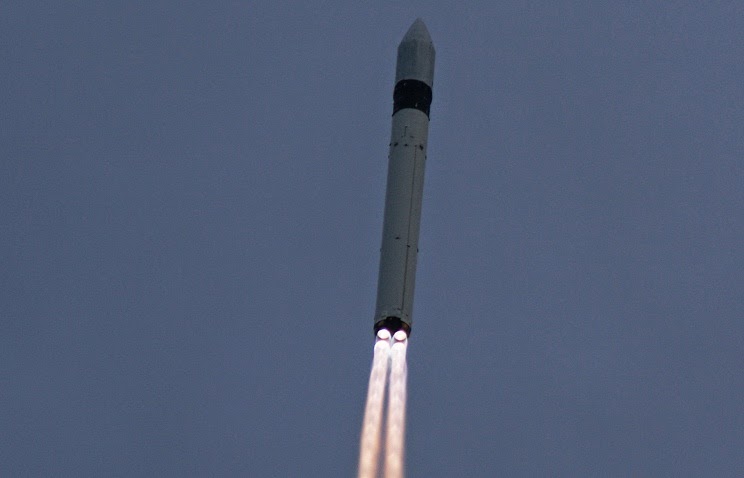
Rokot blasts off from  Plesetsk Cosmodrome. Credit: ITAR-Tass.

On the 23rd, the Russians also launched a military mission. Lifting off from the Plesetsk Cosmodrome, the Rokot booster lifted the Bris-M upper stage into high altitude before placing 3 Russian military satellites into their orbits. The Rokot is a lighter vehicle, and I'm not aware if it can lift satellites designed to work with the troublesome Proton-M rocket.

Rokot ascending. Credit: ITAR-Tass.


Japan's H2A lifts off from Tanegashima Space Center. Credit: KYODO/The Japan Times.

Finally we get to the Far East, where the Japan Aerospace Exploration Agency (also known as JAXA) launched a heavy H-2A rocket carrying the Advanced Land Observing Satellite-2. This spacecraft is designed to map regions of the Earth that suffer natural disasters and emergencies. It will also be used to study tropical rain forests, ice packs and other geological features affected by natural and man-made disasters.

Perhaps it can located trouble before the next Godzilla attack (Just kidding, no offense!).


Tuesday, September 3, 2013

Rocket launch updates

Long March 4C rocket blasts off from Jiuquan, China.

The last couple of weeks have seen the usual flurry of rocket launches from around the world. These satellite launches rarely make TV coverage, but are an important sign of the strength of space programs around the world. They demonstrate how reliant we are upon the space technology that lies behind our way of life in the 21st century.

Launch of  a Long March rocket from Jiuquan.

Yesterday China launched a Long MArch 4C rocket from its Jiuquan Satellite launch center. Three satellites, expected to be secret spy satellites, were placed into orbit.  The Jiquan Center is the same facility from where the Chinese Manned Missions take place. NASA Spaceflight.com has a great article on this launch at : http://www.nasaspaceflight.com/2013/09/long-march-4c-launches-yg17-mission/

Russian Zenit S2B rocket. Credit: Ria Novosti.

On Sunday September 1st, the Russian Zenit rocket returned to duty, placing an Israeli communications satellite into space. This rocket is the land-based version of the Zenit Sea-launched version. The last Zenit launch from its sea-based space center failed, destroying an Intelsat satellite. This launch took place from Baikonur launch facility in Kazakhstan.

The heavy-lift Ariane 5 blasts off. Credit: Ariannespace.

Last Thursday the European Space Agency launched an Ariane 5  heavy lift rocket from its space center in French Guiana on the coast of South America. The two satellites were successfully placed into orbit. One was a European communications satellite, the other a military satellite for India.

The powerful Delta-4 rocket on the pad at Vandenberg AFB, California. 
Credit: ULA & Spaceflight Now.

Last Wednesday morning saw the launch of the Delta-4 rocket under the direction of the United Launch Alliance. Launch site was the Vandenberg Air Force Base pad in California. The mission placed a National Reconnaissance spy satellite into space. 

Japanese Epsilon rocket on the pad at Uchinoura facility. Credit: JAXA.

Things didn't work out very well for the expected launch of the Japanese Epsilon rocket on August 27. The Epsilon is a new rocket, expected to place the SPRINT-A satellite into orbit. The SPRINT-A is an observatory which will study the planets in our solar system. An unexpected malfunction caused the countdown to terminate with 19 seconds left. Engineers are working on the problem. Keep an eye on Space.Com for updates: http://www.space.com/22540-japan-aborts-epsilon-rocket-launch.html

Monday, May 27, 2013

Delta IV lifts WGS-5 to orbit

Delta IV launch from LC-47. ULA picture.

Wideband Global SATCOM-5 was sent into orbit Friday to become part of the US military's network of communications satellites giving worldwide networking communications to ships, planes, and groundfighters wherever they may be.

The United Launch Alliance is the spin-off company owned 50-50 by Boeing and Lockheed that provides launch services for the US government. That includes the military, NASA, and our spy agencies. Using the Launch Complex 37 pad at Cape Canaveral, ULA prepped and launched the Delta IV rocket at 6:27 pm MDT Friday May 24th. It was the 71st ULA launch in a 77-month period. It was the second launch for the government in 9 days, the last being a launch of an Atlas rocket (covered in the previous post). 

Great coverage of the flight at SpaceFlight Now: http://www.spaceflightnow.com/delta/d362/#.UaNuSc3E6nG