Showing posts with label Apollo. Show all posts

Sunday, November 12, 2017

50 Years Ago: Apollo 4 Flight Get US Closer to the Moon

Lift-off of the mighty Saturn V rocket assembly from pad 39. NASA.

After the fire disaster of Apollo 1, tests still continued while lessons were learned and changes were made to the Apollo command and service modules. Possibly faulty wiring and systems in the Apollo Block 1 command modules were redesigned to bring newer, better safety factors in line with program directives. There was still a use for the Block 1 command modules though, and the flight of Apollo 4 was one of them.
Stages being assembled in the giant Vehicle Assembly Building, or VAB.

The Apollo 4 mission, also designated as AS-501, was the first mission to start with the Apollo naming protocol. The families and friends of the Apollo 1 fire tragedy had insisted failed test being redesignated as Apollo1.  Three other Saturn test flights had occurred before this mission, but had used the Saturn 1b first stage for the unmanned tests. This Apollo 4 mission had been delayed from its original date in 1966, due to the Apollo 1 Stand-down and the delays in re-wiring and re-equipping the newer Block 2 capsules. Thus it was that this mission would use a still-functional, unmanned Apollo Block 1 capsule as a test capsule to record data during the flight.
The fully-fitted Saturn V stack inside the VAB, in one of the four assembly bays. On a humid day, tiny clouds could form at the very top inside the building.

Roll-out of Apollo4 on the giant crawler and tower transporter, slowly moving away from the VAB.

Apollo 4 in place on pad 39A. The crawler has already unlocked and moved away from the launch base.
 

 The Saturn V's first stage heaving the rocket into the upper atmosphere.
 
Liftoff finally occurred on November 9. This was the first flight of the Stage 1C and S-2 second stage. It was the first time NASA had restarted the S-IV-B third stage. The capsule was placed into a high arc to simulate the returning velocity of capsule coming back from the moon. The capsule safely passed through re-entry, chutes deployed, and it landed in the Pacific ocean not far from the recovery ship USS Bennington. It was a hugely important mission, because it proved that the Saturn V could work, and that the systems were in place to get men to the Moon and back safely before the end of the decade.
Apollo 4 capsule ends its trip in the Pacific Ocean.

Apollo 4 command module next to the USS Bennington before retrieval.

The Apollo 4 capsule is on display at the Stennis Space Center in Mississippi. The hatch is open so that you can see inside.


Sunday, January 29, 2017

50 Years Ago: Apollo 1 Fire

Astronauts Gus Grissom (L), Ed White (C), and Roger Chaffee (R). Picture taken at Launch Complex 34, with the gantry tower in the background.

Hard to believe it was fifty years ago. On January 27, 1967, we lost three astronauts during a test of the newly-designed Apollo command module  at the eventual launch site. It's a famous event, most of us remember reading about it. Mostly I remember having seen something on TV and having adults tell me what happened. Over the years I learned more and more of the mistakes that were made leading up to the moment of terror when an electrical arc from an exposed wire ignited the 100% oxygen in the test environment. The fire was quick and the intensity so hot and at such incredible pressure that it cracked the hull of the capsule and prevented immediate attempts to rescue the crew. But it was too late - the crew died firstly from the toxic fumes. Today I don't want to remember the scenes of the aftermath, there are plenty of sites on the Internet and a plethora of books describing it all. I like to picture them as they were before the fire, as shown above.


Above is an aerial view of LC-34. It was taken in 1963 during preparations for SA-4, a test launch of Saturn 1. You can see the twin gantry towers, which is the red tower complex seen in the first photo. A test Saturn rocket sits on the concrete pad base attached to the launch tower. The circular building is the launchpad protective firing room. It's obvious how close the pad was to the shoreline. Today it is all gone, except for the roads, concrete pads, the rocket launch base, and the firing room bunker. 


The photo above is from my last trip to the Cape. This is the approach road to the complex on the western side. The concrete pads are out of sight to the right, while in the distance you can see launch towers from LC-37 ( still active launch site) on the left. You can visit the site if you take the Cape Canaveral AFB tour from the Kennedy Space Center visitors Center. This tour is only available during days when no rocket launches are planned, and I think only one tour a day is allowed. 


The tour bus lets you off within walking distance of the launch pad base. The tower itself was scrapped years later, as were most of the facilities on old launch pads. It's actually quite a wide concrete base. There is a great feeling of quiet there except for the wind that blows towards the Atlantic just a short distance away.


This picture gives a greater sense of the size of the base related to human height. As you can see, weather and age are having its toll on the structure. There is some talk of tearing it down, but I would rather see some funds put into an effort to restore it. I would love to see NASA build a small building here to protect it from the elements and display in miniature how the pad looked and operated. To me, the pads are just as important as the rockets.


Next you can see the gigantic opening made for the flame exhaust from the mighty Saturn 1 engines. I believe the tubular ring is part of the fire suppression system to lesson the ground shock of the engine power. There is something symbolic in being able to look upwards towards space through this open portal. 


These are the blast deflectors which would be placed under the rocket to deflect the fire and exhaust to a horizontal direction, avoiding a wave of pressure and flame from rebounding off the ground and damaging the engine section. These were not scrapped yet when I visited, and are stored at the edge of the giant pad. In the old picture of the pad, click it to enlarge it, and look behind the left side of the towers about midway up, and you can see on of these deflectors. That's where they still are.


 From the launch tower base, you can look somewhat south and see the firing room bunker. In case of danger, the crew would be evacuated from the rocket, and taken up a long protected tunnel to the blast-resistant bunker. You can find it in the old complex photo very easily.


This is a view of the Firing room bunker as we drove past it in the bus. There was no stopping here, the bunker is off-limits to the tour. Our guide did not know if anything has been preserved inside the bunker. It was planned that the Saturn 1b rockets would launch from this pad complex, and the launch control room would have been in here. As it was, four Saturn 1 test launches were from here, and there were two Saturn 1B test launches from this pad before the Apollo 1 fire. Afterwards, the return of astronauts to space took place in the next manned launch, Apollo 7, from this complex. Operations then moved to the LC-39 complex.

When you walk under the launch base, you can feel history there. You sense the reverence and awe in the fellow visitors, and everyone whispers even though we are out in the open. This is part of our great space race past, and it is a place that deserves to be preserved and visited.

Sunday, July 17, 2016

50 Years Ago: New Apollo Program Logo

Design for the Apollo program insignia.
 
Fifty years ago on July 16, 1966, NASA held a special news event at the Kennedy Space Center in Florida. The event celebrated the unveiling of the new logo design that would symbolize the upcoming Apollo moon landing program. Significantly, you can see that North America and its Florida launch site figure dominantly on the Earth and that the A's crossbar includes three stars representing the three-men crews that would fly the missions.

Sunday, February 21, 2016

50 Years Ago: Preparing for AS-201

Apollo AS-201 on the pad at Cape Kennedy.

Fifty years ago, in 1966, NASA was ready to begin an intensive testing program of the Saturn rocket with the Apollo spacecraft components. The first unmanned launch would be mission AS-201 scheduled for February 26. The launch vehicle was the Saturn 1, designed for getting Apollo into Earth orbit and testing command, service, and lunar module components before sending them to the Moon. There had been ten Saturn 1 test launches since 1961, using boiler-plate mock-up equipment in place of actual command and service module elements. In the latter half of 1965, the Saturn 1 rocket segments were brought to Cape Kennedy and stacked on the pad at Launch Complex 34.
Components of the Saturn 1 first stage.

Chrysler was the manufacturer of the first stage. Yes, the same company that manufactures cars. On this model, the stage featured eight J-2 engines that could produce thrust of 1,600,000 pounds of force. It arrived at the Cape in August 1965. It was set up directly on the pad.
Components of the Saturn 1 second stage.

 The second stage of the rocket is actually the Saturn IVb stage, built by Douglas Aircraft Company (now part of Boeing). It also worked as the third stage of the Saturn V rocket. It used one J-2 engine for propulsion. It was mated to the rocket, on the pad, in October 1965.

Command and Service modules being mated.
 
The Block 1 Command and Service modules joined the rocket in December 1965. They were built by North American Aviation. The Block 1 design was intended for all Earth-orbit testing and manned missions, before the Lunar Orbit rendezvous scheme was adopted by NASA, and the capsule did not include a docking hatch in its nose. Once the plan for landing in the LEM was included, the Block II was developed, and manned mission planning with Block I was shortened to only two missions. 
Finishing the Stack.
 
Testing of the rocket continued both night and day. In late 1965, the automation testing computer developed malfunctions which slowed down the rate of testing, but it was of course repaired and plans continued for the February 26 launch.

Wednesday, May 28, 2014

50 Years Ago: Saturn 1 SA-6 Mission Success

Saturn 1 rocket mission SA-6 on pad LC-37B.

On May 28th, 1964, NASA launched the 6th test flight of a Saturn rocket from Cape Canaveral. In this case the rocket was the Saturn 1, boasting eight H-1 engines in the first stage. On this mission, the payload was not the Jupiter nose cone, but was the first "boilerplate" or test version, of the Apollo capsule.


Before the launch: Engineers prepare the "Boilerplate" capsule for the mission.

The mission for this flight was to allow over 113 sensors in the capsule to measure the stresses of flight on the spacecraft, monitoring pressures and acceleration. The capsule was not planned to separate from the stage, but would remain attached.

Dr. Werner Von Braun in front of pad LC-37B. Seeing his dream of rockets to the Moon being tested.

There had been two previous attempts to launch the rocket. The first attempt was scrubbed because of fuel contamination, the second attempt failed due to overheating the guidance system. On this third attempt, engineers discovered a flaw in the optical unit of the instrument panel, covered by liquid oxygen vapors. Engineers determined it would not impact the flight, and a go was given.


Aerial view of the Saturn stack ready for launch.

The rocket lifted off from launch complex pad 37B at seven minutes after Noon, Eastern time. The only problem in the flight occurred when one of the H-1 engines shut down early. The other motors continued to burn a bit longer to compensate. After first stage separation, the second stage ignited and ten seconds later the escape tower jettisoned.

Moment of truth: The first stage ignites.

The second stage with the Apollo test capsule entered orbit reaching up to 123 miles high. The craft managed to make 54 orbits, eventually coming down into the Pacific Ocean.


Artist's concept of the SA-6 mission. The second stage propels the rocket higher into space after dropping the expended first stage.

After examining the instrumentation records, engineers determined that a gearing piece in the H-1 engine was at fault. The gears were replaced for the next launch and no further H-1 engine failures occurred.

Friday, May 16, 2014

50 Years Ago: Making Apollo Safe

Little Joe II in ascent.

Fifty years ago, engineers were doing their best to make sure astronauts could escape a fiery end to the Saturn rocket. On May 13, 1964, NASA launched a "Little JoeII" rocket which was designed to carry test versions of the Apollo Command and Service Module into a launch simulating the forces it would experience on later actual missions. In this case, the modules were a boiler-plate model, or a dimensionally-correct replica of the spacecraft which included weights and sensors for testing. The purpose of this test was not aimed at the capsule, but rather the structure perched on top of it - the escape tower. Blasting off from the White Sands missile range in California, rocket soared to 17,000 feet and then remotely exploded. In an instant, the rocket thrusters on the tower detected the failure and roared into action, separating the command module  away from the explosion and up further to 24,000 feet. At that point the tower was jettisoned and descent parachutes were deployed, returning the command module to the Earth. The entire test took only 7 1/2 minutes, and was passed successfully.

Tuesday, April 15, 2014

50 Years Ago: FIrst Lunar Test Vehicle Ready

LLRV in flight over Edwards AFB in 1965.

Back in 1964 on April 15, the NASA FLight Research Center received the first version of the LLRV (Lunar Landing Research Vehicle). Built by Bell Aerosystems Company, the cage-like vehicle operationally resembled the flight characteristics of the Apollo Lunar Excursion Module. On this machine, astronauts and test pilots would practice maneuvers that would be required to land the LEM on the Moon in future Apollo missions. The controls were adapted to function in Earth gravity, but feel to the pilot how engineers thought they would feel while simulating Lunar gravity. The vehicle was very unstable, and was considered one of the most dangerous craft a test pilot could ride. This was the first of two vehicles delivered.

A closer look at the LLRV. COl. Emil "Jack" Klueger was one of the test pilots who would learn to tame the beast.

Wednesday, April 2, 2014

50 Years Ago: Lunar Module Design Reaches Milestone

Mock-up of Apollo Program LEM (Lunar Excursion Module) at Grumman.

To meet the goal originally set by President Kennedy, of landing a man on the Moon and safely returning him to the Earth by the end of the decade, NASA and its contractors had a tremendous pressure to use every available moment to prepare for that event. There comes a point where decisions have to be made to stop designing and start manufacturing. So it was with the LEM in the last week of March, 1964. Officials from the NASA Manned Space Center arrived at Grumman Aircraft Engineering Corporation for a three day inspection of the current design of the LEM. The goal was to arrive at a "freeze" of the main design elements of the lunar module, so that manufacturing could begin shortly. Once the engineers had decided the final design acceptance or directions, the press was allowed to enter the building and get a look at the future of manned lunar landers. For those of you familiar with the final appearance of the LEM, you can see there are still some design elements to adjust, but the major components and functions have been determined at that point.

Now let's take a look back to some interesting phases of the LEM design, using models for the previous years.

Lunar capsule concept, 1961. The multiple leg concept is well established.

Lunar Excursion Module design, 1963. There's too much heavy window in the design, which needs reduction in weight.The hatch will not permit a spacesuited astronaut with a big pack to get through.

LEM design, 1964 before final redesign. It's almost there, but the Hatch still needs to conform to allow the passage of a spacesuit with a large square backpack. The windows are in final mode.

Thursday, January 30, 2014

50 Years Ago: Mission SA-5 Launches

Mission SA-5 launches from pad 37B.

Fifty years ago, Americans eagerly awaited the Gemini program which would precede the eventual Moon landings, but progress was also being made on the Apollo program itself. The first launch of the Saturn I block 2 rocket was made on January 29 from launch pad 37B at Cape Kennedy in Florida. This was the first orbital mission for the unmanned test rocket; a second stage, the S-IV, had been added to the previously tested first stage. The first stage also had added eight fins which would greatly aid the stability of the first part of the launch.

Beautiful launch, successful flight.

The Saturn 1 would not be the rocket to carry men to the Moon, but would play an integral role in preparing for the missions. First of all it would become our first heavy-lift vehicle. Second, it would place astronauts and spacecraft into orbit to be tested before sending them on to the Moon. Eventually it would play a part in US-Russian Space Cooperation and the transportation of astronauts to our first space station.

This mission did not include a test capsule, but did include a Jupiter-C nosecone, and placed the navigational instrument package into the second stage where it would normally be. When the second stage entered orbit, it became the largest satellite to ever begin circling the Earth. With this launch, the United states proved it could launch payloads heavier than the Russians, and that the USA had taken the lead in missile technology lifting vehicles.

Monday, July 15, 2013

50 Years Ago: NASA Prepares for Apollo

Little Joe II being Assembled at White Sands testing range.

Fifty years ago, NASA had just concluded the Mercury Project, determining that man could survive in space and control a rocket in orbit and return safely to the Earth. The Gemini Program began, ready to send up a crew of two astronauts in each capsule to practice the skills which would be needed to make the trip from the Earth to the Moon. The first steps of the Apollo program continued, with the expansion of testing for the Saturn rocket components.

Little Joe 2 Mercury flight.

To test the Mercury spacecraft, NASA had flown test capsules on the diminutive Little Joe 2 rocket. Now, they planned to use an advanced version called Little Joe II (roman numeralized!) to do the same with the Apollo capsule. On July 15, 1963, components of the new Little Joe II were moved from the General Dynamics/Convair assembly plant to the White Sands Missile Test Range for preparation for testing.

Boeing 377 Guppy special cargo aircraft.

Days earlier, on July 12, the space agency transported a dummy Saturn S-IVB rocket stage to Cape Canaveral. This was the first time that a rocket stage was transported to the Cape by aircraft. Previous transfers had been made on special barges towed by tugboats across the Gulf of Mexico.


Guppy in a later paint scheme.

The Guppy was a rare vehicle. Engineers took a Boeing 377 Stratocruiser and extensively modified the fuselage to accept a hugely oversized payload just like the Saturn stage. It was nicknamed Guppy after the small freshwater fish which always seems to look like it swallowed something too big for its belly.


Saturn S-IVB stage being loaded through the center of the fuselage.

Saturn stage being loaded through the front loading section.


The latest version, the Boeing SuperGuppy.

Friday, May 3, 2013

50 Years Ago: Apollo Drop Testing

Apollo era Test Capsule "Boilerplate 19A" a split picture before (left) and After (right) restoration work. Credit: Kansas Cosmosphere and Space Center.

Fifty Years ago NASA performed the first parachute drop test for the Apollo program. The test was conducted by the Northrop Corporation for NASA, dropping the test capsule (nicknamed a "boilerplate" model) from a specially configured C-133 cargo plane. The three parachutes safely landed the test craft, helping engineers calculate the forces placed on the capsule (and eventually, astronauts) during descent and landing.

In the picture above, one of the many test capsules used by NASA was recently restored to its original condition by the talented workers at the Kansas Cosmosphere and Space Center. The work took about 8 weeks, and you can see the difference in the split view. Congratulations to the Center on some great restoration work!

My study of the boilerplate models make me think that the model used in the original test 50 years ago may have been BP-6, whereas the model above, BP-19 was used in later parachute tests. I've not yet found a picture of BP-6.

Thursday, April 4, 2013

50 Years Ago: Testing the Apollo Capsule

Artist concept art of the Apollo CM in re-entry mode.

On April 4, 1963, NASA was busy smacking the test version of the Apollo command module into a water tank. Engineers had plenty of data on how the Mercury single-occupant capsule reacted upon splashdown, but the upcoming Gemini flights (2-person capsule) and Apollo missions (3-person capsule) would need lots of data to ensure the safety of the astronauts.


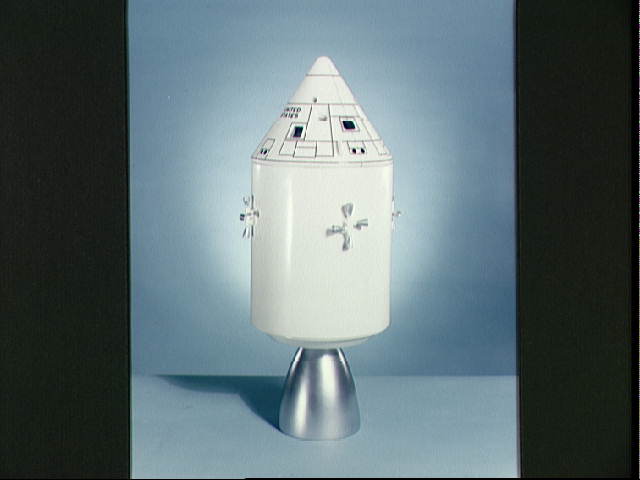
Model of CM atop the Service Module (SM).

There were two types of impact testing to be done. Of course, the first was a water landing test, as the planned return to Earth was expected to land astronauts in the ocean. Engineers also had to plan for a possible landing on the cold hard ground. The scenario considered that in case of a launch abort, the escape tower would pull the capsule from the service module (SM) and open the parachutes. because of unpredictable wind situations, the capsule could possibly drift back over the land and smack the crew into the ground.
The CM is released from the tower.
In both cases of ground and water impact tests,  picture above shows the testing procedure. High-speed cameras would film the capsule releasing from a tower (to simulate the drop velocity) against a backdrop of squares (not sure if they are painted or tiles). The squares help the engineers plot movement and impact speeds.

Recent: Orion capsule mockup in water test tank.
Recently, NASA has been developing the Orion capsule which will launch atop the giant SLS rocket (Space Launch System). The SLS is being designed as NASA's heavy-lift rocket to take heavy or large payloads into orbit or to send astronauts on missions farther from the Earth. NASA still performs drop tests to measure the durability of the craft and how well it will protect our space explorers.


In the picture above, Orion makes quite a splash. These days, motion sensors are placed on the surface points and interior structure to record stress of impact at all points. It's sort of like motion capture used by the film industry. BTW, Blogger's new method of inserting images leaves a bit to be desired. I just couldn't get the splash picture to center properly. Honestly, I tried. Grrrr.