Monday, April 14, 2014

50 Years Ago: Project Fire

Atlas D rocket lifting off with Project FIRE from Pad LC-12.

Fifty years ago, scientists designing the spacecraft for Project Apollo knew that the command module with three astronauts would be slamming into the Earth's atmosphere at over 25,000 mph. To understand the heat stresses on the craft's protective shield, they needed to actually plunge an object with sensors into the atmosphere at that speed and analyze the results. Project FIRE (Flight Investigation Reentry Environment) studied these effects for the various NASA spacecraft.  On April 14, 1964, NASA launched an Atlas D rocket carrying a Project Fire test object from LC12 into a 500 mile arc into space. Never intending to reach orbit, the craft separated and plunged down at a steep angle replicating the speed the Apollo capsule would be travelling. Sensors on board the experiment could then measure and define the stresses encountered and the heat effects.

Wind tunnel model of the Project FIRE experiment.

To reach the incredible speed, as the object prepared to return to Earth, and Antares II motor ignited and pushed the experiment even faster. Lasting about 30 seconds, the eventual speed of about 26,000 mph was achieved. While cameras on the ground filmed the fiery descent the craft recorded heat on the exterior at about 20,000 degrees F. After 32 minutes from launch time, the craft impacted into the Atlantic Ocean.

Sunday, April 13, 2014

50 Years Ago: Gemini-Titan 3 Crew Announced

Gemini-Titan 3 Prime and Backup crews: (L-R) Young, Grissom, Schirra, Stafford.

Fifty years ago, with the excitement of a successful test mission of the GT-1 unmanned vehicle just completed, NASA made official the names of the astronauts who would pilot the first manned mission in Project Gemini. The Prime crew would include veteran astronaut Gus Grissom and new astronaut John Young. The backup crew, who would launch in case of illness or injury to either of the prime crew before the flight, would be veteran astronaut Wally Schirra and new astronaut Tom Stafford.

NASA official portrait of Virgil (Gus) I. Grissom, with model of Gemini spacecraft.

Gus Grissom was the astronaut on board the Mercury space capsule Liberty Bell 7 when in arced over the Atlantic on the second flight in Project Mercury. His 15-minute sub-orbital flight was a success, but his spacecraft experienced a hatch jettison malfunction after landing in the water. With the capsule filling with water, Grissom was able to escape as Navy frogmen struggled to hook the craft to helicopter tow cables. Unfortunately the craft sank to the bottom of the Atlantic. After a review, Grissom was cleared from any mistakes and became one of NASA's top astronauts. He was previously a test pilot, and had flown 100 combat missions during the Korean War. He would be the first American to fly twice into space.

John Young, in Gemini-era spacesuit.

John Young graduated from Georgia Institute of Technology with a degree in Aeronautical Engineering. He served in the Navy during the Korean War and became a jet pilot afterwards. After tours of duty on aircraft carriers, he became a test pilot and finally joined NASA in Astronaut Group 2, known as the "New Nine." Young would have a very adventurous career with NASA, but his addition to the first Gemini flight came about because the original planned commander was Alan Shepherd, the first American in space, had suddenly come down with an ear and balance ailment which grounded him from flight. Tom Stafford had been planned as pilot, but with Shepherd's removal, the backup crew moved forward leaving Grissom as Commander and Young as Pilot. Wally Schirra then became the new backup crew commander working with Tom Stafford. Such is the life of a NASA astronaut.

Grissom, center, and Young, just to the right, during a spacecraft review meeting at NASA in 1964.


Friday, April 11, 2014

50 Years Ago: Gemini Program FIrst Unmanned Launch

NASA published image of Gemini Launching atop a modified Titan II rocket. The Launch tower more closely resembles the familiar tower design we would see later with the Apollo program.

Between the end of the Mercury program and the start of launches for Project Gemini, there were lots of rockets tested, satellites put into space, and experiments conducted in the upper atmosphere and Earth orbit. Then 50 years ago on April 8th, the look and feel of the new Gemini program came to life as the twin engines on the Titan II rocket roared into action. With the exhaust plume directed under the pad and to the side, cameras had a clear view of the rocket flames as the vehicle lifted off and cleared the tower. Perched on top of the rocket was a mockup of the Gemini capsule (called the boilerplate) that gave us the view of how missions would look in future launches. In the future, two astronauts would ride the rocket and no American would go into space alone again. 

Before the launch. The gantry tower, which was used to help stack the stages of the rocket together with the capsule, lowered into a horizontal position to avoid damage from the blast-off. 

Designated mission GT-1 (Gemini-Titan 1), this test mission was designed to evaluate the entire Titan II launch vehicle system, and the Gemini spacecraft integrity and compatibility with the rocket. After a perfect countdown and liftoff, the rocket staged and placed not only the capsule but also the second stage into orbit about 204 miles at its highest. OK, maybe not perfect. The vehicle faster than expected placing the craft in orbit going 14 miles faster than planned. The orbit path was not meant to last a long time, and the assembly was calculated to re-enter the atmosphere in 3 and a half days.

The next day, Titan II ICBM testing at Florida came to an end. The 33rd and final rocket launch for the USAF made a successful trip out over the Atlantic, and the ICBM portion of Titan II Research and development was completed.


Atlas V Blast-off Restarts Florida Launches

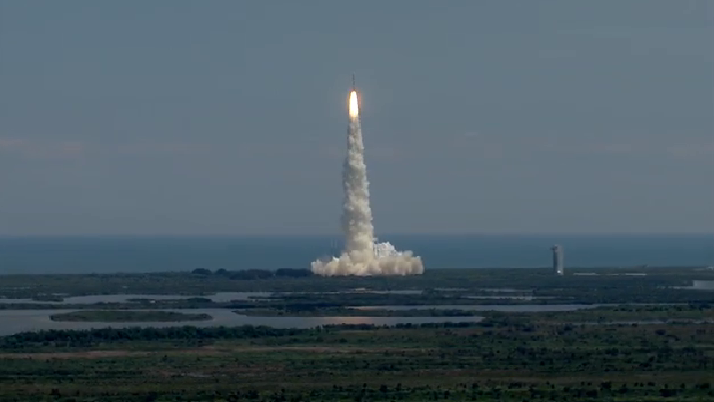
Mission NROL-67 blasts off from SLC-41 in Cape Canaveral. All pics in this post are from ULA.

Yesterday at 1:45 PM EDT an Atlas V carrying a spy satellite lifted off without problems for an eastern flight across the Atlantic Ocean and up into geosynchronous orbit. With this successful launch, and no reported problems from the recently repaired Range radar, the launch schedule from Florida can resume. The next flight is on April 14, when SpaceX launches the Falcon rocket with its Dragon resupply spacecraft to the ISS.

Atlas V on pad SLC-41.

It was a beautiful day for a launch, and congratulations to the ULA (United Launch Alliance) team that has launched two Atlas V missions across the country from each other within about a week's time.

Ground view of the Atlas V.

View from across the inlet. Cape Canaveral and the Kennedy Space Center are surrounded by a beautiful wildlife refuge. The white tower to the left of the pad is the rocket gantry complex.

Another aerial view that really shows how the pad is surrounded by water. The Freshwater parts also include alligators!

Liftoff!

The Atlas V goes supersonic. The solid rocket boosters give a tremendous push.

With their fuel expended, the boosters are jettisoned and the rocket continues to climb using its core fuel. 

Thursday, April 10, 2014

US Cargo Missions to ISS to Resume

SpaceX Falcon rocket with Dragon cargo spacecraft at Complex SLC-40. 

The main radar installation that supports launches from both the Kennedy Space Center and the Cape Canaveral Air Force Station suffered a fire a few weeks ago. It turns out that the radar, operated by the 45th Space Wing of Patrick Air Force Base, required major surgery to repair. As a consequence, launches scheduled from the east coast of Florida were delayed. Today that delay will end, hopefully, with the launch of an Atlas V carrying a classified military satellite. Following today's launch, SpaceX will be clear to launch its Dragon cargo spacecraft to the ISS on April 14th.

Atlas V launch last Thursday from Vandenberg AFB.

Today's Altas V launch was itself dependent on a successful launch of another Atlas V mission last week from Vandenberg AFB in California. That mission, carrying an Air Force weather satellite, started a 7 day turnaround for support crew elements and a review of the launch data. Once the data had been cleared, and the support crew from the United Launch Alliance (ULA) had transferred over to  Florida to work on the launch of the new updated Atlas V 541, which can launch heavier payloads than the earlier Atlas V versions. Today's mission carries a secret spy satellite for the National Reconnaissance Office. 

Progress spacecraft approaches the ISS.

In the meantime, the glitch that occurred on the recent Russian Soyuz launch to the ISS seems not to have repeated with the launch this week of a Progress robotic cargo spacecraft to the station. Using the navigational shortcut trajectory, the Progress M-23M (P55) spacecraft successfully arrived to dock with the station after a six hour flight on Wednesday April 9th. A previous Progress spacecraft, Progress M-22M (P54), undocked from the ISS on Monday. Filled with garbage and waste, the craft will remain in orbit for 11 days while engineers on the ground conduct some final experiments, then it will burn up in the atmosphere. The current Progress is docked at the Russian-built Pirs module.

Wednesday, April 2, 2014

50 Years Ago: Lunar Module Design Reaches Milestone

Mock-up of Apollo Program LEM (Lunar Excursion Module) at Grumman.

To meet the goal originally set by President Kennedy, of landing a man on the Moon and safely returning him to the Earth by the end of the decade, NASA and its contractors had a tremendous pressure to use every available moment to prepare for that event. There comes a point where decisions have to be made to stop designing and start manufacturing. So it was with the LEM in the last week of March, 1964. Officials from the NASA Manned Space Center arrived at Grumman Aircraft Engineering Corporation for a three day inspection of the current design of the LEM. The goal was to arrive at a "freeze" of the main design elements of the lunar module, so that manufacturing could begin shortly. Once the engineers had decided the final design acceptance or directions, the press was allowed to enter the building and get a look at the future of manned lunar landers. For those of you familiar with the final appearance of the LEM, you can see there are still some design elements to adjust, but the major components and functions have been determined at that point.

Now let's take a look back to some interesting phases of the LEM design, using models for the previous years.

Lunar capsule concept, 1961. The multiple leg concept is well established.

Lunar Excursion Module design, 1963. There's too much heavy window in the design, which needs reduction in weight.The hatch will not permit a spacesuited astronaut with a big pack to get through.

LEM design, 1964 before final redesign. It's almost there, but the Hatch still needs to conform to allow the passage of a spacesuit with a large square backpack. The windows are in final mode.

Tuesday, April 1, 2014

50 Years Ago: NASA Preps for Gemini and other Programs

Titan II rocket on the pad at LC19, Cape Kennedy in 1964. There appears to be a "boiler-plate" Gemini capsule perched on top, possibly for a test flight.

Fifty years ago, as March ended and spring began, the nation had a problem similar to the one we face today: Our new rocket was not ready. The Mercury program had concluded in 1963 with the launch of Gordon Cooper. From that point on, no American would launch alone in a spacecraft again. Gemini would feature a larger spacecraft carrying two astronauts, for longer duration flights in preparation for the eventual Apollo Moon landing program. But the rocket still needed work, as did the capsule, and of course, the astronauts.

First launch of a Titan II ICBM from the pad at Cape Kennedy.

By March 30 the US Air Force had announced nine major changes needed to the Titan II ICBM missile would be required to "man-rate" the rocket. 1) Addition of malfunction detection system; 2) backup flight control; 3) redundant electrical system with changes for additional launch vehicle equipment; 4) substitution of radio guidance for inertial guidance; 5) elimination of retrorockets and verniers; 6) new structure on second stage to hold new flight guidance and control equipment; 7) new second stage skirt assembly to join spacecraft; 8) simplification of trajectory tracking; and 9) redundancy in hydraulic systems. Throughout 1964 NASA would be testing and launching Titan II rockets from pad LC-19. Previous Titan 1 and II testing had occurred at LC-16.

Sketch of the pad layout at Launch Complex 19.

Astronauts, too, were working long hours in preparation for their Gemini missions. Some of the astronauts from project Mercury, along with the "New Nine," rehearsed the maneuvers they would be performing in simulators at NASA. One of the cool picture sets I've found is of the Rendezvous Docking Simulator used in training. Gemini missions would feature docking spacecraft to get astronauts ready for the complex maneuvers that would occur in the Apollo program.

Gemini spacecraft simulator suspended from complex wire array harness.

View of approaching Gemini craft from a simulation of a docking component, probably a mock-up of the Atlas-Agena target. I'm not sure which astronaut is hanging out of the hatch. The Gemini capsule would be a second-generation capsule mockup.

A first-generation capsule mockup.

Some of the computers controlling the docking simulator.

Simulator flight control panel for the RDS. 

Besides rockets and capsules, the astronauts needed to train for splashdowns and using the new Gemini spacesuits, an improvement over the Mercury Project suits. 

Gus Grissom, veteran of the Mercury project, tries on the new Gemini spacesuit. In his Mercury flight, he was only able to fly a sub-orbital mission across the Atlantic. In Gemini, he would achieve orbit.