Showing posts with label Titan rockets. Show all posts

Sunday, November 20, 2016

50 Years Ago: Gemini 12 Ends Program with Success

Gemini 12 lifts off on the Titan rocket.
 
This last week marks the 50th anniversary of the successful conclusion of the Gemini space program. On November 11, 1966, the last two astronauts to fly in the Gemini space craft began a mission to resolve some of the troubles encountered during EVAs. 

Aldrin (L) and Lovell (R) standing in a Gemini training capsule.
 
The commander of Gemini 12 was Jim Lovell, veteran Navy pilot, who had last flown on the Gemini 7 with Frank Borman. That flight was notable for it's 14-day endurance mission (estimated to be the time astronauts would live in space going to the Moon and returning home). Gemini 7 was also part of the first actual rendezvous in space, with Gemini 6A. Making his first trip into space, was rookie Gemini pilot Edwin "Buzz" Aldrin. Aldrin had been a combat pilot in the Korean War. He then attended MIT where he obtained a Doctorate in Science in Astronautics, starting his work on advanced space rendezvous calculations. Eventually he would earn the nickname, "Dr. Rendezvous."

Launch of Gemini 12's partner, the Agena target vehicle on board an Atlas rocket.

The mission started with the launch of an Altas rocket from pad 14 at Cape Canaveral. The plan on this mission was for the Gemini 12 to follow behind, catch up to the Agena, then dock with it. It was planned for Aldrin to perform several EVAs including a spacewalk out to the Agena. They would use the Agena's engines to boost the pair into a higher orbit, and then perform a separation followed by a tethered spacecraft experiment as had been done on previous Gemini missions. During the insertion into orbit, however, there was a slight malfunction in the motor, and it was decided after docking that the boost to higher orbit would not be attempted. After the mission, an attempt was made to control the engine from the ground, and it did not activate in any case.

View from close to the pad of the successful launch.
 
Th launch of the Titan carrying Gemini 12 took place about 90 minutes later, to enable the crew to approach the Agena from about an orbit behind. Liftoff took place from Pad LC-19. During the moment of staging as the rocket first stage was jettisoned, engineers noticed a rupture in the first stage oxidizer tank. Gemini 12 reached orbit and proceeded with catching up to the Agena and docking with it the next day, November 12. There was a failure in the rendezvous radar, and the docking was then performed manually.
Picture by Aldrin of the nose of the Gemini docked with the Agena Target Vehicle.
 
View of Aldrin outside the Gemini spacecraft.
 
 
Aldrin then exited the Gemini for his tethered spacewalk. This Gemini mission differed from previous missions in that extra handholds had been placed on the spacecraft and Agena, which would give Aldrin an advantage in moving and maneuvering between the craft. Also, before the mission, Aldrin had made much use of training preparations using a swimming pool to practice techniques he would use for this mission. These techniques would become standard practice for astronauts from now on.
Photo by Lovell of Aldrin performing a stand-up experiment during the second EVA.
 
During the first EVA of over 2 hours, Aldrin proved that the extra practice and handholds made a huge difference in relieving a spacewalker from extra duress and exhaustion. He retrieved a micro-meteorite shield from the Agena, and performed other experiments while moving about, including a trip to the rear of the Gemini service module. In his second EVA, he stayed in the Gemini hatch and performed further experiments there, including additional photography and extended tool techniques. After the second EVA, the spacecraft undocked for the tethered ship activity. 
View of the tethered Agena target vehicle and tether.
 
The Gemini 12 backed off a bit from the Agena and began maneuvering into a slow spin around the Agena. Similar to previous attempts, most of the time the tether did not stay tight but the experiment was considered a success. The tether was then released and the Gemini backed off to a safer distance.
Aldrin took this picture of the Gemini's nose during the third EVA.


Aldrin made a third, stand-up EVA the next day on the 14th. He took more pictures and performed a few more experiments. While the previous EVAs had each been over 2 hours, this was a shorter one for 55 minutes. When he closed the hatch, it was the last time a Gemini space suit would be used in an EVA, From here on out, EVAs would use Apollo - era designs.

Helicopter Point-of-view of Lovell being hoisted up from the recovered Gemini. This is a good view of the flotation "collar" that Navy frogmen would place around the capsule to stabilize it during recovery.
 
Gemini 12 performed perfect re-entry procedures and came back home on November 15. They splashed down only 5 kilometers off-target, and were televised from the recovery ship USS Wasp. The astronauts were taken up to a helicopter and flew back to the carrier.  Upon their safe return, Gemini Space Program space activities had ended. It was time for Apollo.
Aldrin and Lovell receive a happy welcome back on board USS Wasp. Both men would fly into space again, with Lovell making two more Apollo missions.


Friday, December 4, 2015

50 Years Ago: Gemini 7 Blasts off for Complex Mission

The Titan rocket lifts off from Pad LC-19 at Cape Kennedy.

On December 4, 1965, astronauts Frank Borman and Jim Lovell were carried into space by a Titan rocket on board the Gemini VII spacecraft. Their mission was to test how astronauts could adapt to a very long space flight, and eventually they completed 20 experiments. Because of the cramped environment of the Gemini capsule, great care and planning had gone into the storage and retrieval of everything from food packs to waste sample bags and even scraps of paper.

Astronaut Lovell in the new spacesuit prior to boarding.

Both astronauts were testing a new spacesuit for this mission, the G5C design. This suit replaced the traditional helmet for a zippered hood, which would cover a NASA flight helmet which included communications gear. Additional zippers and connections were meant to make it easier to remove the suit in the tiny confines of the capsule and reduce storage space used. During the first part of the flight, the suits proved to be very uncomfortable and hot. The experience helped NASA to decide that astronauts would be better off without spacesuits on during most of a mission except during critical flight operations.

Besides the long-duration aspect of the mission, an additional parameter had been changed to test rendezvous skills that would be needed for later Apollo Moon missions. The Gemini VI mission had been planned to take place on October 25, but was cancelled when the Agena docking target was lost during blast off just before the manned mission began. Modifications were made to the Gemini VI mission, so that they could take off during the second half of the Gemini VII mission and use the Gemini VII spacecraft as its new rendezvous target.

Until that time, Borman and Lovell would spend their days in zero gravity performing experiments related to living and working in space. The worst part of the mission had to be when they were required at times to store waste samples, which would sometimes release disgusting odors into the tiny living area. Then there were also times of boredom. Following the advice of Pete Conrad, they had taken along a few books. Many of the personal health and hygiene skills practiced on this mission helped astronauts in later long-duration missions live more comfortably.

Friday, August 21, 2015

50 Years Ago: Gemini V launches for Long-Duration Mission

Liftoff of Gemini V on the Titan II rocket from Pad LC-19.
 
Fifty years ago on August 21, 1965, astronauts Gordon Cooper, Jr. and Charles (Pete) Conrad, Jr., blasted off from Cape Canaveral for a long-duration mission around the Earth. The main mission was to study the effects of a mission lasting the time it would take to reach the Moon and return to the Earth. They would also practice orbiting rendezvous, by launching a targeting device and practicing maneuvering with it.
The entire crew of the Gemini V mission. From left to right, Backup crew Elliot See and Neil Armstrong, and Prime crew Pete Conrad and Gordon cooper.

"Gordo" Cooper would be the first astronaut to orbit the Earth for a second time. He had previously flown a 34-hour mission in the last Mercury flight, "Faith 7" and had been the last astronaut to fly alone. During that mission he was the first American to sleep in space, and relied on his superb piloting skills as several life support and flight controls broke down or gave him difficulty during the mission. He was in command of the Gemini V mission, which would turn out to be his last flight for NASA.

Astronauts move from the transport van to the gantry elevator.
 
"Pete" Conrad was making his first flight. He was a member of the "New Nine" batch of astronauts which would go on to be the prime crews for the later Apollo missions. He had been an excellent test pilot with the US Navy, and had a sarcastic sense of humor. He often referred to this mission as "Eight days in a garbage can" due to the cramped cockpit of the Gemini capsule.
Gemini V on the pad.
 
 Service crew making final checks before closing the hatches on the Gemini capsule. This view gives a good view of the cramped quarters the astronauts would endure during the mission.
 
 
Panoramic view of the blastoff from Launch Complex 19. The launch control blockhouse is in the reinforced mound to the left. Today, that blockhouse is all that remains at the site.
 
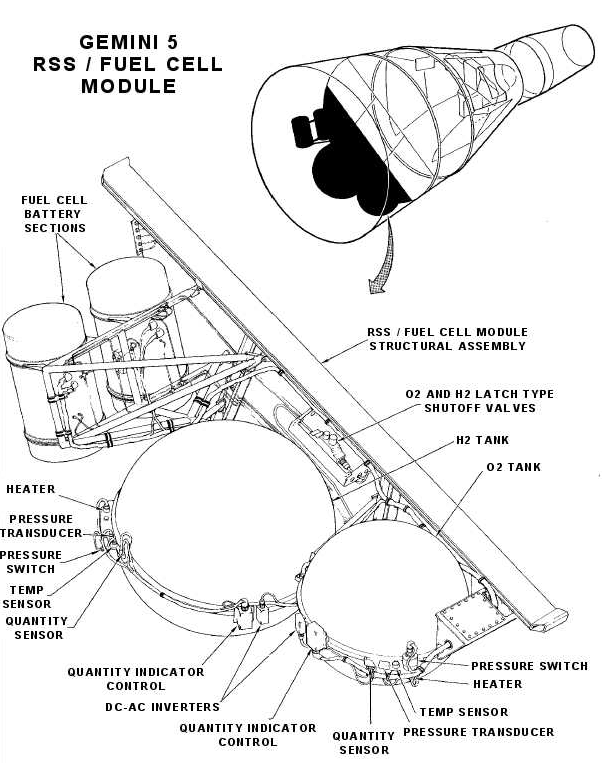
NASA diagram of the new Fuel Cells in the Gemini service module behind the capsule. The new fuel cells were a vast improvement over the chemical-reaction batteries used in previous spacecraft, and made the long-duration flight possible. 

The Radar Evaluation Pod. It was to be ejected in orbit, and used as a target for rendezvous practice.

After two hours in orbit, the crew ejected the REP (Radar Evaluation Pod). They would use the device to rendezvous with and maneuver, but Cooper detected a pressure loss in the Fuel cell. He shut it down while the craft was out of radio contact with mission control. It would mean that the rendezvous with the REP would have to be abandoned. After re-establishing contact, ground engineers calculated that the fuel cell could be turned back on and would not mean a cancellation of the rest of the mission objectives. On the ground, astronaut Buzz Aldrin calculated a new method for the orbiting crew to practice rendezvous by piloting to a fixed point in space.

Upper stage of the Titan II rocket, under recovery.
 
Down in the Atlantic, recovery crews located the upper stage of the Titan II rocket, which had kept floating due to the remaining gas in a nitrogen tank. It was recovered by the crew of the USS Dupont, and is on display today at the US Space and Rocket Center in Huntsville, Alabama. Meanwhile the crew continued on their mission to endure eight days in orbit.


Monday, March 23, 2015

50 Years Ago: First Manned Gemini Mission Blasts Off

Gemini 3 crews (L-R): John Young, Gus Grissom, and backup crew Wally Schirra, Tom Stafford.

Fifty Years ago the first manned flight of a Gemini spacecraft lifted off from Launch Complex 19 on the Cape Kennedy installation. Astronauts Gus Grissom (who flew on Mercury's second sub-orbital flight) and rookie astronaut John Young rode the spacecraft perched on the Titan II rocket. The 4 hour 52 minute flight lifted off at 9:24 am Eastern time on March 23 and the Gemini spacecraft successfully entered orbit. 

The gantry lowers into firing position.

Titan II missile lifts off from the pad carrying the GT-3 capsule and crew.

Th 3-orbit mission was designed to test the flying capabilities of the Gemini spacecraft. Besides a thorough checkout of the life support and operational systems, the crew was to test their ability to change orbital levels, maneuver, and manually control their descent to a splashdown location. All parameters were successful, although they did end up about 80 miles from their expected landing position.

View of a Gemini mission lifting off from LC-19.

During the flight, it turned out that the playful John Young had snuck a corned-beef sandwich onto the capsule. During the flight, he surprised Grissom with a sandwich he pulled out from his flight suit. Each astronaut took a bite, then stowed the sandwich away. Mission controllers were later upset, worried that crumbs might have gotten into the flight controls and endangered the mission.

There was also a slight thruster problem, in that a left yaw variation kept occurring. This was later traced to a venting water boiler. This problem would have dire consequences in a later Gemini flight.

After splashdown, the crew moved into rafts once Navy divers secured the craft and helicopters arrived to remove the crew.

Once safely returned to Earth, the crew had to wait a half hour longer than expected while the recovery ship USS Intrepid moved to their location. Considering the loss of the Mercury capsule earlier, Grissom and Young decided not to open the hatches until the recovery divers had arrived.

The empty capsule about to be hoisted aboard USS Intrepid.

With the completion of GT-3, the Russians seemed to still be ahead - they had already had a three-man mission (Voskhod 1), and their two-man mission (Voskhod2) had completed an EVA as well. For NASA, however, it was the first flight of an American two-manned craft, and the first re-entry of a manned capsule where the crew could change their splashdown site. NASA was ready to begin the long series of Gemini test missions which would prepare crews for the Apollo program. 

The Gemini 3 capsule was preserved, and today can be seen at the Grissom Memorial in Mitchell, Indiana.


Monday, February 2, 2015

50 Years Ago: Gemini GT-2 Test Flight

Mission GT-2 lifts off from Pad LC-19, on January 19, 1965.

Recently, on December 5, 2014 we watched the successful test of the Orion space capsule which will be part of NASA's heavy lift SLS rocket system. Fifty years ago, on January 19, 1964, NASA tested the Gemini capsule in a similar mission profile using the unmanned GT-2 test capsule on a Titan rocket. The sub-orbital flight was designed to fling the capsule into space and test the heat shield as it made a fiery re-entry through the atmosphere. That's exactly what the recent Orion flight was designed to do.

Remote- controlled picture of superheated plasma trailing the capsule as it re-enters the atmosphere.

The flight was a total success. The equipment aboard the capsule included an automatic sequencer designed to send signals at precise moments to fire the second stage, separate the capsule, jettison the storage section behind the capsule, orient the capsule for re-entry, and activate the parachutes. The capsule flew through an arc over the Atlantic Ocean, landing 2127 miles downrange, and splashdown occurred about 52 miles from the recovery aircraft carrier, the USS Lake Champlain.

GT-2 capsule arrives in Cape Canaveral. It has been placed on the equipment storage section (The white cone segments under the capsule).

The capsule was never intended to be manned. Instead, it was packed with early forms of computerized sequencers and test measuring devices to study the effects that re-entry physics would play on the structure of the craft and the simulated astronauts. This capsule eventually would become the first spacecraft to fly in space twice! For the Air Force's Manned-Orbital-Laboratory program (MOL), a hatch would be placed through the heat shield so that an astronaut could leave the cockpit and enter a spy-instrument control section that would be placed behind the capsule.


GT-2 on display at the Air Force Space and Missile Museum at Cape Canaveral. I took this picture on my last visit to Cape Canaveral. The capsule wears the US Air Force insignia that was painted on it for its mission in 1966. It was jam-packed with equipment, no room for even a little astronaut in there!

Another view of the capsule. The entire craft is covered with a protective plastic shield to preserve it. 

Not my picture. Another view that shows the hatch placed after mission GT-2.

NASA print of the launch of the mission. The gantry portion of the tower is lying down in the foreground.

Just before the flight. The gantry portion of the tower is lowered down before blast-off.


Friday, April 11, 2014

50 Years Ago: Gemini Program FIrst Unmanned Launch

NASA published image of Gemini Launching atop a modified Titan II rocket. The Launch tower more closely resembles the familiar tower design we would see later with the Apollo program.

Between the end of the Mercury program and the start of launches for Project Gemini, there were lots of rockets tested, satellites put into space, and experiments conducted in the upper atmosphere and Earth orbit. Then 50 years ago on April 8th, the look and feel of the new Gemini program came to life as the twin engines on the Titan II rocket roared into action. With the exhaust plume directed under the pad and to the side, cameras had a clear view of the rocket flames as the vehicle lifted off and cleared the tower. Perched on top of the rocket was a mockup of the Gemini capsule (called the boilerplate) that gave us the view of how missions would look in future launches. In the future, two astronauts would ride the rocket and no American would go into space alone again. 

Before the launch. The gantry tower, which was used to help stack the stages of the rocket together with the capsule, lowered into a horizontal position to avoid damage from the blast-off. 

Designated mission GT-1 (Gemini-Titan 1), this test mission was designed to evaluate the entire Titan II launch vehicle system, and the Gemini spacecraft integrity and compatibility with the rocket. After a perfect countdown and liftoff, the rocket staged and placed not only the capsule but also the second stage into orbit about 204 miles at its highest. OK, maybe not perfect. The vehicle faster than expected placing the craft in orbit going 14 miles faster than planned. The orbit path was not meant to last a long time, and the assembly was calculated to re-enter the atmosphere in 3 and a half days.

The next day, Titan II ICBM testing at Florida came to an end. The 33rd and final rocket launch for the USAF made a successful trip out over the Atlantic, and the ICBM portion of Titan II Research and development was completed.


Tuesday, April 1, 2014

50 Years Ago: NASA Preps for Gemini and other Programs

Titan II rocket on the pad at LC19, Cape Kennedy in 1964. There appears to be a "boiler-plate" Gemini capsule perched on top, possibly for a test flight.

Fifty years ago, as March ended and spring began, the nation had a problem similar to the one we face today: Our new rocket was not ready. The Mercury program had concluded in 1963 with the launch of Gordon Cooper. From that point on, no American would launch alone in a spacecraft again. Gemini would feature a larger spacecraft carrying two astronauts, for longer duration flights in preparation for the eventual Apollo Moon landing program. But the rocket still needed work, as did the capsule, and of course, the astronauts.

First launch of a Titan II ICBM from the pad at Cape Kennedy.

By March 30 the US Air Force had announced nine major changes needed to the Titan II ICBM missile would be required to "man-rate" the rocket. 1) Addition of malfunction detection system; 2) backup flight control; 3) redundant electrical system with changes for additional launch vehicle equipment; 4) substitution of radio guidance for inertial guidance; 5) elimination of retrorockets and verniers; 6) new structure on second stage to hold new flight guidance and control equipment; 7) new second stage skirt assembly to join spacecraft; 8) simplification of trajectory tracking; and 9) redundancy in hydraulic systems. Throughout 1964 NASA would be testing and launching Titan II rockets from pad LC-19. Previous Titan 1 and II testing had occurred at LC-16.

Sketch of the pad layout at Launch Complex 19.

Astronauts, too, were working long hours in preparation for their Gemini missions. Some of the astronauts from project Mercury, along with the "New Nine," rehearsed the maneuvers they would be performing in simulators at NASA. One of the cool picture sets I've found is of the Rendezvous Docking Simulator used in training. Gemini missions would feature docking spacecraft to get astronauts ready for the complex maneuvers that would occur in the Apollo program.

Gemini spacecraft simulator suspended from complex wire array harness.

View of approaching Gemini craft from a simulation of a docking component, probably a mock-up of the Atlas-Agena target. I'm not sure which astronaut is hanging out of the hatch. The Gemini capsule would be a second-generation capsule mockup.

A first-generation capsule mockup.

Some of the computers controlling the docking simulator.

Simulator flight control panel for the RDS. 

Besides rockets and capsules, the astronauts needed to train for splashdowns and using the new Gemini spacesuits, an improvement over the Mercury Project suits. 

Gus Grissom, veteran of the Mercury project, tries on the new Gemini spacesuit. In his Mercury flight, he was only able to fly a sub-orbital mission across the Atlantic. In Gemini, he would achieve orbit.

Wednesday, June 5, 2013

50 Years Ago: Rocket Tragedies and Triumphs

Titan II on Launch Pad, Cape Canaveral.

Fifty Years ago, the US Air Force and NASA Engineers were continuing to test and modify a multitude of rockets and ICBMS (InterContinental Ballistic Missiles). The Titan series were being modified to carry astronauts in NASA's Gemini program, soon to start now that the Mercury Program had come to a conclusion. On May 29th, 1963, a Titan II rocket was launched from Launch Complex 15 at Cape Canaveral. It was the 16th launch from LC-15. Nine flights had been mostly successful, yet six had encountered problems or come up short in meeting the mission goals. The last Titan launch had been the 1,400th rocket launched from the Cape, on May 21 (may have been May 24th) which successfully placed its test payload more than 6,500 miles down the AMR (Atlantic Missile Range).


Not so successful.

Fifty seconds into the flight, fuel began to leak into the engine compartment and started a fire. The rocket lost control at at 55 seconds of flight, it blew up spectacularly.

Rocket garden at Redstone Arsenal, Alabama.

Also on May 29, a target payload previously launched by a Titan I missile began to re-enter the atmosphere. Waiting for it was a Nike-Zeus rocket, fired from the Kwajalein Island in the middle of the Pacific Ocean. The rocket warhead successfully intercepted the target coming down. This shows that even this early in rocket development, the US was able to see hope in the idea of defense against nuclear missiles. It would be politics that would shut that effort down eventually, only to see it be resurrected  later by Presidents Reagan and Bush (43).

Minuteman I on display.

Tests also continued on the Minuteman ICBMs, which used a solid rocket fuel motor. May 29th was a busy day, as a Minuteman took off from either LC31 or LC32 and placed its payload 4,000 miles down the AMR. This was the last launch of the Minuteman tests by Boeing personnel, future launches would be by the Air Force.

Minuteman II in flight.


Minuteman I on pad LC-31/32.


Minuteman family of vehicles.

On June 5, A minuteman II was launched over the Atlantic, successfully placing its payload all the way out near Ascension Island. On the other coast, an Atlas E rocket lifted off from Vandenberg AFB the day before.


Polaris missile on pad 29 at Cape Canaveral.

It wasn't just NASA and the Air Force launching rockets. The Navy was in on it, too. On June 6th, the Navy sent up a Polaris A-3 rocket from launch Complex 29. The Polaris system was designed for launch from nuclear-powered submarines.

Polaris family of rockets.