Showing posts with label EVAs. Show all posts

Saturday, August 18, 2018

Russian Cosmonauts go for a walk

Cosmonaut Sergey Prokopyev releases a tiny nano-satellite into space. NASA TV.

On Wednesday August 15, Russian cosmonauts Sergey Prokopyev and Oleg Artemeyev opened the hatch on the Pirs module just after midnight and stayed out for over seven hours. They completed the tasks of installing the German-made Icarus experiment outside the Pirs module, and also hand-launched four nano-satellites that had been built by Russian science students. 

The Icarus experiment will track the migrations and movements of animals that have been tagged with tiny transmitters. Scientists will study how animal populations have modified their migrations and movements while encountering changes in their environments.

 Artemyev, left, and Prokopyev in a practice for the upcoming spacewalk. Credit: Roscosmos.

This was Artemyev's third spacewalk, and the first EVA for Prokopyev. The next ISS spacewalk will be in September.


Wednesday, July 4, 2018

Another Dragon, Another EVA for ISS

NASA Astronaut Ricky Arnold moves out of the airlock for his third EVA this year. NASA credit.
 
June was pretty busy for the crew of Expedition 56. With all of the maintenance and experiments performed by the six-person crew, you'd think they were busy enough! But no, they also had to prepare for a spacewalk and to make preparations for a new Dragon Cargo ship. On June 14, astronauts Drew Feustel (Expedition 56 commander) and Ricky Arnold (flight engineer) performed a6 hour 49 minute EVA to install improved HD camera equipment on the outside of the station.
 
Expedition 56 commander Drew Feustel led the 6th EVA of the Year.
 
The two spacewalkers  installed the HD cameras to help improve the view of the upcoming Dragon crewed ship docking and future Boeing Starliner crew vehicle dockings. In addition to the cameras, they moved some grab handles and performed some maintenance outside the Japanese KIBO module.


Dragon cargo spacecraft grappled by the CanadArm2 robotic arm. 
 
Following liftoff on Friday, and a three-day orbital chase, another Dragon cargo ship arrived at the ISS and was captured by robotic arm on Monday July 2. Astronauts Ricky Arnold, backed up by Drew Feustel, maneuvered the craft to dock at the US-built Harmony module. It carried science equipment, supplies, and biological experiments. Dragon is scheduled to stay at the station for about a month.
Parking is getting pretty limited up there.
 
With the arrival of Dragon, the ISS ports look pretty full. There are two Soyuz crew vehicles, a Cygnus cargo ship, a Dragon cargo ship, a Russian Progress cargo ship, and the inflatable Bigelow BEAM module attached to docking ports. Soon, however, we can expect further US-built crew ships (Dragon2 and Boeing Starliner) to be arriving for testing. This will make parking very interesting at the ISS!

Sunday, April 8, 2018

ISS: Expedition 55 Having a good start to Spring!

Current Spacecraft docking at the ISS. Credit: NASA.

Spring has gotten off to a good start up in Low Earth Orbit. When the Expedition 54 crew left the station on March XX, it left only three crew aboard: Expedition 55 Commander Anton Shkaplerov (Roscosmos) Norishige Kanai (Japan) and Scott Tingle (NASA). They did not have long to wait. On March 23, the reinforcements arrived on Soyuz spacecraft MS-08, docking at the Russian-built Poisk module. Joining the crew was Soyuz commander Oleg Artemyev (Roscosmos), Dr. Andrew Feustet (NASA), and Rick Arnold (NASA). Comprising the Expedition 55/56 crew, they are all veterans of spaceflight with Artemyev having already visited the ISS for six months in 2014. Dr. Feustel flew aboard shuttle Atlantis in 20009 with the Hubble Servicing Mission, shuttle Endeavor's final mission in 2011 (STS-134), and already has six EVAs to his credit. He will The Expedition 56 commander at the end of Expedition 55. Astronaut Arnold flew aboard shuttle Discovery in 2009, delivering the last set of solar panels to the ISS.
MS-08 approaches the station.
 
Nice view of MS-08 passing below the already-docked Progress cargo spacecraft.
 
 The last week of March was a busy one for the full crew. On March 28, ISS crewmembers closed the hatch on Progress 68P, having removed all its cargo and replaced the cargo with trash and waste items. The Progress ship undocked from the Russian-built Pirs module and was maneuvered into a lower orbit. Russian ground controllers are using the craft for some engineering tests, until they are ready to de-orbit the craft on April 25 and let it burn up over the Pacific Ocean.

Progress 68 just getting ready to undock as the ISS flies over the Atlantic Ocean.
 
The next day, March 29, two of NASA's astronauts went outside for a spacewalk, the fourth of the year. Astronauts Feustel and Arnold performed an EVA for a little over six hours, replacing worrisome cables on a cooling system, installing a TV camera, and placing a new communications antenna on the US Tranquility module. 
Drew Feustel on his March 29 EVA. This makes 7 EVAs in his career.
 
With the spacewalk completed, astronauts began preparing for their next visitor. On April 2, SpaceX launched another resupply mission to the ISS using the Falcon 9 re-usable rocket and the Dragon cargo spacecraft. Mission CRS-14 brings the station a plethora of science equipment as well as consumables and regular maintenance items. Dragon reached the station and docked on April 4 to the US Harmony module. It will remain on the station until May.
Dragon CRS-14 approaches the station over the magnificent colors of our planet.
 
 Next big event for the station crew will be the end of Expedition 55 in April.


Saturday, February 10, 2018

Dragon Undocks and EVAs mark the beginning of 2018 on ISS.

Dragon cargo spacecraft safely back on Earth on the recovery ship.

Full of returning experiments, science samples, and items for further testing, the Dragon cargo spaceship undocked from the ISS on January 13. Surviving the fiery re-entry, the craft parachuted down to the Pacific Ocean and was recovered by SpaceX teams which will prepare the ship for returning to SpaceX and to NASA.
 
 
 Astronaut Scott Tingle prepares for the year's first EVA.
 
January and February start off with EVAs on the International Space Station. On January 23, astronauts Mark Vande-Hei and Scott Tingle conducted EVA-47 to replace parts on the Robotic Arm. Once outside the airlock, the spacewalkers removed the spare part from a locker on the outside of the station and replaced the faulty part on the arm. Unfortunately there is a software issue with the activation of the part, which will result in a further spacewalk later in February.
 
Russian Cosmonauts Alexander Misurkin (R) and Anton Shkaplerov (L) prepare to exit the airlock for their EVA.

February 2nd saw the second EVA when cosmonauts Anton Shkaplerov and Alexander Misurka exited the PIRS module to perform maintenance work. This was Misurkin's fourth spacewalk. They successfully moved to the Zvesda module and replaced a faulty electronics box for a high-gain radio communications system. The bad parts were jettisoned towards a burn-up in the atmosphere. This station marked the 207th EVA for maintenance on the spacestation, including both American and Russian spacewalks. Typical for space agencies, this is also known as the Russian EVA-44 spacewalk. I'm not sure that I can comprehend how they keep track of these things when they have duplicate designations... 

Cosmonauts moving about the Zvesda module.

The EVA concluded after 8 hours and 13 minutes, which makes it the longest Russian spacewalk. Coming up on the ISS: A Russian Progress Cargo ship will take off on Sunday Feb. 11, and another US EVA in this coming week.


Sunday, August 20, 2017

ISS: Dragon Arrives and Russians Take a Walk

SpaceX Dragon resupply cargo vessel orbiting Earth and about to dock with the ISS. NASA pic.

SpaceX made another great launch last Monday, August 14th. The Falcon 9 rocket lifted the Dragon cargo spacecraft into orbit, and then flew back to Earth for a soft landing back at Cape Canaveral. The Dragon carried thousands of pounds of supplies and experiments for the crew on Expedition 52 in the International Space Station. 

NASA graphic of the current spacecraft locations on the ISS.

After a two day "chase" the Dragon spacecraft caught up to the ISS and maneuvered into a capture position. Astronauts Jack Fischer and Paulo Nespoli used the robotic arm to grab the capture point and guide the craft to its docking adapter. Eventually the spacecraft was secured at the new Common Berthing Mechanism (CBM) on the US Harmony module. Dragon will remain at the station for unloading, and then reloading of items to return to Earth in September.


Cosmonauts Fyodor Yurchkhin (L) and Sergey Ryazanskiy (R) preparing to exit.

On Thursday, August 17, Russian cosmonauts conducted an EVA to launch satellites and bring samples back inside. Expedition 53 commander Fyodor Yurchikhin and flight engineer Sergey Ryazanskiy left the Russian Pirs module for a seven hour spacewalk. They launched five nanosatellites that had been stored outside the station from a previous supply mission. One of the satellites was to test 3-D printed materials, while several others were commemorative or experimented with communications.

Sunday, January 15, 2017

ISS Spacewalkers Replace Batteries, Part 2

Astronaut Shane Kimbrough exits the station through the Quest airlock. His suit had the red stripe, allowing flight controllers to easily identify which astronaut was visible on camera.

On Friday January 13, American EVA 38 took place to complete the battery change-out that was the focus of last week's spacewalk. Expedition 50 commander Shane Kimbrough led the EVA, making his fourth spacewalk, while he was joined by ESA astronaut Thomas Pesquet, who was making his first spacewalk. 

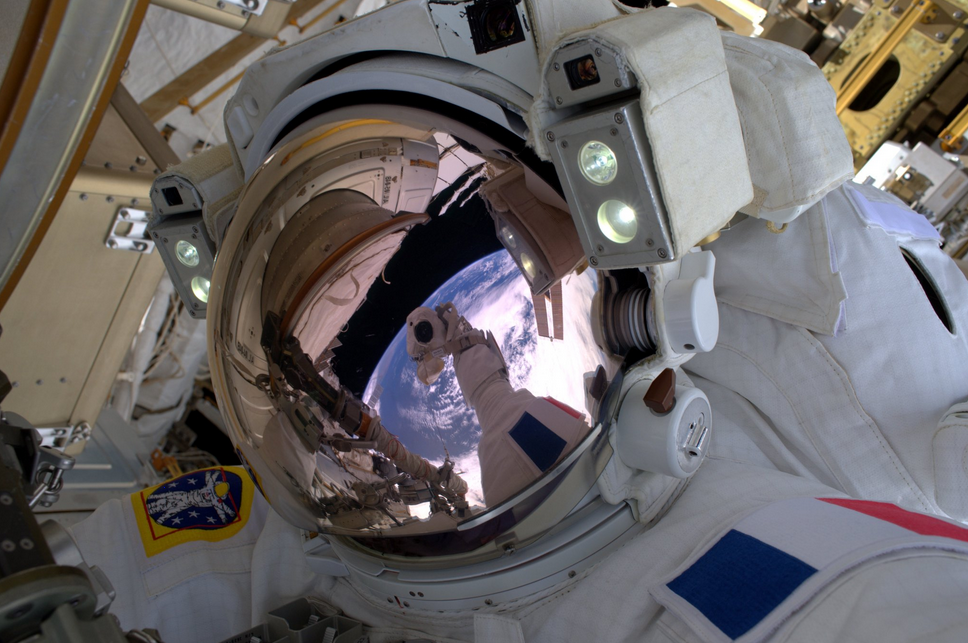
Kimbrough takes a great selfie, focusing on his reflective helmet which shows the Earth in the background. It's also a great view of the helmet assembly, with its extra lighting, cameras for astronaut POV, and solar protection covering on visor.
 The mission of this EVA was to complete the switchout of the older Nickel-Hydrogen truss batteries with the newer Lithium-Iron batteries. This power changeout has been underway for a long time, as astronauts have used several spacewalks and several robotic arm procedures to replace cables, switch power routings, and finally relocate old batteries to storage and install new batteries on the Truss.

Just hanging out, over 180 miles above the Earth. Easy Peasy. Picture from Thomas Pesquet's camera.
The station's Truss battery sections are in 4 parts, due to how the truss components were launched and assembled. The oldest Truss is designated P6. It's oldest batteries were changed out to newer lithium-hydrogen batteries (new then) by shuttle astronauts back in 2009 and 2010. But now the batteries will need to be replaced so that the station can continue its work-life towards 2024, so new batteries are required, and the new lithium-ion batteries are the new technology. It's planned to take up to 4 years to replace all the Ni-H2 batteries. These spacewalks replaced the oldest Ni-H2 batteries on Truss S-4.

Inside part of the S-4 Truss segment.
The battery change-out was completed a couple of hours ahead of schedule, so the astronauts used the rest of the EVA time to accomplish some tasks which would have been done on the next scheduled spacewalk. The total time of the spacewalk was just under six hours.
Back inside. Peggy Whitson assisted the astronauts in removing themselves from the EVA suits.
You can read all the details of this complex mission at NASASpaceflight.com: https://www.nasaspaceflight.com/2017/01/spacewalkers-upgrading-iss-batteries/

Sunday, January 8, 2017

ISS: Spacewalkers Replace Batteries, Part 1

Astronauts Peggy Whitson (L) and Shane Kimbrough (R) prepare to leave the airlock. There have been 196 spacewalks in support of the International Space Station so far.

On Friday, January 6th, astronauts from Expedition 50 of the ISS exited the Quest Airlock for a six and a half hour EVA to begin the four-year process of changing out the station's main batteries, which are reaching their serviceability lifespan. The new Li-Ion batteries were brought to the station on the Japanese HTV-6 cargo spacecraft on the external pallet. Using the stations remote-control arm, the batteries were removed from the craft and placed in the are of the exchange, which for this mission was the S4 segment of the main truss. There was a lot of work to do in preparation for this part of the battery exchange, both inside and out of the station. Relays and cables to affected station segments were checked, secured, and switched to other areas for the duration of the exchange.

Shane Kimbrough looks quite pleased to be performing his 3rd career spacewalk. Station solar panels in the background.

During the last week, ground controllers used one of the access arms to begin a series of shuffling old batteries from their home on the truss and replacing them with the new batteries stored in temporary positions on the truss. The purpose of this EVA was to finish certain installation tasks that could not be done with the robotic arms. It proves again how the human presence can never be completely removed from space activities for maximum efficiency. 
Astronaut Shane apparently enjoys selfies. Up there, who wouldn't?
 
Peggy Whitson during suit preparation. This was her 7th career EVA.
The EVA concluded with successful connections of three of the six replaced batteries. Part two of this EVA is scheduled for Friday January 13th, when Kimbrough goes outside again, this time with ESA astronaut Thomas Pesquet, to complete the hookups for the remaining three batteries. The new lithium-ion batteries are a great improvement over the older nickel-hydrogen batteries. The old batteries will be moved by the robotic arm onto the storage pallet on the HTV-6. They will burn up when the HTV-6 is plunged into the atmosphere over the Pacific for disposal.

For a very detailed description of the EVA, go to: NASASpaceflight.com: https://www.nasaspaceflight.com/2017/01/spacewalkers-upgrading-iss-batteries/

Sunday, November 20, 2016

50 Years Ago: Gemini 12 Ends Program with Success

Gemini 12 lifts off on the Titan rocket.
 
This last week marks the 50th anniversary of the successful conclusion of the Gemini space program. On November 11, 1966, the last two astronauts to fly in the Gemini space craft began a mission to resolve some of the troubles encountered during EVAs. 

Aldrin (L) and Lovell (R) standing in a Gemini training capsule.
 
The commander of Gemini 12 was Jim Lovell, veteran Navy pilot, who had last flown on the Gemini 7 with Frank Borman. That flight was notable for it's 14-day endurance mission (estimated to be the time astronauts would live in space going to the Moon and returning home). Gemini 7 was also part of the first actual rendezvous in space, with Gemini 6A. Making his first trip into space, was rookie Gemini pilot Edwin "Buzz" Aldrin. Aldrin had been a combat pilot in the Korean War. He then attended MIT where he obtained a Doctorate in Science in Astronautics, starting his work on advanced space rendezvous calculations. Eventually he would earn the nickname, "Dr. Rendezvous."

Launch of Gemini 12's partner, the Agena target vehicle on board an Atlas rocket.

The mission started with the launch of an Altas rocket from pad 14 at Cape Canaveral. The plan on this mission was for the Gemini 12 to follow behind, catch up to the Agena, then dock with it. It was planned for Aldrin to perform several EVAs including a spacewalk out to the Agena. They would use the Agena's engines to boost the pair into a higher orbit, and then perform a separation followed by a tethered spacecraft experiment as had been done on previous Gemini missions. During the insertion into orbit, however, there was a slight malfunction in the motor, and it was decided after docking that the boost to higher orbit would not be attempted. After the mission, an attempt was made to control the engine from the ground, and it did not activate in any case.

View from close to the pad of the successful launch.
 
Th launch of the Titan carrying Gemini 12 took place about 90 minutes later, to enable the crew to approach the Agena from about an orbit behind. Liftoff took place from Pad LC-19. During the moment of staging as the rocket first stage was jettisoned, engineers noticed a rupture in the first stage oxidizer tank. Gemini 12 reached orbit and proceeded with catching up to the Agena and docking with it the next day, November 12. There was a failure in the rendezvous radar, and the docking was then performed manually.
Picture by Aldrin of the nose of the Gemini docked with the Agena Target Vehicle.
 
View of Aldrin outside the Gemini spacecraft.
 
 
Aldrin then exited the Gemini for his tethered spacewalk. This Gemini mission differed from previous missions in that extra handholds had been placed on the spacecraft and Agena, which would give Aldrin an advantage in moving and maneuvering between the craft. Also, before the mission, Aldrin had made much use of training preparations using a swimming pool to practice techniques he would use for this mission. These techniques would become standard practice for astronauts from now on.
Photo by Lovell of Aldrin performing a stand-up experiment during the second EVA.
 
During the first EVA of over 2 hours, Aldrin proved that the extra practice and handholds made a huge difference in relieving a spacewalker from extra duress and exhaustion. He retrieved a micro-meteorite shield from the Agena, and performed other experiments while moving about, including a trip to the rear of the Gemini service module. In his second EVA, he stayed in the Gemini hatch and performed further experiments there, including additional photography and extended tool techniques. After the second EVA, the spacecraft undocked for the tethered ship activity. 
View of the tethered Agena target vehicle and tether.
 
The Gemini 12 backed off a bit from the Agena and began maneuvering into a slow spin around the Agena. Similar to previous attempts, most of the time the tether did not stay tight but the experiment was considered a success. The tether was then released and the Gemini backed off to a safer distance.
Aldrin took this picture of the Gemini's nose during the third EVA.


Aldrin made a third, stand-up EVA the next day on the 14th. He took more pictures and performed a few more experiments. While the previous EVAs had each been over 2 hours, this was a shorter one for 55 minutes. When he closed the hatch, it was the last time a Gemini space suit would be used in an EVA, From here on out, EVAs would use Apollo - era designs.

Helicopter Point-of-view of Lovell being hoisted up from the recovered Gemini. This is a good view of the flotation "collar" that Navy frogmen would place around the capsule to stabilize it during recovery.
 
Gemini 12 performed perfect re-entry procedures and came back home on November 15. They splashed down only 5 kilometers off-target, and were televised from the recovery ship USS Wasp. The astronauts were taken up to a helicopter and flew back to the carrier.  Upon their safe return, Gemini Space Program space activities had ended. It was time for Apollo.
Aldrin and Lovell receive a happy welcome back on board USS Wasp. Both men would fly into space again, with Lovell making two more Apollo missions.


Sunday, September 18, 2016

50 Years Ago: Gemini 11

Beautiful blast-off of Gemini 11 on the Titan II rocket.
 
Just fifty years ago, astronauts Pete Conrad and Richard (Dick) Gordon lifted off from the LC-19 pad at Cape Kennedy, Florida.  The flight took place just an hour and a half after the blast-off of an Atlas-Agena mission from LC-14.

Atlas rocket carrying an Agena docking spacecraft lifts off from pad LC-14.
 
Busy times at the Cape. While Gemini 11 lifts off LC-19, in the distance you can see SA-500F, a dummy Saturn V rocket used to test the launch facilities of Pad LC-39A before actual missions begin.

 
A close-up view of the Gemini 11 Launch.
 
In a Gemini first, the manned capsule caught up to the Agena target vehicle 94 minutes after launch and docked without problems. The rapid flight to the docking vehicle was termed "direct ascent" rendezvous and docking, and is similar to the short 6-hour Soyuz flights used today for astronauts to reach the ISS in a minimal time. Once docked, the astronauts used the motor aboard the Agena to propel them into a higher record altitude of 850 miles, more than four times higher than the ISS orbits these days.
NASA publicity shot of Richard Gordon (L), and Pete Conrad (R).
 
The astronauts did not stay in the higher orbit. They docked and undocked a total of four times during the mission, and lowered their main orbital height to about 184 miles up. They then prepared for the main experiment of the mission, to simulate some artificial gravity using a spinning of the combined spaceships.
At a press conference, Pete Conrad uses models of the Gemini and Agena spacecraft to demonstrate how the tether between the vehicle would be used to keep the craft together while spinning around an axis point.
 
In the first mission EVA, Richard Gordon exited the Gemini capsule to attach a tether between the two vehicles. During the two hour plan for the spacewalk, he needed to move over to the Agena's docking collar and remove the 100-meter tether, then attach it to the prepared points on the Agena dock and the Gemini nose. Unfortunately, the activities of the EVA turned out to be much more fatiguing and problematic than the training had suggest it would be. The EVA had to be shortened, but Gordon successfully connected the tether.
Picture of Gordon preparing to exit the Gemini spacecraft.
 
Image of Gordon moving between the two spacecraft. Most of the footage of Gordon outside the craft, taken by Conrad, was of poor quality because of poor visibility in his window. 
 
The slack in the tether is very apparent in this image taken by Gordon.
 
The tether experiment did not go as planned. They were never able to get the taught tether stability needed to fully generate a proper rotation, but the spinning they were able to achieve gave them a measurable amount of centrifugal force.  Later, in a second EVA, Gordon was able to perform a non-tiring series of experiments and photography sessions.
High-quality image of Australia from Gemini 11.
 
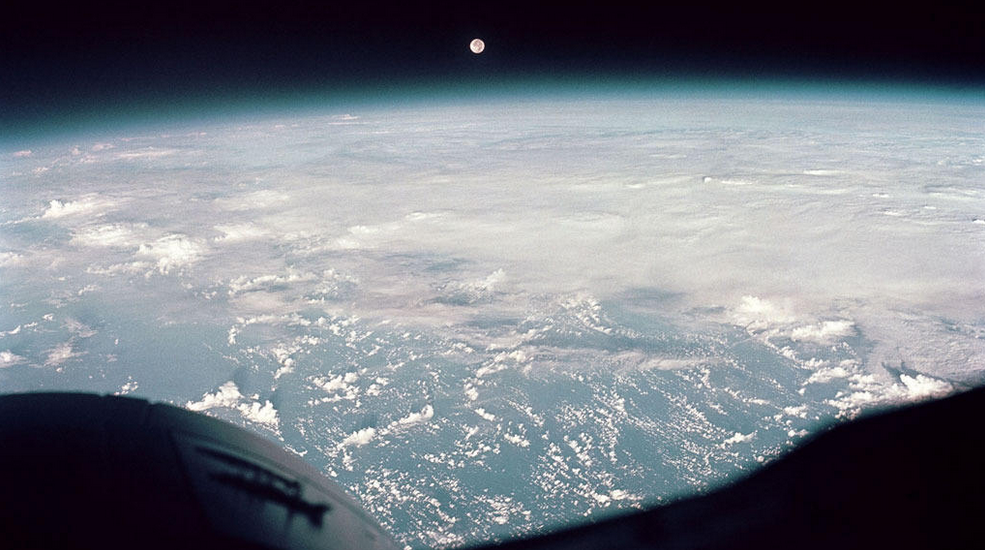
Moonrise over the curvature of the Earth.
 
Three days after launch, the mission ended in a great example of the advances America was making with computer technology. In the first fully-computerized automatic re-entry, the Gemini 11 spacecraft precisely landed only 2.8 miles from its planned position, close by the recovery ship USS Guam.
USS Guam alongside the spacecraft and recovery frogmen.
 
Gordon and Conrad on the deck of USS Guam.
 
An interesting photo I found comparing the size difference between the two-man Gemini spacecraft and the original one-astronaut Mercury space capsule. Keep in mind that the white-colored service module section behind the Gemini astronauts did not return to Earth with the capsule but were destroyed after separation and re-entry.