Showing posts with label Gemini. Show all posts

Sunday, November 20, 2016

50 Years Ago: Gemini 12 Ends Program with Success

Gemini 12 lifts off on the Titan rocket.
 
This last week marks the 50th anniversary of the successful conclusion of the Gemini space program. On November 11, 1966, the last two astronauts to fly in the Gemini space craft began a mission to resolve some of the troubles encountered during EVAs. 

Aldrin (L) and Lovell (R) standing in a Gemini training capsule.
 
The commander of Gemini 12 was Jim Lovell, veteran Navy pilot, who had last flown on the Gemini 7 with Frank Borman. That flight was notable for it's 14-day endurance mission (estimated to be the time astronauts would live in space going to the Moon and returning home). Gemini 7 was also part of the first actual rendezvous in space, with Gemini 6A. Making his first trip into space, was rookie Gemini pilot Edwin "Buzz" Aldrin. Aldrin had been a combat pilot in the Korean War. He then attended MIT where he obtained a Doctorate in Science in Astronautics, starting his work on advanced space rendezvous calculations. Eventually he would earn the nickname, "Dr. Rendezvous."

Launch of Gemini 12's partner, the Agena target vehicle on board an Atlas rocket.

The mission started with the launch of an Altas rocket from pad 14 at Cape Canaveral. The plan on this mission was for the Gemini 12 to follow behind, catch up to the Agena, then dock with it. It was planned for Aldrin to perform several EVAs including a spacewalk out to the Agena. They would use the Agena's engines to boost the pair into a higher orbit, and then perform a separation followed by a tethered spacecraft experiment as had been done on previous Gemini missions. During the insertion into orbit, however, there was a slight malfunction in the motor, and it was decided after docking that the boost to higher orbit would not be attempted. After the mission, an attempt was made to control the engine from the ground, and it did not activate in any case.

View from close to the pad of the successful launch.
 
Th launch of the Titan carrying Gemini 12 took place about 90 minutes later, to enable the crew to approach the Agena from about an orbit behind. Liftoff took place from Pad LC-19. During the moment of staging as the rocket first stage was jettisoned, engineers noticed a rupture in the first stage oxidizer tank. Gemini 12 reached orbit and proceeded with catching up to the Agena and docking with it the next day, November 12. There was a failure in the rendezvous radar, and the docking was then performed manually.
Picture by Aldrin of the nose of the Gemini docked with the Agena Target Vehicle.
 
View of Aldrin outside the Gemini spacecraft.
 
 
Aldrin then exited the Gemini for his tethered spacewalk. This Gemini mission differed from previous missions in that extra handholds had been placed on the spacecraft and Agena, which would give Aldrin an advantage in moving and maneuvering between the craft. Also, before the mission, Aldrin had made much use of training preparations using a swimming pool to practice techniques he would use for this mission. These techniques would become standard practice for astronauts from now on.
Photo by Lovell of Aldrin performing a stand-up experiment during the second EVA.
 
During the first EVA of over 2 hours, Aldrin proved that the extra practice and handholds made a huge difference in relieving a spacewalker from extra duress and exhaustion. He retrieved a micro-meteorite shield from the Agena, and performed other experiments while moving about, including a trip to the rear of the Gemini service module. In his second EVA, he stayed in the Gemini hatch and performed further experiments there, including additional photography and extended tool techniques. After the second EVA, the spacecraft undocked for the tethered ship activity. 
View of the tethered Agena target vehicle and tether.
 
The Gemini 12 backed off a bit from the Agena and began maneuvering into a slow spin around the Agena. Similar to previous attempts, most of the time the tether did not stay tight but the experiment was considered a success. The tether was then released and the Gemini backed off to a safer distance.
Aldrin took this picture of the Gemini's nose during the third EVA.


Aldrin made a third, stand-up EVA the next day on the 14th. He took more pictures and performed a few more experiments. While the previous EVAs had each been over 2 hours, this was a shorter one for 55 minutes. When he closed the hatch, it was the last time a Gemini space suit would be used in an EVA, From here on out, EVAs would use Apollo - era designs.

Helicopter Point-of-view of Lovell being hoisted up from the recovered Gemini. This is a good view of the flotation "collar" that Navy frogmen would place around the capsule to stabilize it during recovery.
 
Gemini 12 performed perfect re-entry procedures and came back home on November 15. They splashed down only 5 kilometers off-target, and were televised from the recovery ship USS Wasp. The astronauts were taken up to a helicopter and flew back to the carrier.  Upon their safe return, Gemini Space Program space activities had ended. It was time for Apollo.
Aldrin and Lovell receive a happy welcome back on board USS Wasp. Both men would fly into space again, with Lovell making two more Apollo missions.


Sunday, September 18, 2016

50 Years Ago: Gemini 11

Beautiful blast-off of Gemini 11 on the Titan II rocket.
 
Just fifty years ago, astronauts Pete Conrad and Richard (Dick) Gordon lifted off from the LC-19 pad at Cape Kennedy, Florida.  The flight took place just an hour and a half after the blast-off of an Atlas-Agena mission from LC-14.

Atlas rocket carrying an Agena docking spacecraft lifts off from pad LC-14.
 
Busy times at the Cape. While Gemini 11 lifts off LC-19, in the distance you can see SA-500F, a dummy Saturn V rocket used to test the launch facilities of Pad LC-39A before actual missions begin.

 
A close-up view of the Gemini 11 Launch.
 
In a Gemini first, the manned capsule caught up to the Agena target vehicle 94 minutes after launch and docked without problems. The rapid flight to the docking vehicle was termed "direct ascent" rendezvous and docking, and is similar to the short 6-hour Soyuz flights used today for astronauts to reach the ISS in a minimal time. Once docked, the astronauts used the motor aboard the Agena to propel them into a higher record altitude of 850 miles, more than four times higher than the ISS orbits these days.
NASA publicity shot of Richard Gordon (L), and Pete Conrad (R).
 
The astronauts did not stay in the higher orbit. They docked and undocked a total of four times during the mission, and lowered their main orbital height to about 184 miles up. They then prepared for the main experiment of the mission, to simulate some artificial gravity using a spinning of the combined spaceships.
At a press conference, Pete Conrad uses models of the Gemini and Agena spacecraft to demonstrate how the tether between the vehicle would be used to keep the craft together while spinning around an axis point.
 
In the first mission EVA, Richard Gordon exited the Gemini capsule to attach a tether between the two vehicles. During the two hour plan for the spacewalk, he needed to move over to the Agena's docking collar and remove the 100-meter tether, then attach it to the prepared points on the Agena dock and the Gemini nose. Unfortunately, the activities of the EVA turned out to be much more fatiguing and problematic than the training had suggest it would be. The EVA had to be shortened, but Gordon successfully connected the tether.
Picture of Gordon preparing to exit the Gemini spacecraft.
 
Image of Gordon moving between the two spacecraft. Most of the footage of Gordon outside the craft, taken by Conrad, was of poor quality because of poor visibility in his window. 
 
The slack in the tether is very apparent in this image taken by Gordon.
 
The tether experiment did not go as planned. They were never able to get the taught tether stability needed to fully generate a proper rotation, but the spinning they were able to achieve gave them a measurable amount of centrifugal force.  Later, in a second EVA, Gordon was able to perform a non-tiring series of experiments and photography sessions.
High-quality image of Australia from Gemini 11.
 
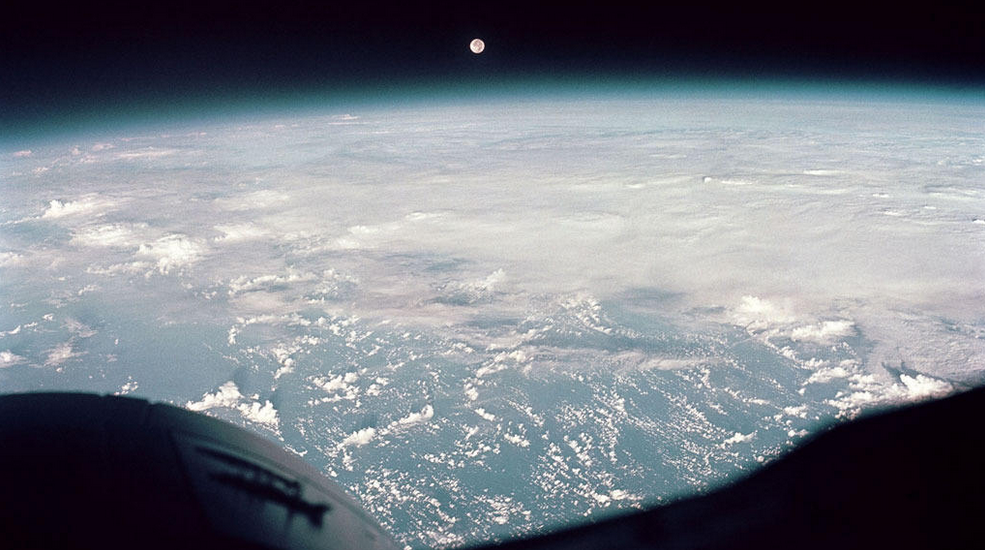
Moonrise over the curvature of the Earth.
 
Three days after launch, the mission ended in a great example of the advances America was making with computer technology. In the first fully-computerized automatic re-entry, the Gemini 11 spacecraft precisely landed only 2.8 miles from its planned position, close by the recovery ship USS Guam.
USS Guam alongside the spacecraft and recovery frogmen.
 
Gordon and Conrad on the deck of USS Guam.
 
An interesting photo I found comparing the size difference between the two-man Gemini spacecraft and the original one-astronaut Mercury space capsule. Keep in mind that the white-colored service module section behind the Gemini astronauts did not return to Earth with the capsule but were destroyed after separation and re-entry.


Sunday, July 31, 2016

50 Years Ago: Gemini 10 Docks in Space

Gemini 10 lifts off from Cape Kennedy.

Fifty years ago on July 18, 1966, astronauts John Young and Michael Collins took off for another NASA attempt at docking with the Agena target vehicle. On two prior missions, there had been problems with the Agena docking vehicles, sometimes due to errors in launch, and recently when the payload shroud failed to separate from the target dock. On this flight, things went much better. The Agena was blasted into space more than an hour before the Gemini-Titan rocket took off. It successfully deployed in orbit and awaited the Gemini capsule.
Agena Target Vehicle in view from the Gemini capsule.

Gemini 10 took off from Launch Complex 19 at about 3 in the afternoon into clear skies. During launch, it seems that one of the umbilical hoses from the launch tower came loose and clung to the Titan's second stage. It appeared to pose no trouble during the remaining flight. The capsule reached an altitude of 159 miles. Their first goal was to reach the Gemini 10 Agena target. Using fuel in the service module, they made up the 970 miles separating them, and docked with the Agena the next day (July 19th). For the first EVA of the mission, Collins opened his hatch and began photography experiments. One item pictured was a color patch on the capsule, which engineers would use to resolve color imaging issues for space photography. He also made some ultraviolet images of the Milky Way. The EVA was cut short when both astronauts experienced severe eye irritation. Some lithium hydroxide had leaked into their ventilation system. After closing the hatch the air system was purged and the problem solved.
Closing in for docking.
They next used the fuel in the Agena to boost their orbit higher, until they had reached more than 40 miles higher. This was the highest altitude reached by astronauts so far. Their goal was to reach another space vehicle - this time the Gemini 8 Agena target, which had lost power and was floating dead in in space. It was the original Agena that had been involved in the first docking in space on Gemini 8, just moments before a malfunction in the Gemini 8 thruster system caused the two docked vehicles to spin dangerously. To save their lives, Neil Armstrong and Dave Scott had forced an emergency separation from the Agena and then completed gaining control of their capsule and landing early in the Pacific Ocean. Now, Young and Collins found the Agena orbiting in a stable position and ready for the second part of the mission. For this rendezvous, they jettisoned the original Agena and approached the Agena (8) with their own thruster system.

Artist's idea of the Collins EVA to Agena 8. (If I could read the artist's name I would give credit.)
 
Collins performed the second EVA, exiting the Gemini capsule and floating the short distance to the Agena vehicle, where he retrieved a micrometeorite collection shield. The hand-held maneuvering unit helped him orient himself, but there were no handholds on the Agena in those days, so working around the Agena was difficult. After returning to the capsule, there were problems with the umbilical cord and so before closing the hatch, it was jettisoned along with the EVA chestpack. Ten other science experiments were performed by the astronauts during the mission. On July 21st, they deorbited and re-entered the atmosphere, landing 3 miles from the recovery ship USS Guadalcanal.

Helicopter view of John Young being hoisted up to safety.
 
For Command Pilot John Young, this was his second spaceflight, having originally flown with Gus Grissom on the first Gemini manned flight. He would go on to ave the longest career of any astronaut, and eventually became the only person to fly four different spacecraft type: Gemini, Apollo Command Module, Apollo Lunar Module, and the Space Shuttle. This was Michael Collins' first space mission, and he would go on to fly on the historic Apollo 11 mission. For a time, the capsule of Gemini 10 was on display in Norway, but is now home in the USA at the Kansas Cosmosphere and Space Center.

John Young on the left, Michael Collins on the right.


Sunday, June 5, 2016

50 Years Ago: The Missing Crew of Gemini 9

Prime and Backup crews for Gemini 9. Front (L to R): Elliot See, Charles Basset. Back (L to R): Tom Stafford, Gene Cernan.
 
There's a very good reason why NASA assigns a backup crew to every spaceflight mission.
The Gemini 9 mission was planned as the 7th manned Gemini flight and the 13th manned American flight since the first flight of Alan Shephard.  The crew assigned to this mission was to be command pilot Elliot See and pilot Charlie Basset. Tom Stafford and Gene Cernan were assigned as backup crew. The backup crew did the same training as the prime crew, and knew the mission parameters inside and out.

Elliot See during backup training for Gemini V.
 
Commander Elliot See, Jr. was a Navy pilot who was selected to be an astronaut in the second group of astronauts, nicknamed the "New Nine". He had an Engineering degree, and had worked in the Navy as a test pilot being well versed in engine performance and testing. He was backup for the Gemini V mission, and was placed in command of the Gemini IX mission.
Charles Bassett learning to perform in micro gravity in a "Vomit Comet" flight.
 
Charles Bassett II was a captain in the US Air Force where he did graduate work in Electrical Engineering before being assigned as a test pilot. He performed over 3,600 hours of flight time and worked at Edwards AFB testing many aircraft. He joined NASA's third astronaut group, and was assigned to the Gemini IX flight because of his strength in zero-G training. For both See and Bassett it would be their first flights.
Tom Stafford (L) with Wally Schirra (seated) during training for Gemini 6.
 
Tom Stafford originally graduated from the Naval Academy but became an officer and trained to fly with the US Air Force. He graduated from the USAF test pilot school in 1959 and became an instructor at the flight testing school. He also was selected as one of the New Nine astronauts. He was not unfamiliar with learning backup crew roles, as he was scheduled to fly the first Gemini mission with Alan Shepard. When Shepard was flight disqualified for medical reasons, he was moved to backup crew and their prime positions were taken by Gus Grissom and John Young. He eventually flew as pilot in Gemini VI with Wally Schirra and then positioned to backup crew for Gemini IX.
Gene Cernan in the Gemini style spacesuit.
 
Gene Cernan started his degree in Electrical Engineering at Perdue University and ended up with a Masters from the US Naval Postgraduate School. He flew attack jets such as the A-4 Skyhawk, and joined NASA along with Bassett in the third group of recruits. Gemini IX would be his first flight.
NASA T-38 training aircraft.
 
Astronauts were assigned by NASA to flight T-38s for a couple of reasons. First, the astronauts were all pilots at the time, and they needed to keep their flight proficiency and skill honed to a fine degree. Second, astronauts were sent all over the country, sometimes for public appearances, sometimes for training, sometimes for assignments they had in working with the corporations building the equipment they would fly in space. Having their own aircraft saved countless hours off their busy schedule over flying with commercial flights.  On February 28th, 1966, both prime and backup crews for Gemini IX flew T-38s from Houston TX to the McDonnell Aircraft manufacturing center in ST. Louis, MO. See and Bassett flew in one plane, and Stafford and Cernan flew in another.
Crashed remains of the T-38 in the parking lot.
 
The weather was poor with rain and low clouds. During landing procedures, both planes' pilots discovered they had overshot the runway. Pilot Stafford chose to pull up for another try. Pilot See evidently tried to circle and land on a parallel runway, but the plane was too low and See activated the afterburner to gain altitude. Unfortunately the plane clipped the Building 101 roof, losing the right wing and landing gear. the plane tumbled into the parking lot beyond, where both See and Bassett died from their injuries. Curiously, they died within 500 feet of the Gemini capsule they were to fly in the mission.
With the death of the prime crew, NASA faced a public relations disaster as well as an upset in scheduling. However, thanks to careful planning, the backup crew of Stafford and Cernan were able to move to the prime crew position and eventually fly the Gemini IX mission, 50 years ago today.

Saturday, June 4, 2016

50 Years Ago: Gemini 9 and the Angry Alligator

Mission patch for Gemini IX.
 
Fifty years ago on June 3, astronauts Gene Cernan (pilot) and Tom Stafford (Command pilot) blasted off from Launch Complex 19 at Cape Kennedy in Florida. Officially the mission was known as Gemini 9A, because elements of the planned flight had changed from the original mission. Designed as a mission to dock with the Agena Target Vehicle (ATV) and perform a spacewalk, details changed when the ATV failed to reach orbit on May 17 and the follow up Gemini mission was postponed. 
Stafford and Cernan prepare to enter the Gemini capsule (Spacecraft SC9).
 
Preparing to close out the capsule. Backup astronauts have left a humorous note for the main crew.
 
 A backup target craft, the Augmented Target Docking Adapter (ATDP) was rushed to completion and launched on June 1st. Although it achieved orbit, sensors indicated that the payload fairing had not ejected properly. NASA decided to go ahead with Gemini 9A to at least complete the rendezvous and EVA portions of the mission. 

Liftoff from LC-19.
 
 Liftoff from Pad POV.
 
Gemini IX A reached an orbit of 148 miles. The primary mission of rendezvous began. A second goal was for Gene Cernan to leave the capsule, move to the rear of the service module, and put on a Astronaut Maneuvering Unit designed by the Air Force. In addition, the astronauts would complete seven experiments from inside the craft.
With the shroud ajar, docking would be impossible.
 
After 3 hours and 20 minutes of flight, the astronauts spotted the ADTP in the distance and nudged the spacecraft closer. When they arrived at the rendezvous, Stafford described it as looking like an angry alligator. It was determined that the explosive bolts holding the shroud had fired correctly, but two lanyard straps were holding the fairings in position. Eventually the fault would be traced to ground engineers from McDonald had prepared the ADTP mating to the thruster stage without consulting with the Douglas engineers who had prepared the ADTP to work with the original Centaur booster, which was not used.
Stafford in the command pilot's seat.
 
Backup astronaut Buzz Aldrin suggested that during the EVA, Cernan might use certain tools available in the craft to cut away the straps so the shroud would finish deploying. Ground engineers denied the attempt for fear of the sharp edges around the ADTP shroud and thruster stage. With docking cancelled, the crew rested during the second day, and Cernan prepared for the EVA on the third day. 
Astronaut Gene Cernan on EVA, attached by life support umbilical cords.
 
Cernan ran into difficulties during the spacewalk. The inflation of the suit caused quite a bit of inflexibility and stiffness, more than the astronauts had prepared for in ground training. Cernan had difficulty moving around and the twisting umbilical caused orientation problems. He eventually tried to move to the back of the service module for work with the AMU. Lack of handholds and the stiff suit made even simply moving a couple of feet very painful and difficult. While working to make connections from the AMU to his suit, his visor fogged up and he had to try using his nose to clear a spot for seeing. His heart beat rose to 180 a minute, and he was sweated profusely. Once the connected, Cernan asked for permission to proceed. Knowing that Cernan would have to disconnect from the capsule while exhausted and in pain, Stafford decided to call a stop to the procedure and get Cernan back inside. Reversing the steps, Cernan finally got back to the hatch but Stafford had to make quite an effort to help him re-enter the hatch feet first and get back into the cramped cabin. The total time of the EVA was 128 minutes.
Splashdown on June 6th, 1966.
 
The astronauts completed the rest of the experiments and on the 45th orbit began re-entry procedures. They landed a record 700 meters from their planned touchdown, and were quickly picked up by the carrier USS Wasp. 
USS Wasp alongside the recovered capsule.
 
The astronauts posed on the capsule for press photos.
 

Wednesday, June 1, 2016

50 YA: Gemini IX Premission Glitch

Atlas-ATDS mission lifts off from pad LC-14, June 1, 1966.

Fifty years ago, NASA tried a second time to start the Gemini IX mission. Earlier in May 17, 1966, the mission was scrubbed when the Atlas-Agena target vehicle mission failed by a malfunction in the Atlas rocket and the inability of the ATV to reach orbit. Astronauts Tom Stafford and Gene Cernan were supposed to launch hours later, but the mission was postponed.
Cernan (L) and Stafford (R) discuss the postponement of their mission on May 17, 1966.

 Now on June 1st, a backup Atlas rocket lifted off from Launch Complex 14 at Cape Canaveral. It's payload was the Augmented Target Docking Adapter (ATDP), a variation of the ATV. The Agena rocket section was replaced with the re-entry control section of a Gemini Capsule, so it was a bit shorter than the typical Agena Target Vehicle. Flight planners determined that the ATDP would function just fine for the objectives of the mission, and after launch, the ATDP was determined to have successfully entered a 161-mile high orbit.  Unfortunately, sensors indicated that the aerodynamic shroud over the ATDP had not jettisoned properly.

It was decided to proceed with the Gemini IX launch, and that during the expected EVA Cernan would try to release the shroud. Preparations then continued with preparing the Gemini Titan for launch on the 3rd.