Showing posts with label 50 YA. Show all posts

Sunday, November 12, 2017

50 Years Ago: Apollo 4 Flight Get US Closer to the Moon

Lift-off of the mighty Saturn V rocket assembly from pad 39. NASA.

After the fire disaster of Apollo 1, tests still continued while lessons were learned and changes were made to the Apollo command and service modules. Possibly faulty wiring and systems in the Apollo Block 1 command modules were redesigned to bring newer, better safety factors in line with program directives. There was still a use for the Block 1 command modules though, and the flight of Apollo 4 was one of them.
Stages being assembled in the giant Vehicle Assembly Building, or VAB.

The Apollo 4 mission, also designated as AS-501, was the first mission to start with the Apollo naming protocol. The families and friends of the Apollo 1 fire tragedy had insisted failed test being redesignated as Apollo1.  Three other Saturn test flights had occurred before this mission, but had used the Saturn 1b first stage for the unmanned tests. This Apollo 4 mission had been delayed from its original date in 1966, due to the Apollo 1 Stand-down and the delays in re-wiring and re-equipping the newer Block 2 capsules. Thus it was that this mission would use a still-functional, unmanned Apollo Block 1 capsule as a test capsule to record data during the flight.
The fully-fitted Saturn V stack inside the VAB, in one of the four assembly bays. On a humid day, tiny clouds could form at the very top inside the building.

Roll-out of Apollo4 on the giant crawler and tower transporter, slowly moving away from the VAB.

Apollo 4 in place on pad 39A. The crawler has already unlocked and moved away from the launch base.
 

 The Saturn V's first stage heaving the rocket into the upper atmosphere.
 
Liftoff finally occurred on November 9. This was the first flight of the Stage 1C and S-2 second stage. It was the first time NASA had restarted the S-IV-B third stage. The capsule was placed into a high arc to simulate the returning velocity of capsule coming back from the moon. The capsule safely passed through re-entry, chutes deployed, and it landed in the Pacific ocean not far from the recovery ship USS Bennington. It was a hugely important mission, because it proved that the Saturn V could work, and that the systems were in place to get men to the Moon and back safely before the end of the decade.
Apollo 4 capsule ends its trip in the Pacific Ocean.

Apollo 4 command module next to the USS Bennington before retrieval.

The Apollo 4 capsule is on display at the Stennis Space Center in Mississippi. The hatch is open so that you can see inside.


Sunday, May 7, 2017

50 Years Ago: Surveyor 3 on the Moon

Photo of Surveyor 3 actually on the Moon, as taken by astronauts of Apollo 12 years later.

Fifty years ago, NASA continued its preparations for the Apollo program by landing another probe on the lunar surface. This was the third in the Surveyor series, built by Hughes Aircraft, and principally tasked with getting photos of the surface, and sampling the soil. This was the first space probe to include an extendable scoop to bring lunar dust to a sampling experiment on the lander. Surveyor 3 lifted off from Cape Kennedy from launch complex LC-36B on April 17. 

An Atlas-Centaur booster used to place the Surveyor spacecraft on the Moon. This is the one from Surveyor-1. 

Surveyor 3 touched down on April 20, 1967, in the Mare Cognitum part of Oceanus Procellarum. It had a hard landing because the descent radar incorrectly calculated the altitude and shut the engine down early. It then bounced several times, as high as 10-meters on one bounce, eventually soft-landing and staying upright. Over the short time of its mission it took over 6,000 images to send to excited scientists on Earth.


One of the panorama-series of images taken by Surveyor 3.
 
The sampling arm on the spaceprobe made four short trenches in the soil. Each scoop would bring the sample up to a camera that would then take close pictures of the soil appearance and then transmit the images back to Earth.
Surveyor 3 is the most famous of the seven Surveyor missions, because of what happened during the Apollo 12 mission in 1969. Astronauts from Apollo 12 landed very close to the spacecraft (on purpose!) and retrieved several pieces for return to Earth and analysis. 
 

The camera from Surveyor 3, currently on display at the Smithsonian National Air and Space Center in Washington, D.C.

Sunday, March 5, 2017

50 Years ago: FIrst steps towards the shuttle designs

SV-5D Lifting Body on display at the USAF Museum in Dayton, OH.
 
Fifty years ago, on March 5, 1967, the US Air Force made a second flight attempt in a series of experiments to test how a lifting body shape would control re-entry into the atmosphere. The first launch had been made in December of 1966, resulting in a crash of the test vehicle into the sea. On this second attempt, a lifting body (also known as the X-23 made by Martin Marietta) was launched atop an Atlas missile and the craft separated and simulated a re-entry. At Mach 2 a special designed parachute deployed to recover the vehicle, which was supposed to be picked up by a flying cargo aircraft which would grab the parachute.

X-23 atop an Atlas Missile before launch.
 
In the second flight, the parachute deployed but as the recovery aircraft flew by for inspection it noticed the proper parachute opening had not occurred, and so it would be dangerous to attempt an in-flight recovery. It was determined to allow the craft to descend to the sea for ship pick-up. Unfortunately the craft and parachute sank before the ship could arrive.
The third attempt on April 19 was a complete success. The parachute deployed properly, and the recovery cargo plane was able to snag the chute and bring the craft home. Although the craft was declared ready to be flown again, no further test flights with this design were made.
 
A view of the recovery cargo plane just before parachute capture.
 

Saturday, February 18, 2017

50 Years ago: Lunar Orbiters Scout for Landing Sites

Lunar Orbiter Engineering Mockup.
 
Fifty years ago, in February 1967, NASA pressed on with the preparations for the Apollo missions despite the recent deaths of the Apollo 1 astronauts. The purpose of the Lunar Orbiter spacecraft was to photograph potential landing sites for the Apollo missions expected to occur within the next few years. This particular spacecraft, Lunar Orbiter 3, blasted off from pad LC-19 at Cape Kennedy (Canaveral) on February 5, 1967. 
 
Lunar Orbiter 3's ride: Atlas-Agena D.
 
The Atlas rocket was basically the same as those which powered America's first orbital manned missions. The Agena second stage was a fueled and powered-up version of the Agena target vehicles used during the Gemini program. The orbiter itself was built at the Langley facility in Virginia, recently featured in the movie, "Hidden Figures."
Liftoff from Pad LC-19.
 
Blast off took place before dawn and the rocket lifted the Agena into position where its motors pushed the spacecraft fast enough to defeat Earth's gravity. The Orbiter reached the Moon on February 8. The camera recorded lunar images from February 15 to 23. Over 500 images were taken.
Image from Lunar Orbiter 3.
 
Image quality was very good, so much so that one image managed to pinpoint the landing spot for Surveyor 1. The spacecraft stayed in orbit in a gradually decaying orbit when it struck the lunar surface in October 1967.
 

Sunday, January 29, 2017

50 Years Ago: Apollo 1 Fire

Astronauts Gus Grissom (L), Ed White (C), and Roger Chaffee (R). Picture taken at Launch Complex 34, with the gantry tower in the background.

Hard to believe it was fifty years ago. On January 27, 1967, we lost three astronauts during a test of the newly-designed Apollo command module  at the eventual launch site. It's a famous event, most of us remember reading about it. Mostly I remember having seen something on TV and having adults tell me what happened. Over the years I learned more and more of the mistakes that were made leading up to the moment of terror when an electrical arc from an exposed wire ignited the 100% oxygen in the test environment. The fire was quick and the intensity so hot and at such incredible pressure that it cracked the hull of the capsule and prevented immediate attempts to rescue the crew. But it was too late - the crew died firstly from the toxic fumes. Today I don't want to remember the scenes of the aftermath, there are plenty of sites on the Internet and a plethora of books describing it all. I like to picture them as they were before the fire, as shown above.


Above is an aerial view of LC-34. It was taken in 1963 during preparations for SA-4, a test launch of Saturn 1. You can see the twin gantry towers, which is the red tower complex seen in the first photo. A test Saturn rocket sits on the concrete pad base attached to the launch tower. The circular building is the launchpad protective firing room. It's obvious how close the pad was to the shoreline. Today it is all gone, except for the roads, concrete pads, the rocket launch base, and the firing room bunker. 


The photo above is from my last trip to the Cape. This is the approach road to the complex on the western side. The concrete pads are out of sight to the right, while in the distance you can see launch towers from LC-37 ( still active launch site) on the left. You can visit the site if you take the Cape Canaveral AFB tour from the Kennedy Space Center visitors Center. This tour is only available during days when no rocket launches are planned, and I think only one tour a day is allowed. 


The tour bus lets you off within walking distance of the launch pad base. The tower itself was scrapped years later, as were most of the facilities on old launch pads. It's actually quite a wide concrete base. There is a great feeling of quiet there except for the wind that blows towards the Atlantic just a short distance away.


This picture gives a greater sense of the size of the base related to human height. As you can see, weather and age are having its toll on the structure. There is some talk of tearing it down, but I would rather see some funds put into an effort to restore it. I would love to see NASA build a small building here to protect it from the elements and display in miniature how the pad looked and operated. To me, the pads are just as important as the rockets.


Next you can see the gigantic opening made for the flame exhaust from the mighty Saturn 1 engines. I believe the tubular ring is part of the fire suppression system to lesson the ground shock of the engine power. There is something symbolic in being able to look upwards towards space through this open portal. 


These are the blast deflectors which would be placed under the rocket to deflect the fire and exhaust to a horizontal direction, avoiding a wave of pressure and flame from rebounding off the ground and damaging the engine section. These were not scrapped yet when I visited, and are stored at the edge of the giant pad. In the old picture of the pad, click it to enlarge it, and look behind the left side of the towers about midway up, and you can see on of these deflectors. That's where they still are.


 From the launch tower base, you can look somewhat south and see the firing room bunker. In case of danger, the crew would be evacuated from the rocket, and taken up a long protected tunnel to the blast-resistant bunker. You can find it in the old complex photo very easily.


This is a view of the Firing room bunker as we drove past it in the bus. There was no stopping here, the bunker is off-limits to the tour. Our guide did not know if anything has been preserved inside the bunker. It was planned that the Saturn 1b rockets would launch from this pad complex, and the launch control room would have been in here. As it was, four Saturn 1 test launches were from here, and there were two Saturn 1B test launches from this pad before the Apollo 1 fire. Afterwards, the return of astronauts to space took place in the next manned launch, Apollo 7, from this complex. Operations then moved to the LC-39 complex.

When you walk under the launch base, you can feel history there. You sense the reverence and awe in the fellow visitors, and everyone whispers even though we are out in the open. This is part of our great space race past, and it is a place that deserves to be preserved and visited.

Sunday, November 20, 2016

50 Years Ago: Gemini 12 Ends Program with Success

Gemini 12 lifts off on the Titan rocket.
 
This last week marks the 50th anniversary of the successful conclusion of the Gemini space program. On November 11, 1966, the last two astronauts to fly in the Gemini space craft began a mission to resolve some of the troubles encountered during EVAs. 

Aldrin (L) and Lovell (R) standing in a Gemini training capsule.
 
The commander of Gemini 12 was Jim Lovell, veteran Navy pilot, who had last flown on the Gemini 7 with Frank Borman. That flight was notable for it's 14-day endurance mission (estimated to be the time astronauts would live in space going to the Moon and returning home). Gemini 7 was also part of the first actual rendezvous in space, with Gemini 6A. Making his first trip into space, was rookie Gemini pilot Edwin "Buzz" Aldrin. Aldrin had been a combat pilot in the Korean War. He then attended MIT where he obtained a Doctorate in Science in Astronautics, starting his work on advanced space rendezvous calculations. Eventually he would earn the nickname, "Dr. Rendezvous."

Launch of Gemini 12's partner, the Agena target vehicle on board an Atlas rocket.

The mission started with the launch of an Altas rocket from pad 14 at Cape Canaveral. The plan on this mission was for the Gemini 12 to follow behind, catch up to the Agena, then dock with it. It was planned for Aldrin to perform several EVAs including a spacewalk out to the Agena. They would use the Agena's engines to boost the pair into a higher orbit, and then perform a separation followed by a tethered spacecraft experiment as had been done on previous Gemini missions. During the insertion into orbit, however, there was a slight malfunction in the motor, and it was decided after docking that the boost to higher orbit would not be attempted. After the mission, an attempt was made to control the engine from the ground, and it did not activate in any case.

View from close to the pad of the successful launch.
 
Th launch of the Titan carrying Gemini 12 took place about 90 minutes later, to enable the crew to approach the Agena from about an orbit behind. Liftoff took place from Pad LC-19. During the moment of staging as the rocket first stage was jettisoned, engineers noticed a rupture in the first stage oxidizer tank. Gemini 12 reached orbit and proceeded with catching up to the Agena and docking with it the next day, November 12. There was a failure in the rendezvous radar, and the docking was then performed manually.
Picture by Aldrin of the nose of the Gemini docked with the Agena Target Vehicle.
 
View of Aldrin outside the Gemini spacecraft.
 
 
Aldrin then exited the Gemini for his tethered spacewalk. This Gemini mission differed from previous missions in that extra handholds had been placed on the spacecraft and Agena, which would give Aldrin an advantage in moving and maneuvering between the craft. Also, before the mission, Aldrin had made much use of training preparations using a swimming pool to practice techniques he would use for this mission. These techniques would become standard practice for astronauts from now on.
Photo by Lovell of Aldrin performing a stand-up experiment during the second EVA.
 
During the first EVA of over 2 hours, Aldrin proved that the extra practice and handholds made a huge difference in relieving a spacewalker from extra duress and exhaustion. He retrieved a micro-meteorite shield from the Agena, and performed other experiments while moving about, including a trip to the rear of the Gemini service module. In his second EVA, he stayed in the Gemini hatch and performed further experiments there, including additional photography and extended tool techniques. After the second EVA, the spacecraft undocked for the tethered ship activity. 
View of the tethered Agena target vehicle and tether.
 
The Gemini 12 backed off a bit from the Agena and began maneuvering into a slow spin around the Agena. Similar to previous attempts, most of the time the tether did not stay tight but the experiment was considered a success. The tether was then released and the Gemini backed off to a safer distance.
Aldrin took this picture of the Gemini's nose during the third EVA.


Aldrin made a third, stand-up EVA the next day on the 14th. He took more pictures and performed a few more experiments. While the previous EVAs had each been over 2 hours, this was a shorter one for 55 minutes. When he closed the hatch, it was the last time a Gemini space suit would be used in an EVA, From here on out, EVAs would use Apollo - era designs.

Helicopter Point-of-view of Lovell being hoisted up from the recovered Gemini. This is a good view of the flotation "collar" that Navy frogmen would place around the capsule to stabilize it during recovery.
 
Gemini 12 performed perfect re-entry procedures and came back home on November 15. They splashed down only 5 kilometers off-target, and were televised from the recovery ship USS Wasp. The astronauts were taken up to a helicopter and flew back to the carrier.  Upon their safe return, Gemini Space Program space activities had ended. It was time for Apollo.
Aldrin and Lovell receive a happy welcome back on board USS Wasp. Both men would fly into space again, with Lovell making two more Apollo missions.


Sunday, September 18, 2016

50 Years Ago: Gemini 11

Beautiful blast-off of Gemini 11 on the Titan II rocket.
 
Just fifty years ago, astronauts Pete Conrad and Richard (Dick) Gordon lifted off from the LC-19 pad at Cape Kennedy, Florida.  The flight took place just an hour and a half after the blast-off of an Atlas-Agena mission from LC-14.

Atlas rocket carrying an Agena docking spacecraft lifts off from pad LC-14.
 
Busy times at the Cape. While Gemini 11 lifts off LC-19, in the distance you can see SA-500F, a dummy Saturn V rocket used to test the launch facilities of Pad LC-39A before actual missions begin.

 
A close-up view of the Gemini 11 Launch.
 
In a Gemini first, the manned capsule caught up to the Agena target vehicle 94 minutes after launch and docked without problems. The rapid flight to the docking vehicle was termed "direct ascent" rendezvous and docking, and is similar to the short 6-hour Soyuz flights used today for astronauts to reach the ISS in a minimal time. Once docked, the astronauts used the motor aboard the Agena to propel them into a higher record altitude of 850 miles, more than four times higher than the ISS orbits these days.
NASA publicity shot of Richard Gordon (L), and Pete Conrad (R).
 
The astronauts did not stay in the higher orbit. They docked and undocked a total of four times during the mission, and lowered their main orbital height to about 184 miles up. They then prepared for the main experiment of the mission, to simulate some artificial gravity using a spinning of the combined spaceships.
At a press conference, Pete Conrad uses models of the Gemini and Agena spacecraft to demonstrate how the tether between the vehicle would be used to keep the craft together while spinning around an axis point.
 
In the first mission EVA, Richard Gordon exited the Gemini capsule to attach a tether between the two vehicles. During the two hour plan for the spacewalk, he needed to move over to the Agena's docking collar and remove the 100-meter tether, then attach it to the prepared points on the Agena dock and the Gemini nose. Unfortunately, the activities of the EVA turned out to be much more fatiguing and problematic than the training had suggest it would be. The EVA had to be shortened, but Gordon successfully connected the tether.
Picture of Gordon preparing to exit the Gemini spacecraft.
 
Image of Gordon moving between the two spacecraft. Most of the footage of Gordon outside the craft, taken by Conrad, was of poor quality because of poor visibility in his window. 
 
The slack in the tether is very apparent in this image taken by Gordon.
 
The tether experiment did not go as planned. They were never able to get the taught tether stability needed to fully generate a proper rotation, but the spinning they were able to achieve gave them a measurable amount of centrifugal force.  Later, in a second EVA, Gordon was able to perform a non-tiring series of experiments and photography sessions.
High-quality image of Australia from Gemini 11.
 
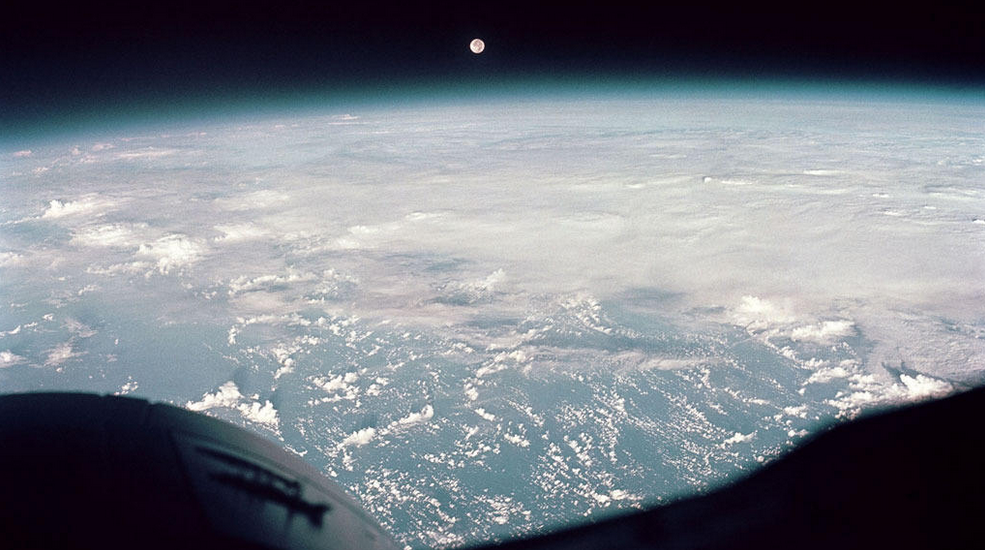
Moonrise over the curvature of the Earth.
 
Three days after launch, the mission ended in a great example of the advances America was making with computer technology. In the first fully-computerized automatic re-entry, the Gemini 11 spacecraft precisely landed only 2.8 miles from its planned position, close by the recovery ship USS Guam.
USS Guam alongside the spacecraft and recovery frogmen.
 
Gordon and Conrad on the deck of USS Guam.
 
An interesting photo I found comparing the size difference between the two-man Gemini spacecraft and the original one-astronaut Mercury space capsule. Keep in mind that the white-colored service module section behind the Gemini astronauts did not return to Earth with the capsule but were destroyed after separation and re-entry.