Showing posts with label SpaceX. Show all posts

Sunday, April 8, 2018

ISS: Expedition 55 Having a good start to Spring!

Current Spacecraft docking at the ISS. Credit: NASA.

Spring has gotten off to a good start up in Low Earth Orbit. When the Expedition 54 crew left the station on March XX, it left only three crew aboard: Expedition 55 Commander Anton Shkaplerov (Roscosmos) Norishige Kanai (Japan) and Scott Tingle (NASA). They did not have long to wait. On March 23, the reinforcements arrived on Soyuz spacecraft MS-08, docking at the Russian-built Poisk module. Joining the crew was Soyuz commander Oleg Artemyev (Roscosmos), Dr. Andrew Feustet (NASA), and Rick Arnold (NASA). Comprising the Expedition 55/56 crew, they are all veterans of spaceflight with Artemyev having already visited the ISS for six months in 2014. Dr. Feustel flew aboard shuttle Atlantis in 20009 with the Hubble Servicing Mission, shuttle Endeavor's final mission in 2011 (STS-134), and already has six EVAs to his credit. He will The Expedition 56 commander at the end of Expedition 55. Astronaut Arnold flew aboard shuttle Discovery in 2009, delivering the last set of solar panels to the ISS.
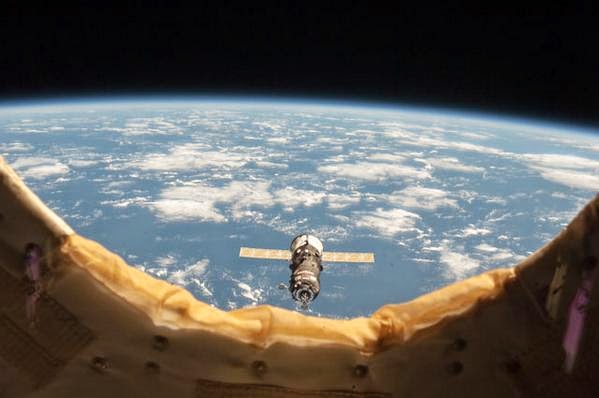
MS-08 approaches the station.
 
Nice view of MS-08 passing below the already-docked Progress cargo spacecraft.
 
 The last week of March was a busy one for the full crew. On March 28, ISS crewmembers closed the hatch on Progress 68P, having removed all its cargo and replaced the cargo with trash and waste items. The Progress ship undocked from the Russian-built Pirs module and was maneuvered into a lower orbit. Russian ground controllers are using the craft for some engineering tests, until they are ready to de-orbit the craft on April 25 and let it burn up over the Pacific Ocean.

Progress 68 just getting ready to undock as the ISS flies over the Atlantic Ocean.
 
The next day, March 29, two of NASA's astronauts went outside for a spacewalk, the fourth of the year. Astronauts Feustel and Arnold performed an EVA for a little over six hours, replacing worrisome cables on a cooling system, installing a TV camera, and placing a new communications antenna on the US Tranquility module. 
Drew Feustel on his March 29 EVA. This makes 7 EVAs in his career.
 
With the spacewalk completed, astronauts began preparing for their next visitor. On April 2, SpaceX launched another resupply mission to the ISS using the Falcon 9 re-usable rocket and the Dragon cargo spacecraft. Mission CRS-14 brings the station a plethora of science equipment as well as consumables and regular maintenance items. Dragon reached the station and docked on April 4 to the US Harmony module. It will remain on the station until May.
Dragon CRS-14 approaches the station over the magnificent colors of our planet.
 
 Next big event for the station crew will be the end of Expedition 55 in April.


Thursday, September 21, 2017

Last of the Summer ISS Traffic

Space Voyagers prepare to bard their spacecraft. Top to bottom: Alexander Misurkin, Joe Acaba, Mark Vande Hei.
 
As we approach the time for summer to transition to fall, one spacecraft arrived at ISS while another took its leave. Soyuz MS-06 lifted off from Baikonur on Tuesday, carrying the second half of the Expedition 53 crew. The Soyuz was piloted by Soyuz commander Alexander Misurkin (Roscosmos), and flight engineers Joe Acaba and Mark Vende Hei both of NASA. Both Misurkin and Acaba are veterans of previous space missions. Vande Hei is making his first trip into space. The crew will stay aboard the International Space Station for five and a half months, eventually becoming the lead half of Expedition 54.

Soyuz rocket departs at night from Baikonur.

The crew joins Expedition 53 Commander Randy Bresnik and flight engineers Sergey Ryazanskiy (Roscosmos) and Paolo Nespoli (ESA). As well as working on over 200 experiments in the next half year, the team is preparing for three spacewalks during October. 
After undocking, the Dragon gently moves away from the ISS before commencing re-entry procedures.
 
On the 17th, the SpaceX Dragon unmanned cargo ship undocked and was moved awy from its berth by the robotic arm, under the control of astronaut Bresnik. Once at a safe distance, ground engineers fired the descent thrusters and slowed the craft for re-entry. Splashdown in the Pacific off of California took place at 10:14 a.m.  This had been the 12th resupply mission with Dragon for SpaceX.

Space Station parking before the Dragon left the station.

Sunday, June 4, 2017

ISS: Cargo and Crew Transfers Underway

Soyuz MS-03 undocks from the International Space Station. A Progress Supply ship is docked in the background. (Credit: NASA)

On June 2, Soyuz ship MS-03 departed for a return trip to Earth. Rather than the usual three crewmembers, this trip only included two: Oleg Novitskiy (Roscosmos) and Thomas Pesquet (ESA). 
Before the departure, a Change of Command ceremony took place.
Peggy Whitson turns over command of the station to Fyodor Yurchikhin. (Credit: NASA TV)

On June 1st, Expedition 51 officially ended when astronaut Peggy Whitson gave command to cosmonaut Fyodor Yurchikhin. With the ceremony completed, the Expedition 52 period did not officially begin until Novitskiy and Pesquet departed for Earth. The two had 196 days in space before leaving on Friday. Crew reinforcements for Expedition 52 will arrive in July.
From L-R: Novistkiy, Whitson, Pesquet. (NASA)
 
 
Computer simulation of Soyuz module separations during re-entry process. The crew is located in the center module, which has the heat shield. The service module and crew docking module burn up during re-entry.
 
Touchdown! Soyuz MS-03 safely lands after firing landing thrusters activate during the final few moments of descent. Landing took place in Kazakhstan.

Meanwhile, there is a resupply mission ending and another one beginning. SpaceX was due to launch a special resupply mission on Friday, but had to postpone for a day because of lightning concerns at the launch site. This mission (CRS-11) would feature the first use of a reusable Dragon cargo ship. Ship number C-106 was last used on mission CRS-4 in September of 2014.


Falcon-9 rocket lifts off from LC-39A at Kennedy Space Center, FL. (Credit: SpaceX)

Actual launch of mission CRS-11 took place Saturday June 3. The Falcon 9 rocket took off flawlessly and after ten minutes separated from the Dragon spacecraft, which continued its flight into orbit. The rocket itself however, descended by parachute and engine power to land vertically back at Kennedy on pad LC-13. With a safe landing, the rocket can be refurbished and prepared to be reused on another future flight.

Cygnus resupply spacecraft. (NASA)
 
While Dragon makes its way to the ISS, another ship is leaving. Early Sunday morning, astronauts Jack Fischer and Peggy Whitson used the station's CanadArm robotic arm to pull the undocked Cygnus spacecraft OA-7 (Named John H. Glenn) from its berth and release it. This move comes a month earlier than scheduled, in an effort to reduce the future workload for the crew. The Cygnus will now move away from the station, and spend a week doing experiments under control from ground flight engineers. The John H. Glenn will deploy several small satellites on Thursday, and after experiments are completed, the craft will de-orbit and burn up over the Pacific Ocean on June 11.


Sunday, January 15, 2017

SpaceX Falcon Returns to Flight

Falcon 9 rocket on the pad at Vandenberg AFB. Credit: SpaceX.
Last September in 2016, a Falcon rocket exploded during a pad engine test, prompting a cancellation of SpaceX flights until the cause could be determined. Engineers eventually discovered the fault was in a construction error in the second stage liquid oxygen tank. With the corrections having been completed, a new rocket was prepared for the launch of a series of communications satellites.
Blast off from California. Perfect launch.
Credit: SpaceX.
Shortly before 10 am (Pacific time), SpaceX launched the Falcon 9 rocket carrying 10 Iridium satellites from its pad at the Vandenberg Air Force Base on the California coast. The first stage separated on time and the second stage carried the swarm of satellites into their planned orbits.

Touchdown! Falcon first stage lands on a barge in the Pacific. Credit: SpaceX.
As usual, SpaceX continues its mission to perfect landings of the rocket first stage, so it can be used again later. This time the rocket stage landed in the Pacific Ocean, on the landing barge named "Just Read The Instructions." This was the first successful landing in the Pacific. Four have landed in the Atlantic on board the landing barge "Of Course I Love You." Another successful landing took place in Texas on land.
You can read more details about this mission at NASASpaceflight.com at https://www.nasaspaceflight.com/2017/01/spacex-return-to-flight-iridium-next-launch/

Monday, September 5, 2016

Falcon Explodes on Pad; Satellite Destroyed

Explosion begins just below the payload section on the Falcon 9 rocket. Credit: SpaceX

SpaceX suffered a dramatic setback Thursday September 1st when its Falcon 9 rocket exploded on pad SLC-40 at Cape Canaveral. The payload, a communications satellite for Israel designated AMOS-6, was vaporized in the blast.  The explosion occurred during a firing test, when an unexplained detonation occurred in the 2nd stage liquid-oxygen (LOX) tank. SpaceX engineers worked diligently to put out the fires and secure the facility. According to reports in NASASpaceflight.com, SpaceX claims the explosion happened while fuel was loading into the LOX 2nd stage tank, at about 7:07 am Mountain Time. This is the second lost mission for SpaceX in 2 years, and there are many questions being raised about what went wrong while investigators do their best to find out why this tragedy happened.

The AMOS-6 payload section before the LOX fuel loading. Credit: SpaceX.
 
AMOS-6 was a communications satellite built by the Israeli firm Israel Aerospace Industries. It was supposed to take the place of the worn-out AMOS-2 satellite, at an orbital height of 22,000 miles.

Sunday, April 10, 2016

SpaceX Scores New Firsts with Dragon Launch


Dragon spacecraft being grappled with CanadArm2 robotic arm at the station. Credit: NASA

This weekend, SpaceX added to its list of firsts when the Dragon cargo spacecraft docked with the International Space Station. To begin with, the rocket was the new Falcon 9 "Full Thrust" version which replaces all Falcon 9 launches now. The modified thrusters enable the second stage to fire longer, allowing SpaceX engineers to attempt more first stage recovery attempts. 
Dragon CRS-8 with aerodynamic fairings ready for launch. Credit: SpaceX.
 
Liftoff occurred at 4:43p.m. EDT from the Launch Complex 40 at Cape Canaveral Air Force Station, Florida. The flight went very well, with clear visibility and great telescopic views of the stage separation. The previous Falcon 9 and Dragon launch ended in disaster, as the Dragon spacecraft was lost and the returning first stage was destroyed in a landing attempt. 
Liftoff from LC-40, the same launch pad that saw dozens of Titan 3 and Titan 4 rockets lift off, including a flight of the Cassini probe to Saturn. Credit: SpaceX.
 
SpaceX has tried four times previously to land the first stage of the rocket on a barge out at sea, with all four being losses of the rockets and damage to the barge. This fifth experiment was a total success, as having delivered the second stage and Dragon into an orbital trajectory, the first stage fell to its designated landing location, then re-ignited the engine for a controlled descent. It was obvious on the monitors that the seas were somewhat choppy and that there was a good cross-wind blowing (for this rocket, any wind is a cross-wind!). 
View from the observer aircraft as the Falcon first stage descends towards the tiny landing barge. Credit: SpaceX.
 
 The Falcon stands successfully on the pad with the engine deactivated and legs completely deployed. Credit: SpaceX
 
Although the commercial company Blue Origins was the first to successfully land its Alan Shephard rocket upright after a test flight in Texas (and they've done it 3 times now!), SpaceX had the harder task as the Falcon flies higher and faster to place its spacecraft into an orbital trajectory. And to land the stage in a moving, choppy sea on a tiny barge is just outright fantastic flying.
Dragon approaches the ISS. Credit: NASA.
 
Meanwhile, in space, the Dragon cargo spacecraft reached orbit and began its chase to rendezvous withe the International Space Station. Over a two day period, the Dragon re-ignited its engine to change altitude and maneuver closer to  the station. Eventually on Sunday morning, the spacecraft came within range for astronauts Tim Peake and Jeff Williams to extend the CanadArm2 robotic arm and grapple the craft, guiding it to berth at the Harmony module.
Dragon at left is seen in the same view with the Cygnus spacecraft (middle) and a Soyuz spacecraft (on the far right). Credit: NASA.
 
With the Dragon docked, it also set a first as the first time it has been docked to the ISS at the same time as the Cygnus cargo spacecraft! Together with the Russian Progress robotic spacecraft, the three ships are able to bring quite a tonnage of supplies and equipment to the ISS. Of the three craft, however, only the SpaceX Dragon can safely return materials and experiments to the surface of the Earth.

Wednesday, January 20, 2016

Another Falcon Sea Landing Crash

A little bit of SpaceX humor written onto the landing barge off the Pacific coast. All pictures credit: SpaceX.
 
On Sunday Jan. 17, SpaceX launched a Falcon 9 rocket from its launch site at Vandenberg, California to place the Jason 3 satellite into orbit. This version of the Falcon was the last of the designated version 1.1 modifications, a stretched and re-engined Falcon 9. These versions have been flying since 2013. The next flights will be the Falcon 9FT, or "Full Thrust," which was most recently used in December 2015.
SpaceX launch site at Vandenberg AFB, California.
 
Last view of the Falcon 9 as it flies through low clouds.
 
 
Jason satellite program.
 
The Jason-3 satellite is a multi-program partnership between NOAA, NASA, EUMETSAT, and CNES. The multinational experiments will study sea surface topography, mainly sea surface levels. An additional experiment will study the radiation environment around the satellite.
Falcon slowing to touch down on the barge landing pad.
 
The Jason-3 spacecraft was successfully launched into orbit. Following separation, the Falcon 9 first stage descended slowly towards the recovery zone. Although SpaceX had made a totally awesome landing on a land recovery pad in December, Engineers were attempting to make the first successful sea landing on this attempt. Everything looked great right up to touchdown, when after landing one of the legs failed to lock in position, and the rocket toppled over onto the pad. Engineers suspect the heavy fog contributed to condensation which may have iced over and interfered with the lockdown.
Not successful at sea, yet.


Tuesday, December 22, 2015

Success for SpaceX and Falcon 9!

Falcon 9 after touching down on the Cape Canaveral landing site. Credit: SpaceX.

Happy congratulations to SpaceX and the Falcon 9 team! On Monday night, SpaceX launched the newest version of the Falcon, the Falcon 9 Full Thrust, with a payload of eleven Orbcomm communications satellites aboard the payload stage. An earlier attempt Sunday was cancelled due to weather concerns, but this time the rocket took off perfectly and sent the payload stage into orbit, successfully releasing the constellation of satellites.
View of landing Falcon 9 from hovering helicopter. Credit: SpaceX.

SpaceX also broke a new record by returning the first stage Falcon 9 back to the Cape Canaveral launch location and the newly- refurbished pad LC-13. That launch site was previously used in the 60's and 70's to launch Atlas missiles and Atlas-Agena rockets carrying satellites, and was last used in 1978. The launch tower and blockhouse were later demolished and the site declared a historic landmark. SpaceX recently leased the site from the Air Force and prepared it as a landing site for re-useable Falcon first stages. Previous attempts to land the Falcon were carried out at sea on landing barges, and all resulted in crashed rocket stages. This was the first attempt to return to land, and was successful as the pictures show. Prior to this, Blue Origin successfully landed a sub-orbital launched New Shephard rocket. The SpaceX success was more complicated, as this effort was a launch into orbital space.

Saturday, April 18, 2015

SpaceX CRS-6: Good and Bad News

Dragon CRS-6 approaches the ISS.

On Friday, SpaceX's Dragon cargo spacecraft on mission CRS-6 arrived at the International Space Station. After docking with the station's HArmony module early in the morning, the crew began the procedures that would eventually equalize the cabin air pressure and allow unloading to begin on Saturday. The Dragon brings over 2 tons of supplies and science equipment to the station. One of the new items is a space-adapted Expresso coffee-making machine, which brings just that much more civilization to our outpost in space.

Falcon attempts a vertical landing on the SpaceX barge in the Atlantic.

With the Dragon spacecraft safely on its way to the ISS on launch day (Tuesday) the rocket that propelled Dragon into orbit was involved in another experimental landing. SpaceX has been working hard to develop new technology for the Falcon rocket that would allow for a powered, vertical landing. A successful landing system would enable SpaceX to reuse most components of the rocket, thus lowering the cost of delivering payloads to space. In this test, the Falcon 9 rocket descended as planned to a floating landing pad built on a barge placed out in the Atlantic Ocean. The rocket thrusters fired as planned, and the rocket slowed and began orienting itself for an upright touchdown. At the last moment, however, the rocket tipped over, and the resulting explosion is obvious. 

The rocket explodes after crashing on the pad.

SpaceX will begin repairs to the barge and further tests on the Falcon 9 landing system will continue.

Wednesday, April 15, 2015

SpaceX launches Dragon Resupply Craft to ISS

Liftoff! Dragon soars aboard a Falcon 9 rocket from LC-40.

After a one day delay caused by encroaching thunderstorms, SpaceX tried again and successfully launched a Dragon spacecraft to the ISS. Liftoff occurred at 4:10 p.m. EDT from Launch Complex 40 at the Cape Canaveral facility in Florida. The mission designation is CRS-6, as it is the sixth SpaceX resupply mission to the International Space Station. The robotic craft carries about two tons of supplies and experiments, many of which support the mission of astronaut Scott Kelly who is spending an entire year in space. Scientists are using his trip as a grand study of trying to understand what will happen to astronauts undertaking a long trip to Mars one day.

CRS-6 will reach the station in two days, and will spend about five weeks docked to the station.

Wednesday, February 11, 2015

5th Dragon Cargo Ship Returns to Earth

Released from the Robotic Arm on the ISS, Dragon floats free to a safe point where it can fire thrusters. 

The fifth Dragon resupply mission to the International SPace Station (ISS) has come to a successful conclusion. In all, the Dragon space ships have made six stops at the ISS, but the first was a test mission. Of all the various cargo ships that service the station and its crew, Dragon is the only one that returns large quantities of used equipment and experiments back to the Earth for study. All the other robotic supply ships burn up during re-entry, and are usually loaded with trash or non-useable equipment.

SpaceX's Mission Control in California.

Early Tuesday afternoon, astronauts supervised the undocking of the craft from the Node 2 hatch. Using the robotic arm, they gently moved the craft away from the docking port and away from station modules and panels. The craft continued floating away as the arm gently released its grip at 2:09 p.m. Eastern time. Once the Dragon had floated to a designated safe distance from the station, ground flight controllers fired thrusters for three de-orbit burns that guided the spacecraft to a landing site in the Pacific Ocean off the coast of Baja California, splashdown occurring at about 7:44 p.m. Eastern. Awaiting them was SpaceX's recovery ship, where the craft was pulled from the water and is being taken back to Los Angeles followed by a trip to the Texas processing facility.

Dragon floats down to a watery landing.

Monday, January 12, 2015

SpaceX Launch Success and Failure

Dragon (center) docked at the US Harmony module on the ISS. NASA pic.

SpaceX conducted another successful mission to send the unmanned Dragon cargo spacecraft to the International Space Station. The Falcon 9 rocket carrying the Dragon blasted off from Cape Canaveral's  Launch Complex 40 in Florida, lifting off at 4:47 a.m. Eastern time. It was originally scheduled to launch last Tuesday, but a small mechanical problem. After a two and a half minute ascent, the first stage separated and the second stage propelled the Dragon into orbit.

Current configuration of spacecraft docked with the ISS. NASA illustration. Parked spaceships represent American (Dragon), European (ATV), and Russian (Progress) unmanned cargo ships and two Russian manned spacecraft (Soyuz).

The Dragon was carefully maneuvered through orbiting thrusters to rendezvous with the ISS, where astronauts used a robotic arm to grapple the craft and pull it to the docking hatch, where docking was achieved just after 6 a.m. Mountain time this morning. Astronauts will carefully equalize the pressures in the craft and the iSS and will later begin unloading cargo and supplies. Meanwhile, ground engineers from SpaceX will be checking out the craft's systems and reviewing flight performance. You can read a very detailed account of the launch and docking at NASAspaceflight.com.

SpaceX illustration of the Falcon 9 first stage in powered descent.

Although the flight of the Dragon went well, the return of the Falcon 9 first stage did not end well. This flight was also an experiment by SpaceX, in which the first stage would slow descent and use landing engines to soft land on the pad of a specially constructed SpaceX recovery ship out in the Atlantic Ocean. SpaceX has had several successful test flights where the stage returned to a land based pad in Texas, extending landing legs and touching down softly on the pad. This was to be a first attempt to do so on the recovery ship. However, the stage made its approach a bit too fast and ended up being severely wrecked on the ship pad. SpaceX will analyze the attempt and make new corrections and try again at a later date.

Thursday, October 30, 2014

Cygnus Loss Comes During Busy Week of Traffic for ISS

Dragon cargo spacecraft attached to ISS CanadArm robotic arm. About to let go and drift free of the station before de-orbiting. Credit: SpaceX.

Tuesday's spectacular destruction of the Orbital Science Antares rocket and Cygnus spacecraft happened during a busy week of transitions at the International Space Station. The crew of Expedition 41 had seen an eventful October so far with three spacewalks. The crew has begun preparations for an eventual rearranging of the station's docking modules, readying for the time when commercial spacecraft will be arriving with regular ferry flights transferring astronauts between Earth and the station. New experiments are arriving, old ones are being returned to Earth of discarded, garbage is being removed, and supplies building up.

The Dragon spacecraft floats down via parachute to a watery recovery off the coast of Baja California. Credit: SpaceX

Currently there is a regular fleet of unmanned spacecraft that come and go at the ISS bringing supplies or removing equipment and garbage. The only one that actually returns to Earth is SpaceX's Dragon. On Saturday, the Dragon undocked from the station loaded with returning equipment and science experiments and samples, and made a safe splashdown in the Pacific Ocean for a speedy recovery.

A Russian Progress cargo ship undocks and moves away from the ISS. This one happens to be an earlier Progress 35 mission.

On Monday, while the Cygnus "Deke Slayton" spaceship waited for liftoff (which was scrubbed Monday due to an intruding boat near the launch site), The Progress 56 mission spacecraft undocked from the ISS loaded with garbage and waste. It would burn up in the atmosphere upon re-entry. The departure cleared the way for a new ship to dock at the Pirs module.

Spacecraft docked at the ISS on October 27. Cr: NASA.

After the departure of the Progress 56 craft, there remained two Soyuz crew spaceships and the European Space Agency's ATV-5 cargo ship. Recently, the ATV-5 engines were used to move the station away from a potential collision with space debris.

Then the Cygnus flight was cancelled, unexpectedly.

Pad 0A at Wallops Island, Virginia. Wreckage of the spacecraft is being examined and cleared.

It will take weeks to analyze what exactly happened to the Antares rocket. There is, of course, damage to the pad, the buildings and equipment around the pad, and to a nearby sounding rocket launcher as well.

And then it was back to business!

Soyuz rocket lifts off with the Progress 57 mission.

Early Wednesday, the Russian space agency launched a Soyuz 2-1A rocket from Baikonur in Kazakhstan. This rocket variant replaces the usual Soyuz-U, and uses new engine types. The launch was good, and the Progress M-25M spacecraft (designated Progress57 by NASA) headed into orbit on a six-hour trip to the ISS.

Progress approaches the station.

Progress slowly approaches towards the Pirs module.

Progress almost ready to dock.

Exactly six hours after launching, the Progress spacecraft docked with the ISS bringing supplies of fuel, air, water, propellant, and scientific equipment. Progress 57 will stay docked for the next 6 months. The Progress 56 spacecraft, still in orbit, will be performing ground-controlled engineering tests in orbit until commanded to de-orbit and burn up in the atmosphere.