Showing posts with label Orbital Sciences. Show all posts

Thursday, October 30, 2014

Cygnus Loss Comes During Busy Week of Traffic for ISS

Dragon cargo spacecraft attached to ISS CanadArm robotic arm. About to let go and drift free of the station before de-orbiting. Credit: SpaceX.

Tuesday's spectacular destruction of the Orbital Science Antares rocket and Cygnus spacecraft happened during a busy week of transitions at the International Space Station. The crew of Expedition 41 had seen an eventful October so far with three spacewalks. The crew has begun preparations for an eventual rearranging of the station's docking modules, readying for the time when commercial spacecraft will be arriving with regular ferry flights transferring astronauts between Earth and the station. New experiments are arriving, old ones are being returned to Earth of discarded, garbage is being removed, and supplies building up.

The Dragon spacecraft floats down via parachute to a watery recovery off the coast of Baja California. Credit: SpaceX

Currently there is a regular fleet of unmanned spacecraft that come and go at the ISS bringing supplies or removing equipment and garbage. The only one that actually returns to Earth is SpaceX's Dragon. On Saturday, the Dragon undocked from the station loaded with returning equipment and science experiments and samples, and made a safe splashdown in the Pacific Ocean for a speedy recovery.

A Russian Progress cargo ship undocks and moves away from the ISS. This one happens to be an earlier Progress 35 mission.

On Monday, while the Cygnus "Deke Slayton" spaceship waited for liftoff (which was scrubbed Monday due to an intruding boat near the launch site), The Progress 56 mission spacecraft undocked from the ISS loaded with garbage and waste. It would burn up in the atmosphere upon re-entry. The departure cleared the way for a new ship to dock at the Pirs module.

Spacecraft docked at the ISS on October 27. Cr: NASA.

After the departure of the Progress 56 craft, there remained two Soyuz crew spaceships and the European Space Agency's ATV-5 cargo ship. Recently, the ATV-5 engines were used to move the station away from a potential collision with space debris.

Then the Cygnus flight was cancelled, unexpectedly.

Pad 0A at Wallops Island, Virginia. Wreckage of the spacecraft is being examined and cleared.

It will take weeks to analyze what exactly happened to the Antares rocket. There is, of course, damage to the pad, the buildings and equipment around the pad, and to a nearby sounding rocket launcher as well.

And then it was back to business!

Soyuz rocket lifts off with the Progress 57 mission.

Early Wednesday, the Russian space agency launched a Soyuz 2-1A rocket from Baikonur in Kazakhstan. This rocket variant replaces the usual Soyuz-U, and uses new engine types. The launch was good, and the Progress M-25M spacecraft (designated Progress57 by NASA) headed into orbit on a six-hour trip to the ISS.
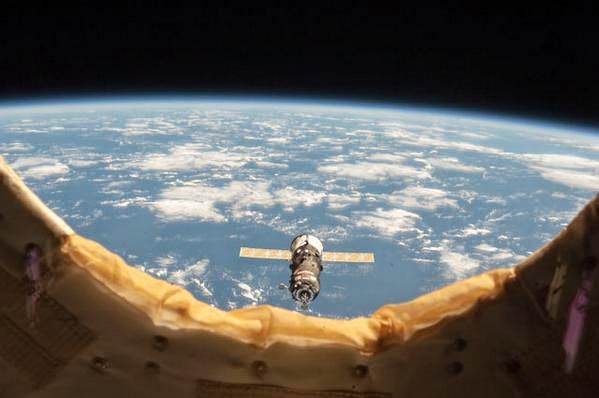
Progress approaches the station.

Progress slowly approaches towards the Pirs module.

Progress almost ready to dock.

Exactly six hours after launching, the Progress spacecraft docked with the ISS bringing supplies of fuel, air, water, propellant, and scientific equipment. Progress 57 will stay docked for the next 6 months. The Progress 56 spacecraft, still in orbit, will be performing ground-controlled engineering tests in orbit until commanded to de-orbit and burn up in the atmosphere.

Sunday, August 17, 2014

ISS Summer Summary

ISS robotic arm just prior to releasing the Cygnus resupply ship. The dotted-line object is the side view of the Cygnus' solar panels, seen exactly edge-on.

It may not be the calendar end to summer, but students all over the USA know good and well that their summer vacation is over and they are heading back to school. And I am finished this year with company business travel, so it's time to get back to commenting on the rubble in space seen from my Space Bunker in Utah. Since my last post at the end of July, what's up with mankind's outpost in Earth Orbit?

Just hours ago, the Cygnus robotic cargo spacecraft burned up in re-entry into the Earth's atmosphere. It's been a busy 6 weeks of comings and goings for Expedition 40 up on the International Space Station. Back in June, both the SpaceX and Orbital launches had been postponed. ANd the new Russian Angara rocket had suffered a launch glitch on the 27th. On July 1st  a launch of a NASA Delta 2 was scrubbed when a problem developed with a sound-suppression system. At least India had success with the launch of a Polar-orbit rocket carrying 5 satellites.

The next day NASA's Delta 2 took off and launched a carbon-dioxide research rocket into space. And the rockets kept on flying. The Russians were next.

The Rokot lifts off from Plesetsk with 3 communications satellites. RIA Novosti.

The Russians had a series of launches starting with the launch of a light-carrier class Rokot from the Plesestk space center on July 4th. Then on the 9th, a Soyuz rocket lifted off from Baikonur with a weather satellite and a couple other payloads. Finally, the new Angara rocket had a successful launch.

Angara on the pad at Plesetsk. RIA Novosti.

The first flight of the Angara on July 9th from Plesetsk lifted a dummy payload into space to test the rocket systems. The Angara is meant to supplement the Soyuz rocket type launches and relieve the burden of launches only a Soyuz can perform, though it is not man-rated. To show off the demand for the Soyuz rocket, another one was launched on the 10th from the French space Center in French Guiana placing 4 communications satellites into orbit. 

Antares lifts off.

On July 13, Orbital Sciences launched its Antares rocket from its facility on Wallops Island, Virginia to place the Cygnus cargo craft on a path to the ISS. Close behind, SpaceX launched a Falcon rocket placing 6 ORBCOMM satellites into orbit on the 14th. On Wednesday, the Cygnus cargo craft docked with the ISS.

Docking for the Cygnus with help from the CanadArm robotic arm.

Carrying food, oxygen, and supplies from Earth, the Cygnus also delivered 32 micro-satellites which will be released over time by the crew of Expedition 40. The Cygnus was docked by engineers on Earth this time using the robotic arm after astronaut Commander Steve Swanson captured the craft, and secured to the Harmony module of the station. The craft is named SS Janet Voss in commemoration of the astronaut who passed away in 2012.

The launches continued. A Soyuz carried a biological research satellite into space on July 20. On the 22nd, a Russian Progress Robot cargo ship was undocked from the ISS to make a place for an upcoming resupply mission. The Progress ship was then directed to deorbit and crash into the Pacific.

A Progress cargo craft approaches the ISS. 

On Wednesday the 23rd, a new Progress craft was launched from Baikonur and arrived at the ISS six hours later. The M-24M carried supplies for the station. Once unloaded, it will eventually be filled with trash and undocked later.

Delta 4 does the job, launching into a clear blue sky. SpaceFlight Now.

On Monday the 28th, a Delta 4 carried the GSSAP classified secret satellite into orbit. The satellite, though developed in secret, will be used to do research on possible collisions in space and any potential enemy military weapons developments in space.

European control room engineers monitor the docking of the ATV to the ISS. ESA.

On Tuesday the 29th, the European Space Agency (ESA) launched the 5th and last of the ATV robot cargo ships to the ISS. It was lifted on the Ariane 5 rocket from the French space center in French Guiana, South America. It was the 60th successful launch of the Ariane 5, a remarkable achievement.

And the rockets kept flying. On August 1st an Atlas 5 blasted off from Cape Canaveral, carrying a GPS navigational satellite. On August 5th SpaceX launched a Falcon 9 rocket carrying the AsiaSat 8. On the same day, the ESA announced a remarkable success: the Rosetta space probe rendezvoused with comet 67P/Churyumov-Gerasimenko. Instead of just passing close by, the probe has matched its speed and direction and will travel with the comet, studying it from close up.

Radar imaging of the comet nucleus. ESA.

The ATV finally docked with the ISS on Tuesday the 12th. It was berthed at the Russian Zvesda module, and astronauts began unloading the cargo ship. Although it is the last of the ATV series of cargo craft, the technology from this version will be used to design and build the service module for NASA's future Orion spaceship.

Long March rocket action. Xinhua news.

China got back into the space scene on August 9th, launching a Long March 4C rocket from the Jiuquan Satellite Launch Center in Gansu Province. It carried a remote-sensing satellite. A few days later on the 12th, another Atlas 5 took off, this time from Vandenberg AFB in California, carrying its own remote-sensing satellite, the WorldView 3.

View from the ISS, Cygnus released from the station, seen just right of center.

And that brings us to the last couple of days. Orbital's CRS-2 mission was over, and the Cygnus craft undocked on Friday. The ground engineers gave the craft remote directions to de-orbit and burn up this morning as it re-entered the atmosphere.

A previous Cygnus craft disintegrates and burns up over the Pacific.

Orbital has 6 more cargo missions under the current contract, and will no doubt receive further contracts in this successful series. And with the morning's fireworks provided by Cygnus, we get back to the business of watching the business of working in space.

Tuesday, October 22, 2013

Cygnus Cargo Spacecraft departs ISS

Astronauts on ISS release the Cygnus spacecraft from the robotic arm, before ground engineers check out systems to move it away from the station. 

The first Orbital Sciences Cygnus mission nears its end as the Cygnus cargo spacecraft was removed from its docking port on the International Space Station. According to schedule, Cygnus will activate its engine Wednesday afternoon for a de-orbital burn that will direct the craft to burn up in the atmosphere somewhere far above the Pacific Ocean. Astronauts Parmitano and Nyberg were at the controls of the CanadArm2 robotic manipulator for the undocking.

Cygnus had been docked at the Harmony module since September 29, bringing 1,300 pounds of cargo and supplies to the ISS. After unloading the supplies, astronauts from Expedition 37 filled the empty space with trash and expendables which are no longer needed aboard the station. The Cygnus is not designed for re-entry, unlike the SpaceX Dragon spacecraft which remains the only way to bring cargo safely back to Earth.

This first demonstration mission has been a success, with engineers able to correct a computer glitch prior to docking in September. The next, operational, mission for a Cygnus cargo spacecraft is expected to take place in December as Orbital Sciences begins regular delivery service to the ISS. This mission has definitely helped propel the commercial side of space operations closer to NASA's goal of letting non-government operators handle the delivery of supplies, and eventually astronauts, to the outposts in space.

Sunday, September 29, 2013

Cygnus spacecraft docked to ISS

CanadArm helps Cygnus dock to ISS.

Orbital Sciences' Cygnus unmanned cargo spacecraft docked with the International Space STation this morning at about 6:44 a.m. MDT. Using the CanaArm robotic arm, ISS Expedition 37 astronauts grabbed the Cygnus as it approached to within 10 meters of the station, then gradually guided the craft to the docking port on the US-built Harmony station module.

Astronaut Karen Nyberg at the docking controls in the ISS Cupola with a great view.

With the spacecraft safely secured, astronauts will perform all required safety checks and pressurizations before opening the hatch on Monday. Once all cargo is unloaded, the craft will eventually be loaded with trash and waste and undocked, deorbited to burn up in the atmosphere during re-entry.

The successful docking of Cygnus today brings the program up to two commercial enterprises, Orbital Sciences and SpaceX, that can be counted on to provide additional supplies to the ISS. That of course means that any future stations or spacecraft in orbit of the Earth could be provided additional supplies on a regular basis, or in an emergency if it's ready. I don't think we're far off from the time when FedEx or UPS or some other delivery company will be using space orbits to make quick deliveries around the world or into space.

Now, if we can just get humans sent into space as cheaply!

You can see more pictures and a detailed description of the docking at NASA Spaceflight.com:
http://www.nasaspaceflight.com/2013/09/cygnus-second-attempt-berth-iss/

Monday, April 22, 2013

Antares Rocket Success!

NASA TV view of Antares leaving Wallops Island, VA.

Orbital Science has done it again. Creators of the Pegasus air-launched satellite rocket, the Minotaur rocket which re-uses former nuclear missiles, OS has now added the Antares satellite booster to their company's stable of privately-owned space systems. Yesterday at 3:00 pm MDT, the Antares lifted off from launch pad 0A to begin a 20-minute mission to reach orbit with a dummy payload (also known as a mass simulator).

Computer art of the Antares rocket.

NASA TV's coverage of the event was well done, including voice and video communications from the facility at the Mid-Atlantic Regional Spaceport (MARS) and mission control, computer graphics of spacecraft orientation when out of camera range, and great on-board video of the liftoff and separation of booster components. The only glitch occurred as they forgot to get a wide-view of the liftoff itself, focusing completely on the upper stage of the rocket. Thankfully, NASA photographers managed to get the missing shot:

Liftoff from pad 0A at MARS.

The Antares becomes the second privately-owned rocket to meet a successful launch in NASA's COTS program (Commercial Orbited Transportation Services program) designed to contract out resupply services to the International Space Station. Until SpaceX and it's Dragon supply craft delivered supplies recently, the effort was done by expensive government rocket programs from the US (Space Shuttle), the Russians (Progress rockets), the Europeans (ATV), and the Japanese (HTV). 


Antares before launch on pad 0A at MARS.

The Antares lifted off perfectly on time. The mission had been plagued lately with a few glitches and weather-related delays during the last week, but Sunday's launch went off without a problem. On board cameras gave great views of the main engine cut-off, the stage separations, and the release of the fairings protecting the simulated payload. Once the payload was released after reaching orbit, the payload service module used thrusters to maneuver itself out of the way, thus completed the mission's test objectives.


Rocket view during launch. Great view of the Atlantic coastline.


Rocket view of stage separation.


Camera view inside the payload fairing before fairing release.

The moment of fairing release. Great camera footage during the flight.

Second stage firing.

Tactical view of payload separation.

The next test mission for OS and the Antares rocket later this summer will replace the dummy payload with the first test version of the Cygnus supply craft. Similar to SpaceX's Dragon and other international cargo ships, the Cygnus is designed to approach the ISS and be grappled by the station's robotic arm, then directed to a space hatch at one of the docking nodes.

Celebrations in mission control.

2013 will be a year that witnesses TWO companies using private commercial services to resupply the ISS. We'll also be looking forward to more testing of the Boeing CST-100 space capsule, which will eventually take astronauts to the ISS. With the addition of Virgin Galactic's suborbital tourism program, this will be a year long remembered for the privatization of space transportation systems.

Sunday, April 7, 2013

Advances in Commercial Space

Antares rocket moves to the launch pad.

Some significant steps are being made in the effort for private companies (as in not government agencies like NASA) this week. Let's start with the imminent launch of the Antares rocket. While the attention lately has been on the obvious success of SpaceX and their Dragon capsule and Falcon rocket,  they'll soon have some competition. The Antares rocket is built by Orbital Sciences, the company which has made successful small satellite launches with the Pegasus winged rocket which is carried aloft by a large jetliner, then released and launched into low orbit. They also have made launches with the Minotaur, a small satellite delivery system based on surplus military missiles. Now, the company is pinning high hopes on the Antares, a larger rocket launched in conventional manner. 


Antares being lifted to upright position on the pad. Both Antares pics by NASA.

Unlike SpaceX's use of a pad at Cape Canaveral, Florida, the Orbital Science team has built their test launch facility at Wallops Island, Virginia on the Atlantic Coast. They are using Pad 0A, which is owned by the newly created Virginia Commercial Space Flight Authority which has named their part of the Wallops Island facility, the Mid-Atlantic Regional Spaceport. Wallops Island is famous for its use  of launching sounding rockets and small satellites into the upper atmosphere and low orbit since the early 1960's. Now, OS plans to launch the Antares into low Earth Orbit in their bid to become the second company able to deliver supplies to the International Space Station. Eventually they want to launch satellites weighing up to six tons into Earth orbit. You can read all about the upcoming launch, scheduled for April 17-18, at SpaceFlight Now's website: http://spaceflightnow.com/

Meanwhile:

Artist creation of Boeing CST-100 capsule on Atlas V rocket. Credit: Boeing.

Hurray for Boeing! They have just recently completed the Preliminary Design Review for mating their CST-100 space capsule to the Atlas V rocket. The adapter ring will connect the wider bottom of the crew capsule's service module with the obviously narrower upper stage of the Atlas rocket.  Although just an artists view at the moment, the picture above looks so real we can easily foresee what we'll be looking at when the first test missions launch in 2017 (hopefully earlier). It's looking like Boeing may become the first commercial provider to launch not just cargo, but astronauts to the ISS. 


Spaceship 2 in a test glide releasing nitrogen gas. Credit: Virgin Galactic.

We're getting much closer to the power-up tests for the new winged spaceship that will haul paying customers into sub-orbital spaceflight. Virgin Galactic has been drop-gliding its new spacecraft recently, and recent tests have been fully fueled although the rocket motor was not ignited. Rumors say the test may come as early as this month.

You can read more about SpaceShip 2, and Boeing's progress at the website for Parabolic Arc:
http://www.parabolicarc.com/

Wednesday, June 13, 2012

Pegasus takes NuSTAR to orbit

Nose of the Pegasus rocket, with bulbous arm on top. Viewed from the carrier aircraft, the arm holds the rocket in place underneath the fuselage.

At about 10:00 am MDT this morning, NASA's NuSTAR satellite was dropped suddenly from the belly of an L1011 wide-bodied jet. Moments later the Pegasus XL rocket motor ignited, and the rocket soared up into the dark sky.

Ten a.m.? Dark sky? Well, this launch was not your typical launch. The rocket was lifted up from the Kwajalein Island runway in the pacific, while it was still dark in the early morning hours. Operations were broadcast on NASATV on UStream. The operation was managed by Orbital Sciences Corporation. Like SpaceX, Orbital is a private company making its way into space with innovative new technologies. This is not the first flight of the Pegasus, but it's use to place the NuSTAR into orbit is making news this morning.

Computer rendering of Pegasus lifting towards space.

The Lockheed L-1011 jet, designated Stargazer, lifted off about an hour before fropping the rocket. After a fall of about 5 seconds, the Pegasus blasted off toward orbit. Thirteen minutes later the NuSTAR satellite separated. NASA's TDRS tracking system soon was receiving signals from the spacecraft. Engineers will check out the systems for a week before sending the signal for the equipment to deploy.

Computer image of NuSTAR deployed.

NuSTAR is an unusual-looking spacecraft. It houses a special high-energy X-Ray telescope. When the command is given, the lens section will extend on a framework out to 10 meters. NuSTAR will discover and explore black holes, as well as galaxy clusters and super-dense dead stars. Mission control for the NuSTAR operation will be located at Jet Propulsion Laboratory (JPL).

Mission Control screen during launch. The Pegasus is boosting the NuSTAR, 
at the very left lower corner.