Sunday, April 20, 2014

Dragon Capsule Docks at ISS

Dragon spacecraft (With solar panels unfurled) docked to the Harmony Module on board the ISS.

Did the Easter Bunny arrive at the ISS on Easter morning? Well, there might be a little stuffed bunny inside, but actually it's SpaceX's Dragon unmanned cargo spacecraft that was grappled by the Station's robotic arm this morning and docked to an open port. The docking was secured at 8:06 AM MDT.

On the other side of the dock. Astronauts prepare to match atmospheres and make sure all the berthing steps have been completed, then need to equalize the pressures. Opening will occur tomorrow morning.

The third successful mission of a dragon resupply spacecraft brings about 2.5 tons of supplies to the ISS, including some new science experiments, and a set of robotic legs for the robot R2, which currently has only a torso, arms, and head.

Falcon rocket on pad Friday morning. Very overcast, weather could have posed a problem for the launch. Fortunately the launch window coincided with workable weather.

View from the other side of the pad. Blastoff went very well!

After MECO (Main Engine CutOff) the first stage fell away and the second stage boosted the payloads into orbit.

SECO (second stage Engine Cut Off) and the second stage falls away from the Dragon spacecraft.

Mission Control at SpaceX. Large crowd watching the proceedings outside the glass walls.

Coming up on the ISS: Members of the Expedition 39 crew are preparing the Russian Progress 43 spacecraft for undocking on April 23, to test out the Kurs radio navigation system, and then redock it on April 25th.  Also on the 23, astronauts will perform a 2-3 hour EVA to replace a malfunctioning computer part on the Truss.

Wednesday, April 16, 2014

SpaceX Gets the Big Pad

NASA and SpaceX officials announce historic deal next to Pad LC39A.

While I was busy posting about important events from 50 years ago, some new historic events were taking place at the Kennedy Space Center. Just before SpaceX was scheduled to launch another Dragon cargo spacecraft to the International SPace Station, NASA and SpaceX officials held a press conference to announce that the Famous LC39A launch pad would be turned over under a lease to SpaceX.  Although the launch was scrubbed due to a helium leak (rescheduled now for Friday afternoon), the historic deal means that SpaceX will now control and modify the launch pad and tower where Apollo rockets sent men to the Moon and Space Shuttles into orbit.

From Mission STS134: Shuttle Endeavor sit s on pad 39A for its last mission to the ISS.

Until now, SpaceX had been in the running against space competitor Blue Origin (which is designing a crew orbital vehicle of their own) who had teamed with ULA (United Launch Alliance, which manages rocket launches for NASA). Recently, fearing that NASA was leaning towards deciding in favor of SpaceX, Blue Origin filed a complaint with the government that their own program better matched NASA's requirements for management of the site. The government office turned down the protest, stating that NASA had not claimed a preference of approach. SpaceX won the contract.


Artist computer rendering of SpaceX Falcon Heavy rocket on 39A.

Pad 39A was originally host to the Saturn V launches of the Apollo era. The Saturn V was the heavy lift vehicle that took men and equipment to the Moon, and later placed the Skylab space station in orbit. SpaceX intends to use the pad to launch its upcoming Falcon Heavy rocket, which will be the most powerful American rocket since the Saturn V. The first test launch of the Falcon Heavy is expected to be near the end of 2015. If it does launch, it will beat NASA's own SLS rocket, also a heavy-lift vehicle, by a couple of years.  You can find out more about the Falcon Heavy here:


Tuesday, April 15, 2014

50 Years Ago: FIrst Lunar Test Vehicle Ready

LLRV in flight over Edwards AFB in 1965.

Back in 1964 on April 15, the NASA FLight Research Center received the first version of the LLRV (Lunar Landing Research Vehicle). Built by Bell Aerosystems Company, the cage-like vehicle operationally resembled the flight characteristics of the Apollo Lunar Excursion Module. On this machine, astronauts and test pilots would practice maneuvers that would be required to land the LEM on the Moon in future Apollo missions. The controls were adapted to function in Earth gravity, but feel to the pilot how engineers thought they would feel while simulating Lunar gravity. The vehicle was very unstable, and was considered one of the most dangerous craft a test pilot could ride. This was the first of two vehicles delivered.

A closer look at the LLRV. COl. Emil "Jack" Klueger was one of the test pilots who would learn to tame the beast.

Monday, April 14, 2014

50 Years Ago: Project Fire

Atlas D rocket lifting off with Project FIRE from Pad LC-12.

Fifty years ago, scientists designing the spacecraft for Project Apollo knew that the command module with three astronauts would be slamming into the Earth's atmosphere at over 25,000 mph. To understand the heat stresses on the craft's protective shield, they needed to actually plunge an object with sensors into the atmosphere at that speed and analyze the results. Project FIRE (Flight Investigation Reentry Environment) studied these effects for the various NASA spacecraft.  On April 14, 1964, NASA launched an Atlas D rocket carrying a Project Fire test object from LC12 into a 500 mile arc into space. Never intending to reach orbit, the craft separated and plunged down at a steep angle replicating the speed the Apollo capsule would be travelling. Sensors on board the experiment could then measure and define the stresses encountered and the heat effects.

Wind tunnel model of the Project FIRE experiment.

To reach the incredible speed, as the object prepared to return to Earth, and Antares II motor ignited and pushed the experiment even faster. Lasting about 30 seconds, the eventual speed of about 26,000 mph was achieved. While cameras on the ground filmed the fiery descent the craft recorded heat on the exterior at about 20,000 degrees F. After 32 minutes from launch time, the craft impacted into the Atlantic Ocean.

Sunday, April 13, 2014

50 Years Ago: Gemini-Titan 3 Crew Announced

Gemini-Titan 3 Prime and Backup crews: (L-R) Young, Grissom, Schirra, Stafford.

Fifty years ago, with the excitement of a successful test mission of the GT-1 unmanned vehicle just completed, NASA made official the names of the astronauts who would pilot the first manned mission in Project Gemini. The Prime crew would include veteran astronaut Gus Grissom and new astronaut John Young. The backup crew, who would launch in case of illness or injury to either of the prime crew before the flight, would be veteran astronaut Wally Schirra and new astronaut Tom Stafford.

NASA official portrait of Virgil (Gus) I. Grissom, with model of Gemini spacecraft.

Gus Grissom was the astronaut on board the Mercury space capsule Liberty Bell 7 when in arced over the Atlantic on the second flight in Project Mercury. His 15-minute sub-orbital flight was a success, but his spacecraft experienced a hatch jettison malfunction after landing in the water. With the capsule filling with water, Grissom was able to escape as Navy frogmen struggled to hook the craft to helicopter tow cables. Unfortunately the craft sank to the bottom of the Atlantic. After a review, Grissom was cleared from any mistakes and became one of NASA's top astronauts. He was previously a test pilot, and had flown 100 combat missions during the Korean War. He would be the first American to fly twice into space.

John Young, in Gemini-era spacesuit.

John Young graduated from Georgia Institute of Technology with a degree in Aeronautical Engineering. He served in the Navy during the Korean War and became a jet pilot afterwards. After tours of duty on aircraft carriers, he became a test pilot and finally joined NASA in Astronaut Group 2, known as the "New Nine." Young would have a very adventurous career with NASA, but his addition to the first Gemini flight came about because the original planned commander was Alan Shepherd, the first American in space, had suddenly come down with an ear and balance ailment which grounded him from flight. Tom Stafford had been planned as pilot, but with Shepherd's removal, the backup crew moved forward leaving Grissom as Commander and Young as Pilot. Wally Schirra then became the new backup crew commander working with Tom Stafford. Such is the life of a NASA astronaut.

Grissom, center, and Young, just to the right, during a spacecraft review meeting at NASA in 1964.


Friday, April 11, 2014

50 Years Ago: Gemini Program FIrst Unmanned Launch

NASA published image of Gemini Launching atop a modified Titan II rocket. The Launch tower more closely resembles the familiar tower design we would see later with the Apollo program.

Between the end of the Mercury program and the start of launches for Project Gemini, there were lots of rockets tested, satellites put into space, and experiments conducted in the upper atmosphere and Earth orbit. Then 50 years ago on April 8th, the look and feel of the new Gemini program came to life as the twin engines on the Titan II rocket roared into action. With the exhaust plume directed under the pad and to the side, cameras had a clear view of the rocket flames as the vehicle lifted off and cleared the tower. Perched on top of the rocket was a mockup of the Gemini capsule (called the boilerplate) that gave us the view of how missions would look in future launches. In the future, two astronauts would ride the rocket and no American would go into space alone again. 

Before the launch. The gantry tower, which was used to help stack the stages of the rocket together with the capsule, lowered into a horizontal position to avoid damage from the blast-off. 

Designated mission GT-1 (Gemini-Titan 1), this test mission was designed to evaluate the entire Titan II launch vehicle system, and the Gemini spacecraft integrity and compatibility with the rocket. After a perfect countdown and liftoff, the rocket staged and placed not only the capsule but also the second stage into orbit about 204 miles at its highest. OK, maybe not perfect. The vehicle faster than expected placing the craft in orbit going 14 miles faster than planned. The orbit path was not meant to last a long time, and the assembly was calculated to re-enter the atmosphere in 3 and a half days.

The next day, Titan II ICBM testing at Florida came to an end. The 33rd and final rocket launch for the USAF made a successful trip out over the Atlantic, and the ICBM portion of Titan II Research and development was completed.


Atlas V Blast-off Restarts Florida Launches

Mission NROL-67 blasts off from SLC-41 in Cape Canaveral. All pics in this post are from ULA.

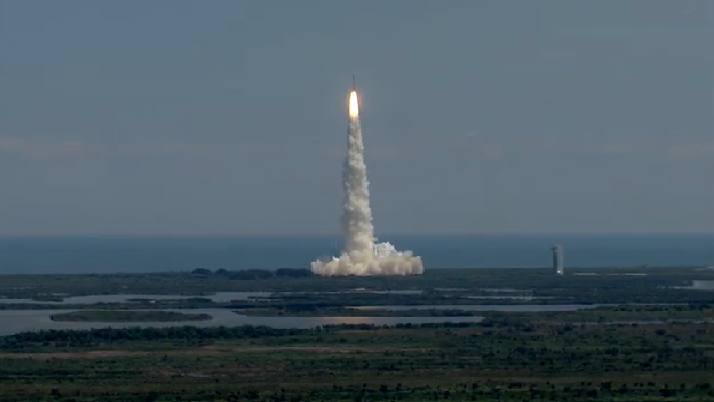
Yesterday at 1:45 PM EDT an Atlas V carrying a spy satellite lifted off without problems for an eastern flight across the Atlantic Ocean and up into geosynchronous orbit. With this successful launch, and no reported problems from the recently repaired Range radar, the launch schedule from Florida can resume. The next flight is on April 14, when SpaceX launches the Falcon rocket with its Dragon resupply spacecraft to the ISS.

Atlas V on pad SLC-41.

It was a beautiful day for a launch, and congratulations to the ULA (United Launch Alliance) team that has launched two Atlas V missions across the country from each other within about a week's time.

Ground view of the Atlas V.

View from across the inlet. Cape Canaveral and the Kennedy Space Center are surrounded by a beautiful wildlife refuge. The white tower to the left of the pad is the rocket gantry complex.

Another aerial view that really shows how the pad is surrounded by water. The Freshwater parts also include alligators!

Liftoff!

The Atlas V goes supersonic. The solid rocket boosters give a tremendous push.

With their fuel expended, the boosters are jettisoned and the rocket continues to climb using its core fuel.