Sunday, December 7, 2014

Images from the Orion Flight

Delta IV Heavy perched on pad LC37 at Cape Canaveral. On Thursday there had been higher winds than desired, and the launch was definitely scrubbed when there was a problem with one of the Core fuel valves. Liftoff reset for the next day.

Friday morning. Although overcast, conditions are fine and the launch proceeds. Excess fuel fumes burn off at the left.

Liftoff! View from the Kennedy Space Center visitors area, looking out towards the Atlantic Ocean. The Delta IV clears the tower and heads out over the ocean.

Last view of the Delta IV just before it enters the overcast layer. All engines performing as expected.

Once in the clouds, NASA TV selected between on-vehicle camera or the mission control computer simulation screen.

View from the onboard camera. You can see one of the boosters on one side and the flames at its bottom. The camera is placed on the capsule edge. Camera lens is a fish-eye lens.

Booster separation. Bright sunlight glare off the white paint of the booster. Only the core center engine is now operating.

Main engine is about to be shutdown, designated MECO (Main Engine Cut-Off). The rocket has passed Bermuda.

MECO, and the main stage has been jettisoned. 


The second stage engine is activated, heading the craft toward its first elliptical-shaped orbit.

The fairings surrounding the mock-up of the service module are jettisoned, and unseen to the camera the escape tower and capsule covering are blasted forward and away from the craft.

After the first elliptical orbit, the second stage fires again to push the craft into a highly arched ellipse which will bring the capsule back to Earth at a high-G descent to simulate the speed at which a returning capsule would reach the atmosphere from a manned mission.

The capsule has separated form the second stage and mock service module, and performs some orientation tests.

The capsule rotates to its final ready position for entering the Earth's orbit at about 8 G's.
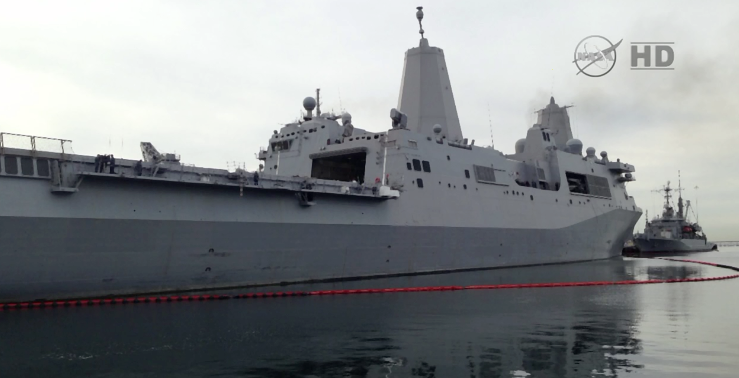
In the Pacific, off the coast of Baja California, the US Navy stands by with the recovery ship USS Anchorage. A drone circles the expected splashdown are for visual coverage, and manned speedboats and helicopters await the Orion capsule.

Orion's path through the atmosphere brought it to about 1.5 miles from it's projected splashdown site. In NASA terms, that's a bulls-eye!

After two drogue parachutes slowed the Orion down, three landing 'chutes opened to bring the Orion to a safe stop in the water. Several buoy balloons inflated to keep the capsule right-side up in the gently swelling waves. After landing, one of the chutes separated and sank, and at least one balloon failed. Recovery crew was swiftly at the capsule.

Well done NASA! Images by NASA, Nasa TV, and ULA.

Wednesday, December 3, 2014

NASA Prepares to Test Orion Capsule

Delta IV Heavy Rocket sits on the pad at Launch Complex 37.

The day is finally arriving when NASA is ready to make the first test flight for the SLS system. If all goes well, the Orion capsule test unit will be lifted into space by a Delta IV heavy rocket from Pad 37 at the Cape Canaveral complex. United Launch Alliance will handle the launch, designed to test the Orion capsule through launch, insertion into space, and then a high-G return through the atmosphere. Sensors packed throughout the capsule will monitor all phases of the flight, indicating to engineers how the project is going so far.

NASA Orion launch InfoCard. CLick on the picture to get info on how you can watch the flight.

The launch is scheduled for 5:05 a.m. Mountain time on Thursday. However, weather could interfere with the launch. There is a chance for rain and winds tomorrow, so NASA weather scientists are closely watching the situation.

You can keep up with the latest news on Orion testing at NASA's Orion webpage:

Sunday, November 30, 2014

First 3D Object Printed in Space

Expedition 42 Commander Barry Wilmore of NASA holds up the first object printed aboard the ISs by the new 3D printing machine.

"Butch" Wilmore, commander of the current Expedition 42 aboard the ISS, installed the 3D printer a couple of weeks ago on November 17th. In coordination with ground engineer teams, calibration tests were made on November 20. Finally ready on November 24, the controllers sent a command to the printer to create a copy of the faceplate of the casing of the printer. This act proves that the machine can, in fact, make some replacement parts for itself. Then the next day, Commander Wilmore removed the part and inspected it. It was discovered that the adhesion of the printed object to its production tray was very strong, more than anticipated. There is some speculation that the material's bonding may be slightly different due to the Zero-G situation. After each printed object is made, analysis will help the engineers fine-tune the device to prepare it for full operational status.

Picture of the 3D printer before launch and some of the objects that are planned to be printed in space.

The 3D printer on the ISS was designed and built by Made In Space, Inc. based in Moffat Field, California. All of the parts that will be printed will eventually be flown back to Earth for greater study. With the cancellation of the Space Shuttle, that would have been difficult due to the limitations on what can be carried down from orbit on the Soyuz return capsules. However, with the success of the SpaceX Dragon cargo spaceship, experiments and equipment can be safely returned to Earth for further studies.

Expedition 42 begins on ISS

Launch of Soyuz rocket carrying Soyuz spacecraft TMA-15M to rendezvous with the ISS. All credits NASA/NASA TV unless otherwise credited.

There was a time when the International Space Station would be manned only by a crew of three. On this Thanksgiving then, we can be thankful that despite the tensions between the NATO countries and Russia, our joint space activities still remain and we can all benefit by the use of the venerable Soyuz rocket system. On November 23, another Russian Soyuz boosted its spacecraft into a quick-rendezvous orbit designed to deliver the Expedition 42 secondary crew to the ISS. Six hours after launch from the Baikonur Cosmodrome, the TMA-15M spacecraft caught up with the ISS and was docked to the Russian Rassvet module.

Expedition 42 Crew Picture: Back, L-R is Russian Roscosmos cosmonaut Elena Serova, Exp. 42 Commander Barry Wilmore (NASA), and Russian cosmonaut Alexander Samokutyaev. Newly arrived crew in front, L-R: Soyuz TMA-15M commander Anton Shkaplerov (Russian Space Agency - Roscosmos), ESA astronaut Samantha Cristoforetti (Italy), and NASA astronaut Terry Virts.

Terry Virts has previously visited the ISS before, as the pilot of the Space Shuttle Endeavor on mission STS-130, when NASA delivered and installed the Tranquility (Node 3) module and Cupola.

Beautiful shot of the Russian Soyuz rocket on the launch pad, having just been raised to vertical position. The other arms (laying down at each side) will next be raised to support position.

After the welcome aboard ceremony the crew settled into their new quarters and joined the daily routines of maintenance, operation of science experiments, and station operations. On Thursday, however, there was a special occasion: A Thanksgiving meal.  Astronauts were able to eat smoked turkey, candied yams, green beans and mushrooms. Of course all products had been irradiated, freeze-dried, or thermostabilized! Be grateful that down here on Earth we could have gravy...

With the full crew now on board, the team will concentrate on more than 150 experiments, and preparing for spacewalks that will get the station ready for upcoming dockings with new spacecraft being built by commercial companies.

Thursday, November 13, 2014

Expedition 41 Ends, Lands Safely on Earth

Change of Command ceremony: Expedition 41 (left 3) turns over station to Expedition 42 (right 3). 

After a mission of 6 months, the Expedition team of Maksiim Surayev (RSA), Reid Wiseman(NASA), and Alexander Gerst(ESA) turned over command of the ISS to Expedition 42 on November 9. On the 10th, they boarded the Soyuz TMA-13M spacecraft and undocked from the station. A few hours later, they activated their rockets to de-orbit and re-enter the atmosphere for a safe parachute landing back on Earth.

Station view of the Soyuz spacecraft, in the distant center of picture.

Expedition 41 inside the Soyuz, with Alexander Samokutyayev of Expedition 42 at the station hatch.

The Soyuz capsule touches down in the steppes of Kazakhstan.

Recovery team, flown by helicopter to the landing site, listens to Maksim Surayev talk to reporters. Pretty cold out there, and the team has to recover to get used to Earth's gravity again. The return capsule can be seen just behind the group in the center.

Thursday, November 6, 2014

50 Years Ago: First Astronaut Fatality

Theodore C. Freeman (Captain, USAF) - official NASA portrait. 

It was an ironic surprise this weekend, when I was searching out some more events to mark the 50 anniversary of events in the space program, to learn a bit about Theodore Freeman. His passing on October 31, 1964, was the first American astronaut to die in a space related incident (flight training). He was killed when a large bird collided with his engine intake on his T-38 jet trainer, which was used by NASA for flight proficiency and quick travel for astronauts. While trying to land his disabled jet, his engine quit and his plane plunged into the ground while he attempted to avoid hitting buildings at Ellington AF Base near Houston.

Third selection of astronauts. Freeman is standing near the middle.

Freeman was born in 1930, and became a test pilot in the US Air Force. After becoming a test pilot, he applied for astronaut training and was selected in the third group in October 1963.

Freeman (foreground) and other astronauts training to eat food packs in microgravity aboard a NASA "Vomit Comet" training aircraft. Beside him is (far left) Charlie Bassett, who was killed two years later in another T-38 accident before his first space flight. Between them is Buzz Aldrin, who would later be the second man to set foot on the Moon.

Aldrin (left) and Freeman (right) training in Gemini spacesuits.

NASA T-38 training jets.

Over this last week, 50 years to the day, another test pilot was killed preparing for space flight when co-pilot Michael Alsbury died in the crash of Virgin Galactic's SpaceShip Two. 

Wednesday, November 5, 2014

SpaceShip Two Crash Probably Pilot Error

Long range camera view of Spaceship Two with twin tail booms rotating up. Credit: SpaceflightNow.com/Clay Center Observatory/Virgin Galactic.

It's a fact: right after the motor ignited, SpaceShipTwo's twin-boom tails began rotating into the position used for descending into the atmosphere from space, causing the craft to become unstable and break apart. While the possibility exists that the cause was pilot error, the chief of the National Transportation Safety Board does not want anyone jumping to conclusions. The investigations will continue for some time, and engineers and scientists will be poring over the data from the flight recorders and cameras. However, this development helps move the concern away from the motor itself.

It seems that the lever used to release the booms was activated by the co-pilot, who died in last week's crash. The pilot was able to free himself as the craft came apart, and safely parachuted to the ground. He suffered injuries from the accident and is recovering in the hospital.