Showing posts with label Orion. Show all posts

Sunday, December 7, 2014

Images from the Orion Flight

Delta IV Heavy perched on pad LC37 at Cape Canaveral. On Thursday there had been higher winds than desired, and the launch was definitely scrubbed when there was a problem with one of the Core fuel valves. Liftoff reset for the next day.

Friday morning. Although overcast, conditions are fine and the launch proceeds. Excess fuel fumes burn off at the left.

Liftoff! View from the Kennedy Space Center visitors area, looking out towards the Atlantic Ocean. The Delta IV clears the tower and heads out over the ocean.

Last view of the Delta IV just before it enters the overcast layer. All engines performing as expected.

Once in the clouds, NASA TV selected between on-vehicle camera or the mission control computer simulation screen.

View from the onboard camera. You can see one of the boosters on one side and the flames at its bottom. The camera is placed on the capsule edge. Camera lens is a fish-eye lens.

Booster separation. Bright sunlight glare off the white paint of the booster. Only the core center engine is now operating.

Main engine is about to be shutdown, designated MECO (Main Engine Cut-Off). The rocket has passed Bermuda.

MECO, and the main stage has been jettisoned. 


The second stage engine is activated, heading the craft toward its first elliptical-shaped orbit.

The fairings surrounding the mock-up of the service module are jettisoned, and unseen to the camera the escape tower and capsule covering are blasted forward and away from the craft.

After the first elliptical orbit, the second stage fires again to push the craft into a highly arched ellipse which will bring the capsule back to Earth at a high-G descent to simulate the speed at which a returning capsule would reach the atmosphere from a manned mission.

The capsule has separated form the second stage and mock service module, and performs some orientation tests.

The capsule rotates to its final ready position for entering the Earth's orbit at about 8 G's.
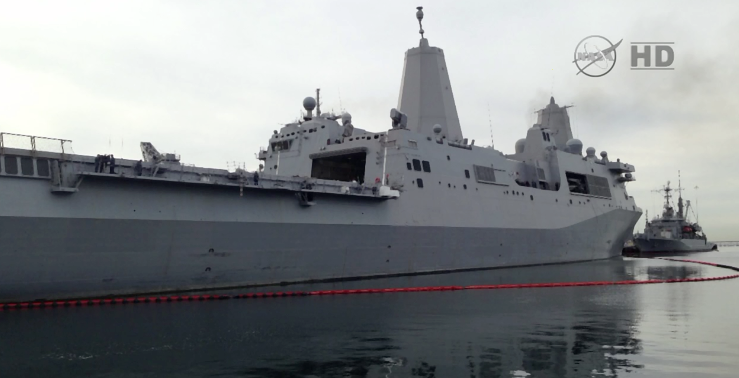
In the Pacific, off the coast of Baja California, the US Navy stands by with the recovery ship USS Anchorage. A drone circles the expected splashdown are for visual coverage, and manned speedboats and helicopters await the Orion capsule.

Orion's path through the atmosphere brought it to about 1.5 miles from it's projected splashdown site. In NASA terms, that's a bulls-eye!

After two drogue parachutes slowed the Orion down, three landing 'chutes opened to bring the Orion to a safe stop in the water. Several buoy balloons inflated to keep the capsule right-side up in the gently swelling waves. After landing, one of the chutes separated and sank, and at least one balloon failed. Recovery crew was swiftly at the capsule.

Well done NASA! Images by NASA, Nasa TV, and ULA.

Wednesday, December 3, 2014

NASA Prepares to Test Orion Capsule

Delta IV Heavy Rocket sits on the pad at Launch Complex 37.

The day is finally arriving when NASA is ready to make the first test flight for the SLS system. If all goes well, the Orion capsule test unit will be lifted into space by a Delta IV heavy rocket from Pad 37 at the Cape Canaveral complex. United Launch Alliance will handle the launch, designed to test the Orion capsule through launch, insertion into space, and then a high-G return through the atmosphere. Sensors packed throughout the capsule will monitor all phases of the flight, indicating to engineers how the project is going so far.

NASA Orion launch InfoCard. CLick on the picture to get info on how you can watch the flight.

The launch is scheduled for 5:05 a.m. Mountain time on Thursday. However, weather could interfere with the launch. There is a chance for rain and winds tomorrow, so NASA weather scientists are closely watching the situation.

You can keep up with the latest news on Orion testing at NASA's Orion webpage:

Tuesday, July 24, 2012

NASA works on new Re-Entry designs

Inflatable heat shield in test chamber.

On Monday, NASA successfully tested a new design in heat shield technology. Launched from Wallops Island Flight Facility in Virginia, the IRVE-3 (Inflatable Reentry Vehicle Experiment-3) sounding rocket took off and reached 280 miles over the Atlantic Ocean. The payload then separated and the HIAD (Hypersonic Inflatable Aerodynamic Decelerator) was inflated with nitrogen gas. 

IRVE-3 launches from Wallops Island, VA.

Screaming back through the Earth's atmosphere at 7,600 mph, the shield inflated to 10 feet in diameter and approached temperatures expected during a typical reentry from space. Parachuting into the ocean, the package was recovered and scientists began studying the data retrieved. The entire flight lasted only about 20 minutes. The science learned from these tests will help NASA make newer, better, and safer reentry shields for future space missions.

Orion parachutes deploying.

In a completely separate test, NASA engineers in Arizona completed another successful test of the parachute recovery system that will be used with the Orion space capsule. An Air Force C-17 cargo plane dropped the capsule from an altitude of 25,000 feet above the desert. This Orion was a capsule mockup, designed to have the shape and size of the eventual capsule and filled with special sensors to monitor everything related to the deceleration and impact landing. The recovery system will be used in an actual test mission from space in 2014.

Saturday, January 7, 2012

Orion Makes a Splash

Somewhere in that wall of water is the Orion test capsule.

This was the last splash test in the series for the Orion test capsule. And it was the worst case scenario. Just like NASA did with the Mercury, Gemini, and Apollo spacecraft, engineers are learning what happens to the Orion capsule when it makes its water landings. In the case of this test, the Orion was dropped to simulate both parachutes open, angling down at the wrong attitude, at a speed of about 47 mph, and rolling over.

The flying capsule will be equipped with a self-righting system. It isn't expected that the capsule will ever really experience this drastic a splashdown, but it was a test they had to make. In this test, the capsule did well, although it remained upside down after the splash.


After the splash.


Before the Test.