Wednesday, May 7, 2014

50 Years Ago: Gemini WIngs and Water Egress Training

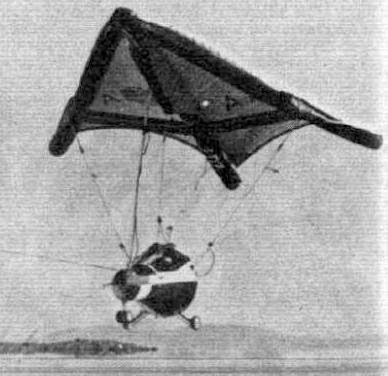
Gemini test craft with inflatable delta wing on display 1964.

Fifty years ago in April and May NASA engineers were excited to test a new concept for returning spacecraft to the ground. So far, Mercury spacecraft had returned to a watery landing via a parachute system to await pickup by the US Navy. NASA realized that a lot of money and effort could be saved if the capsule could return safely and easily to land, especially if it could touch down specifically on a runway. 

Practice landing after release from altitude.

Back in 1951, NASA Engineer Francis Rogallo and his wife Gertrude received a patent for the "Rogallo WIng" that theoretically NASA thought would replace the inflation bag meant to bouy the capsule in water. After re-entry, the heat shield would be jettisoned and the kite-shaped wing inflated and deployed. Through the early 1960,s tests were made with various piloted frames and contraptions to learn how to guide and control a craft suspended underneath one of the wings. Eventually it came to its ultimate testing with Project Gemini. Unfortunately, in 1964 NASA finally came to the conclusion that they would continue the use of parachute descent. The Rogallo Wing was not finished, however. Certainly great information was learned about the use of delta-shaped wings, and the idea of a runway-landing for a spaceship would continue to be tested but in another form. ANd the wing itself had a very popular "spinoff" which became the sport hang glider, so often seen even today around the world.

Wally Schirra training with one-man raft in indoor training facility.

During 1964 and 1965, astronauts of Project Gemini continued to train in simulators, laboratories, and even in pools and the ocean. As NASA decided against the Rogallo Wing, they continued with the planned training of astronauts for water landings. Called Water Egress, the astronauts needed to learn to exit the craft, and if necessary how to stay afloat in the water, how to use emergency rafts, and how to be picked up by helicopter.

Jim Lovell picked up by boat after training.

John Young and Michael Collins practicing water egress at sea.

Monday, April 28, 2014

ISS: Progress Spacecraft Docking Test Completed

Progress M-21M  during docking test.

I have to admit, the look of a Russian spacecraft is growing on me. Although very cramped for space travelers, and certainly with this design "form meets function," the graceful maneuvering  of a spacecraft with its parallel solar panels looking like a pair of wings is pretty cool. On Friday cosmonauts onboard the International Space Station redocked the robotic-controlled Progress M-12M spacecraft to the Russian module. Also designated Progress 53, the Russian craft had docked with the ISS back in November, bringing up needed supplies and equipment. The spacecraft sported the new KURS-NA automated docking systems, which allows for an easier r robotically controlled approach and docking. About 60 feet away from the station, the system suddenly suffered a glitch and required Oleg Kotov to use the station arm to grapple the craft and dock it manually. DUring this test, the craft undocked on April 23 just ahead of a planned EVA by American astronauts. The cosmonauts carefully ran the craft with help from ground engineers, testing maneuverability and robotic procedures. On April 25th, the tests were declared complete and the Progress redocked to the ISS. Ground engineers will spend the next couple of days studying the flight data.

SpaceX Dragon spacecraft docked to the Harmony module. Picture taken during the recent EVA.

Basically the Dragon resupply craft has a similar configuration to the Russian one, that is, with extended "wing" solar panels, a service module, and a cargo capsule. It does not have a disposable science module. The front science module on the Russian spacecraft is left over from the manned Soyuz capsule design, and in the case of a Progress mission, used for carrying more cargo. The true difference between the two designs, is that the Russian craft gets filled with waste and is then is "disposed of" by undocking it and letting it burn up during re-entry over the ocean. The Dragon capsule gets filled with items needed back on Earth, separates from the service module and is returned safely by parachute after de-orbiting.

Astronaut Steve Swanson during last week's EVA, replacing a vital computer backup system.

During the EVA last week, astronauts successfully replaced a backup computer system that would control the orientation of the solar panels of the ISS. In a short couple of hours, the astronauts again made the spacewalk look easy, despite the always-dangerous environment of outer space. 

Update: From the April 20th docking of the SpaceX Dragon. Japanese astronaut and Expedition 39 commander Koichi Wakata (in blue) and NASA Flight Engineer Rick Mastracchio use the controls of the ISS robotic arm to grapple the Dragon once it moved into position near the station. NASA publishes the best of their activity photos within a few days after the event, so I get to "revisit" the event if I want to link to the improved images. As usual, uncredited photos on this blog are usually from NASA itself.

What's next for ISS? Of course every day brings astronaut activity inside the station, maintaining equipment, exercising to fight the effects of weightlessness, performing experiments and preparing for special events. The Progress 53 spacecraft will stay at the station until June 9. On May 29 Tuesday, it's thrusters will be used to orient the station for an upcoming May 13 undocking of the Soyuz TMA-11M which will carry Mikhail Tyurin, Koichi Wakata, and Rick Mastracchio back to Earth, edning Expedition 39. COming to replace them will be Expedition 40/41 crewmembers Max Suraev, Reid Wiseman, and Alexander Gerst, who will blast off from Kazakhstan on May 28.

Thursday, April 24, 2014

50 Years Ago: 1964 New York World's Fair

U.S. Space Park at the World's Fair in 1964: Showing off American space efforts to the world.

Fifty years ago an excited world gathered in New York to see exhibits from all over the globe displayed for visitors to see, to touch, and take pictures to share with folks back home. Each participating country wanted to show off their best and brightest developments, and so it comes as no shock that the Americans wanted to show off their advancing space programs.

Centerpiece of the World's Fair: the Unisphere, which is still in that same position in New York today.

With the Mercury manned space program completed, NASA was starting Project Gemini and developing the Apollo program to land on the Moon. While the Soviets still seemed to be ahead in their space program, America was catching up and the people wanted to see more of it. The US Space Park included a full-scale mockup of the bottom section of the Saturn first stage and its five giant motors; a Titan rocket with a Gemini Capsule; an Atlas rocket with Mercury capsule; a Thor-Delta rocket; The Mercury capsule Aurora 7 flown by Scott Carpenter; a full-scale model of an X-15 research rocket plane; an Agena upper stage; a mockup of the Gemini capsule,; mockups of the Apollo COmmand and service modules and LEM lander; and more than a half dozen mockups of important space probes and satellites.

Closer view of the US Space Park displays.

Astronaut Gordon Cooper receives an award from World's Fair dignitaries. Cooper was the last of the astronauts to fly a Mercury mission.

Full-size mockup of the Saturn V first stage bottom and the 5 main engines.


Program guide cover. In the foreground is the Apollo command and service module mockup.

Model of the Fair.

Now I move off on a slightly different tangent. The 1964 World's Fair was not only noticeable for its US Space Park. Many other American manufacturers we present, showing off the latest technology and how it would impact American society. IBM, Coca-Cola, Bell Telephone, and dozens more set up exhibits, pavillions, and built buildings and entertainment rides to display their leadership in American technology. ANd some of them asked for help to make their displays more memorable. For some, they turned to the master of showmanship, Walt Disney. And Walt used the opportunity and the funding to create some truly innovative rides and exhibits. This new entertainment technology would be used later as he rebuilt them in Disneyland after the Fair closed at the end of 1965. See how many you've interacted or seen yourself, years later!

Yes, that's right - "It's A Small World" is now 50 years old this month. Sponsored by the Pepsi-COla company. If you're a fan of IASW, go have a Pepsi today.

From GE's Progressland guidebook. GE sponsored and funded the "Carousel of Progress" which featured the use of Disney's new "Animatronic" robots used in place of actors. The Carousel of Progress can be found today only in Magic Kingdom in Florida. I made SURE to ride the moving stage when I last visited there in March. 50 Years old and still awesome!

The pinnacle of animatronics. Sponsored by the state of Illinois, "Great Moments with Mr. Lincoln" was a stage show which featured parts of Lincoln's speeches. The robot stood up, moved, talked, and seemed life-like. The exhibit was quickly duplicated at Disneyland before the World's Fair ended, and lasted many years. When the Disney company closed the event, public outcry was so much that it was soon reopened with improvements. Today you can see a newer, first ever, electric Autonomotronic figure in "The Disneyland Story Featuring Great Moments with Mr. Lincoln" in the Disneyland Main Street. Lincoln can also be seen in the "Hall of Presidents" in Liberty Square at Magic Kingdom in Florida.

Excited fair-goers ride the "Ford's Magic Skyway" in an actual Ford convertible (without actual motor). The car is controlled underneath the "skyway" by a prototype of what would later become the PeopleMover ride system (which is still today in the Magic Kingdom in Florida, one of my favorite rides). 50 FOrd automobiles including Ford Mustangs moved along a track featuring scenes exhibiting full-size animatronic dinosaurs and cavemen. Those robots would be later moved to Disneyland, where they feature in a musical diorama  joining the original Grand Canyon as Primeval WOrld. The Disneyland Railroad brings passengers slowly through the exhibit while the "Grand Canyon Suite" plays in its respective scene, and the Rite of Spring music from the movie Fantasia played in Primeval World. Though the dinosaurs look dated, at the time they were as correct as they could be for 1964.

The automated car ride moves passengers into the Skyway tunnel. I haven't figured out yet why it was called a skyway.

The cars moved through the Skyway tunnel. Courtesy TheMustangSource.com.

Passengers are greeted by scenes from the world of Dinoasurs. There were several exhibits at the Fair featuring dinosaurs including life-size dinos exhibited by the oil company Sinclair, which uses a dinosaur as it's logo.

Short EVA to Repair ISS Computer

Astronaut Rick Mastracchio working on the S0 Truss segment computer.

NASA includes redundancy on many items because when something breaks in space, you can't just run down to the local Apple Store for a fix. Last April 11, during a routine check, the backup computer MDM  for the test failed. The main computer still functioned, so the crew was in no risk of losing capabilities, but the backup needed to be replaced. There are 45 MDM computers on the station and this set controlled the Truss systems as well as the mobility of the adjustable solar panels. The Truss is the framework backbone of the ISS, on which hang all the solar panels and modules. This backup computer has been working ever since this S0 section had been delivered to the station by shuttle.

As the station flew into the Earth's shadow, the astronauts had to rely on their suit lights.

No Problem. Back in 2001 the space shuttle Endeavor had brought up a spare MDM which was then stored in the US-built Destiny module. During a short spacewalk yesterday morning astronauts Rick Mastracchio and Steve Swanson floated over to the Truss segment housing the failed computer and replaced it with the spare. All systems are working fine now, and the astronauts returned in what seemed to be a very short time.


Sunday, April 20, 2014

Dragon Capsule Docks at ISS

Dragon spacecraft (With solar panels unfurled) docked to the Harmony Module on board the ISS.

Did the Easter Bunny arrive at the ISS on Easter morning? Well, there might be a little stuffed bunny inside, but actually it's SpaceX's Dragon unmanned cargo spacecraft that was grappled by the Station's robotic arm this morning and docked to an open port. The docking was secured at 8:06 AM MDT.

On the other side of the dock. Astronauts prepare to match atmospheres and make sure all the berthing steps have been completed, then need to equalize the pressures. Opening will occur tomorrow morning.

The third successful mission of a dragon resupply spacecraft brings about 2.5 tons of supplies to the ISS, including some new science experiments, and a set of robotic legs for the robot R2, which currently has only a torso, arms, and head.

Falcon rocket on pad Friday morning. Very overcast, weather could have posed a problem for the launch. Fortunately the launch window coincided with workable weather.

View from the other side of the pad. Blastoff went very well!

After MECO (Main Engine CutOff) the first stage fell away and the second stage boosted the payloads into orbit.

SECO (second stage Engine Cut Off) and the second stage falls away from the Dragon spacecraft.

Mission Control at SpaceX. Large crowd watching the proceedings outside the glass walls.

Coming up on the ISS: Members of the Expedition 39 crew are preparing the Russian Progress 43 spacecraft for undocking on April 23, to test out the Kurs radio navigation system, and then redock it on April 25th.  Also on the 23, astronauts will perform a 2-3 hour EVA to replace a malfunctioning computer part on the Truss.

Wednesday, April 16, 2014

SpaceX Gets the Big Pad

NASA and SpaceX officials announce historic deal next to Pad LC39A.

While I was busy posting about important events from 50 years ago, some new historic events were taking place at the Kennedy Space Center. Just before SpaceX was scheduled to launch another Dragon cargo spacecraft to the International SPace Station, NASA and SpaceX officials held a press conference to announce that the Famous LC39A launch pad would be turned over under a lease to SpaceX.  Although the launch was scrubbed due to a helium leak (rescheduled now for Friday afternoon), the historic deal means that SpaceX will now control and modify the launch pad and tower where Apollo rockets sent men to the Moon and Space Shuttles into orbit.

From Mission STS134: Shuttle Endeavor sit s on pad 39A for its last mission to the ISS.

Until now, SpaceX had been in the running against space competitor Blue Origin (which is designing a crew orbital vehicle of their own) who had teamed with ULA (United Launch Alliance, which manages rocket launches for NASA). Recently, fearing that NASA was leaning towards deciding in favor of SpaceX, Blue Origin filed a complaint with the government that their own program better matched NASA's requirements for management of the site. The government office turned down the protest, stating that NASA had not claimed a preference of approach. SpaceX won the contract.


Artist computer rendering of SpaceX Falcon Heavy rocket on 39A.

Pad 39A was originally host to the Saturn V launches of the Apollo era. The Saturn V was the heavy lift vehicle that took men and equipment to the Moon, and later placed the Skylab space station in orbit. SpaceX intends to use the pad to launch its upcoming Falcon Heavy rocket, which will be the most powerful American rocket since the Saturn V. The first test launch of the Falcon Heavy is expected to be near the end of 2015. If it does launch, it will beat NASA's own SLS rocket, also a heavy-lift vehicle, by a couple of years.  You can find out more about the Falcon Heavy here:


Tuesday, April 15, 2014

50 Years Ago: FIrst Lunar Test Vehicle Ready

LLRV in flight over Edwards AFB in 1965.

Back in 1964 on April 15, the NASA FLight Research Center received the first version of the LLRV (Lunar Landing Research Vehicle). Built by Bell Aerosystems Company, the cage-like vehicle operationally resembled the flight characteristics of the Apollo Lunar Excursion Module. On this machine, astronauts and test pilots would practice maneuvers that would be required to land the LEM on the Moon in future Apollo missions. The controls were adapted to function in Earth gravity, but feel to the pilot how engineers thought they would feel while simulating Lunar gravity. The vehicle was very unstable, and was considered one of the most dangerous craft a test pilot could ride. This was the first of two vehicles delivered.

A closer look at the LLRV. COl. Emil "Jack" Klueger was one of the test pilots who would learn to tame the beast.