Thursday, May 29, 2014

New Crew Joins Expedition 40 on ISS

Soyuz spacecraft faces the ISS (image from a previous mission).

Blasting off at night from Kazakhstan, Soyuz TMA-13M lifted off for a rendezvous with the ISS and the Expedition 40 crew already aboard. On the Soyuz were Soyuz Commander Max Suraev, astronaut Reid Wiseman, and ESA astronaut Alexander Gerst. The flight used the new "shortcut" orbital approach so that instead of 2 days, the capsule arrived at the station around six hours later. Docking occurred at 9:44 PM EDT and the hatches opened a couple of hours later. The new orbital approach means that it takes less time for astronauts to get to the ISS than it does for some overseas airline flights!

The full crew of Expedition 40. 

The new crew joins Expedition Commander Steve Swanson and flight engineers Oleg Artemyev and Alexander Skvortsov who had arrived March 27. The Soyuz is docked at the Russian mini-research module Rassvet. The ISS is orbiting at about 290 miles above the Earth. 

You can read complete details about the launch and arrival at: http://www.nasaspaceflight.com/2014/05/international-trio-soyuz-ride-to-the-iss/

Wednesday, May 28, 2014

50 Years Ago: Saturn 1 SA-6 Mission Success

Saturn 1 rocket mission SA-6 on pad LC-37B.

On May 28th, 1964, NASA launched the 6th test flight of a Saturn rocket from Cape Canaveral. In this case the rocket was the Saturn 1, boasting eight H-1 engines in the first stage. On this mission, the payload was not the Jupiter nose cone, but was the first "boilerplate" or test version, of the Apollo capsule.


Before the launch: Engineers prepare the "Boilerplate" capsule for the mission.

The mission for this flight was to allow over 113 sensors in the capsule to measure the stresses of flight on the spacecraft, monitoring pressures and acceleration. The capsule was not planned to separate from the stage, but would remain attached.

Dr. Werner Von Braun in front of pad LC-37B. Seeing his dream of rockets to the Moon being tested.

There had been two previous attempts to launch the rocket. The first attempt was scrubbed because of fuel contamination, the second attempt failed due to overheating the guidance system. On this third attempt, engineers discovered a flaw in the optical unit of the instrument panel, covered by liquid oxygen vapors. Engineers determined it would not impact the flight, and a go was given.


Aerial view of the Saturn stack ready for launch.

The rocket lifted off from launch complex pad 37B at seven minutes after Noon, Eastern time. The only problem in the flight occurred when one of the H-1 engines shut down early. The other motors continued to burn a bit longer to compensate. After first stage separation, the second stage ignited and ten seconds later the escape tower jettisoned.

Moment of truth: The first stage ignites.

The second stage with the Apollo test capsule entered orbit reaching up to 123 miles high. The craft managed to make 54 orbits, eventually coming down into the Pacific Ocean.


Artist's concept of the SA-6 mission. The second stage propels the rocket higher into space after dropping the expended first stage.

After examining the instrumentation records, engineers determined that a gearing piece in the H-1 engine was at fault. The gears were replaced for the next launch and no further H-1 engine failures occurred.

Tuesday, May 27, 2014

Sea Launch Success and Rocket News

Sea Launch mobile launch platform. Credit: Ria Novosti.

Time to get an overview of recent rocket launches from around the world. We'll start with today's successful launch of a Zenit-3SL rocket from the SeaLaunch floating pad from the Pacific Ocean. Sea Launch is a multi-national corporation owned by companies from Norway, Russia, Ukraine, and the United States. DEspite the current political and military crisis occurring between Ukraine and Russia, the project has gone ahead and lifted a EutelSat 3B Communications satellite into space. This was the 36th rocket launch for the company. Its last launch on February 1st ended badly as the rocket crashed into the sea soon after take-off. The cause has been pin-pointed to a faulty hydraulic oil pump.


Proton-M rocket ready for Launch from Kazakhstan. Credit: RiaNovosti.

From today's Sea Launch success, let's turn back to May 16th and the latest Russian launch embarrassment. A Proton-M rocket carrying an Express-AM4R GPS/communications satellite failed to place its payload into orbit as the second stage failed. The satellite would have been Russia's most capable comsat in space. News reports have indicated that pieces of the craft crashed near a Chinese city. The failure comes just after Russian President Putin made jokes about NASA's problems. The Proton series has experienced a number of failures since its first launches.

Delta IV lifts into the sky from Cape Canaveral. Credit: Florida Today.

The United Launch Alliance (ULA) performed a great launch of the Delta IV rocket on May 16th. Lifting off from Pad LC-37 at Cape Canaveral, the rocket placed an updated GPS satellite into orbit. The $245 million satellite will be the 31st to join the constellation of American GPS satellites. 


Atlas V on the Pad at Cape Canaveral. Credit: NASAspaceflight.com.

A week after the Delta launch, ULA performed a launch of the Atlas V rocket from Cape Canaveral's LC-41. The payload was a classified military satellite. The Atlas V uses a Russian-built RD-180 rocket engines, and the current political stand-off between Russia and the US over Russia's invasion of the Crimea has caused a potential stoppage of supplies of this engine. Russian President Putin has determined that the RD-180 is not to be used by the US for any military missions and there may be further interrupting of missions to the ISS after 2020. ULA has previously used the Delta II rocket for some military applications, but it has been discontinued with one possible flight remaining. The Delta IV launch vehicle may become the military go-to launcher if the Atlas V becomes limited to commercial flights only, but no final determination has been made.

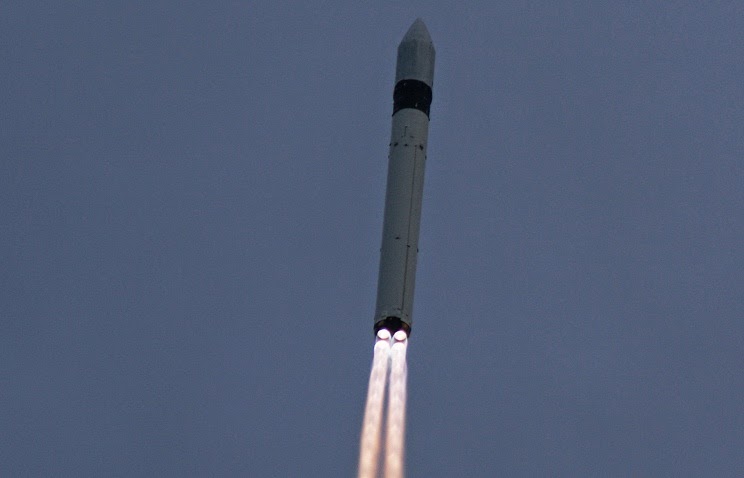
Rokot blasts off from  Plesetsk Cosmodrome. Credit: ITAR-Tass.

On the 23rd, the Russians also launched a military mission. Lifting off from the Plesetsk Cosmodrome, the Rokot booster lifted the Bris-M upper stage into high altitude before placing 3 Russian military satellites into their orbits. The Rokot is a lighter vehicle, and I'm not aware if it can lift satellites designed to work with the troublesome Proton-M rocket.

Rokot ascending. Credit: ITAR-Tass.


Japan's H2A lifts off from Tanegashima Space Center. Credit: KYODO/The Japan Times.

Finally we get to the Far East, where the Japan Aerospace Exploration Agency (also known as JAXA) launched a heavy H-2A rocket carrying the Advanced Land Observing Satellite-2. This spacecraft is designed to map regions of the Earth that suffer natural disasters and emergencies. It will also be used to study tropical rain forests, ice packs and other geological features affected by natural and man-made disasters.

Perhaps it can located trouble before the next Godzilla attack (Just kidding, no offense!).


Sunday, May 18, 2014

CRS-3 Dragon spacecraft returns to Earth

View of the Dragon CRS-3 cargo spacecraft.

SpaceX's CRS-3 Dragon mission has ended today, splashing down in the Pacific Ocean at about 1 pm MDT. It was the 4th time that the company had successfully sent an unmanned cargo spacecraft to rendezvous or dock with the ISS. Using the Canadian-built robotic arm, astronauts pulled the craft away from the docking port and gently released it on its own. The craft was then moved away from the station using thrusters. Eventually the craft spent 5 hours of free floating time  while engineers checked all systems and made sure the outer cargo doors were shut, then firing a de-orbit burn to return to the surface.

You can find a great description of the undocking and the mission of CRS 3 at:

Friday, May 16, 2014

50 Years Ago: Dedication of JPL SPace Flight Operations Facility

Inside the JPL Space Flight Operations control room.

Fifty years ago, on May 14, 1964, a dedication was held at the opening of Jet Propulsion Laboratory's new Space Flight Operations Facility. During the dedicatory remarks, NASA Associate Administrator For SPace Science and Applications, stated: "...Often in our discussions of the Space Program we refer to the 'manned program' and the 'unmanned program.' We even talk about manned space science and unmanned space science. Strictly speaking, this is loose talk. There is, in fact, no such thing as unmanned science. Man and his thinking are the prime ingredients of science.

  "In the Space Program, it becomes simply a matter of where the man is in relation to his instruments and measuring devices. For those space missions that we call unmanned, man is back on Earth while his eyes and ears and other senses are extended electronically and mechanically far out into space by the spacecraft and its instrumentation. From his remote position, he must monitor, issue commands, receive and record data, make routine or emergency decisions as required in a continuing interchange with his inanimate partner out in space.
  "It is to make this partnership effective and productive of data, measurements, obsevations, and information that a centralized facility like the SFOF is necessary..."

Congratulations to JPL on this 50th anniversary, thanks for the many incredible discoveries, and here's hoping for 50 more years of space exploration adventures!

50 Years Ago: Making Apollo Safe

Little Joe II in ascent.

Fifty years ago, engineers were doing their best to make sure astronauts could escape a fiery end to the Saturn rocket. On May 13, 1964, NASA launched a "Little JoeII" rocket which was designed to carry test versions of the Apollo Command and Service Module into a launch simulating the forces it would experience on later actual missions. In this case, the modules were a boiler-plate model, or a dimensionally-correct replica of the spacecraft which included weights and sensors for testing. The purpose of this test was not aimed at the capsule, but rather the structure perched on top of it - the escape tower. Blasting off from the White Sands missile range in California, rocket soared to 17,000 feet and then remotely exploded. In an instant, the rocket thrusters on the tower detected the failure and roared into action, separating the command module  away from the explosion and up further to 24,000 feet. At that point the tower was jettisoned and descent parachutes were deployed, returning the command module to the Earth. The entire test took only 7 1/2 minutes, and was passed successfully.

Wednesday, May 14, 2014

Expedition 39 Returns to Earth


Change of Command. Expedition 39 Commander Koichi Wakata, right, shakes hands with the new Expedition 40 Commander, Steve Swanson for the official turnover of command.

On Monday afternoon, Japanese astronaut Koichi Wakata acting as the Commander of the ISS turned over command of the station to NASA astronaut Steve Swanson. After a six-month stay in space aboard the station, Expedition 39 came to an end on Tuesday when the 38/39 crew boarded the Soyuz TMA-11M spacecraft and undocked from the station's Russian-built Rassvet module at 6:36 PM EDT. Two and a half hours later the Soyuz began its de-orbit burn to begin re-entry. 

View from the Soyuz as it backs away from the ISS.

About 50 minutes later, under a large descent parachute, the Soyuz capsule touched down on the steppes of Kazakhstan. Recovery crews landed by helicopter and assisted the crewmembers in leaving the capsule and resting while being checked by physicians.

Touchdown!

Up on the Station, Commander Swanson and his two crewmates will continue maintenance and experiment work while waiting for the next crewmembers to arrive, expected now on May 28th.