Sunday, September 13, 2015

ISS Starts Expedition 45

Scott Kelly, left, receives command of the ISS from Gennady Padalkin (in red). Picture credits NASA TV and NASA.

On Saturday, September 5, The astronauts and cosmonauts on the International Space Station held a ceremony marking the change of command from the Expedition 44 commander, cosmonaut Gennady Padalka, to astronaut Scott Kelly. Officially, the new expedition began on Sep. 11 when Padalka and flight engineers Andreas Mogensen (ESA) and Aidyn Ambetov (Kazakh Space Agency) undocked in the Soyuz TMA-16M spacecraft. 
Padalka and crew landing in Kazakhstan.

The landing complete's Padalka's fifth space mission. He now holds a record of 879 total days spent in space. The other two returning voyagers were visitors to the ISS and not part of an ISS expedition. Mogensen is from the European Space Agency, while Ambetov is the third cosmonaut to fly from Kazakhstan.  New Expedition 45 commander Scott Kelly, along with cosmonaut Mikhail Kornienko, is staying aboard the ISS for an entire year. Monday September 14 will mark the halfway-point for the long-duration mission.

Friday, September 4, 2015

And Now There Are Nine

Welcome aboard the ISS: (Front, L-R) Kazakh cosmonaut Aidyn Ambetov, Soyuz commander cosmonaut Sergei Volkov, and Danish astronaut (ESA) Andreas Mogensen.

Early this morning, at 3:39 a.m. Eastern time, Soyuz craft TMA-18M (Also designated Soyuz 44) docked with the International Space Station at the Russian Poisk module. After equalizing the atmospheres, the hatch was opened about three hours later and the crew entered the ISS.  Also aboard the craft are more radiation dose meters which monitor the amount of radiation astronauts are exposed to while in Earth orbit, and a special skinsuit designed to help with back pain as an atronaut's spine lengthens in the zero gravity.

Pictured from the ISS, Soyuz TMA-18M approaches docking.
 
Because the station has two members that are staying for an entire year, the crew of this Soyuz is not staying very long. Expedition 44 commander Padalka will leave for Earth on September 11 with Ambetov and Mogensen. They will return to Earth using Soyuz TMA-16M. Newly arrived cosmonaut Volkov will remain aboard the station for another six months, and will return with the year-long residents Kelly and Kornienko on the just-docked TMA-18M, next year in March. Expedition 44 members Lindgren, Konenenko, and Yui will stay in the station until December 2015, and they will return in TMA-17M.
The current parking situation on ISS.

Sunday, August 30, 2015

50 Years Ago: Gemini 5 Sets Record Time in Space

Official Gemini 5 mission patch.
Fifty years ago, astronauts Gordon Cooper and Pete Conrad orbited Earth in their Gemini 5 capsule. Part of the mission had been completed (precision orbit maneuvering test) and other tests were then taken care of. There were several tests of human observation of the ground and weather. They determined that you could measure cloud tops from orbit, and were successful at watching missile test launches from space. Of course, with a mission lasting longer than a week, there were medical tests to explore and review once they returned. Before the mission, NASA had decided not to name the spacecraft on missions, but the astronauts felt that a mission patch was needed and NASA granted them to design the first official mission patch. To reflect the pioneering spirit of their flight, the astronauts chose a covered wagon and placed the slogan "8 Days or Bust" on it. NASA didn't like the slogan (what if the length was not achieved?) so a piece of white cloth was sewn over the slogan for the flight. The patch became popular, and then patches were designed for the Mercury and Gemini missions which had already flown.

Navy divers assist the astronauts after splashdown.
Gemini 5 re-entered the atmosphere on August 29, 1965 and landed 80 miles off course in the Atlantic Ocean. The error was later determined to be a wrong calculation entered into the craft's tiny computer (primitive by today's standards) by an engineer before the mission. The mission length goal had been achieved, and the crew broke the Russian record of orbital duration. For the first time the American press celebrated being ahead of the Russian program for a change. 
Astronaut being lifted onto the rescue helicopter.
Capsule being hoisted onto the deck of the recovery carrier USS Lake Champlain.
The Gemini 5 capsule is today on display at Space Center Houston, in Texas.

Friday, August 28, 2015

Cosmonauts Make Ready for a Crowded ISS

TMA-16M maneuvers near the ISS.

 The crew of Expedition 44 continued their efforts to rearrange the spacecraft docked to the ISS on Friday. Soyuz commander Gennady Padalkin, along with year-long ISS residents Mikhail Kornienko and Scott Kelly, boarded the TMA-16M ship and undocked form the station late last night. In case something were to go wrong and prevent docking again, the three wore their flight spacesuits. They quickly thrusted over to the end of the Zvesda module, where they docked the spacecraft early in the morning hours. The movement of the spacecraft allows an open docking port on the Poisk module, where another crew will dock next week. When that craft arrives, there will temporarily be 9 crew members on the station.

Current arrangment of spacecraft docked at the ISS.
 
While the spacecraft shuffle continued, other crewmembers continued working on the HTV cargo module which recently arrived at the station after blasting off from Japan. 
Moving waste and trash into the emptied HTV-5 is much simpler with zero-G.

Tuesday, August 25, 2015

HTV-5 Arrives at ISS

Cargo ship in orbit just below the ISS.

Monday morning at about 6:58 am EDT, the Japanese robotic cargo spaceship HTV-5 arrived at the International Space Station and was grappled by the robotic arm. The craft had blasted off from the Tanegashima launch center in Japan last week on Wednesday.
Grapple complete. Astronauts will use the robotic arm to safely move the craft to its docking port, in order to avoid thruster gases from contaminating the surfaces of station modules and experiments.

HTV-5 (H-II Transfer Vehicle 5) carries 4.5 tons of supplies for the station. These items are critical for the station's operations, as the last year has seen the loss of three important resupply missions to ISS. In October 2014 the Cygnus vessel exploded on the pad, and this year saw the loss of a Russian Progress cargo ship and the destruction of a SpaceX Dragon cargo ship. 
Japanese Mission Control.

The HTV-5 is docked at the Node 2 docking port, where the SpaceX Dragon is normally berthed.

Friday, August 21, 2015

50 Years Ago: Gemini V launches for Long-Duration Mission

Liftoff of Gemini V on the Titan II rocket from Pad LC-19.
 
Fifty years ago on August 21, 1965, astronauts Gordon Cooper, Jr. and Charles (Pete) Conrad, Jr., blasted off from Cape Canaveral for a long-duration mission around the Earth. The main mission was to study the effects of a mission lasting the time it would take to reach the Moon and return to the Earth. They would also practice orbiting rendezvous, by launching a targeting device and practicing maneuvering with it.
The entire crew of the Gemini V mission. From left to right, Backup crew Elliot See and Neil Armstrong, and Prime crew Pete Conrad and Gordon cooper.

"Gordo" Cooper would be the first astronaut to orbit the Earth for a second time. He had previously flown a 34-hour mission in the last Mercury flight, "Faith 7" and had been the last astronaut to fly alone. During that mission he was the first American to sleep in space, and relied on his superb piloting skills as several life support and flight controls broke down or gave him difficulty during the mission. He was in command of the Gemini V mission, which would turn out to be his last flight for NASA.

Astronauts move from the transport van to the gantry elevator.
 
"Pete" Conrad was making his first flight. He was a member of the "New Nine" batch of astronauts which would go on to be the prime crews for the later Apollo missions. He had been an excellent test pilot with the US Navy, and had a sarcastic sense of humor. He often referred to this mission as "Eight days in a garbage can" due to the cramped cockpit of the Gemini capsule.
Gemini V on the pad.
 
 Service crew making final checks before closing the hatches on the Gemini capsule. This view gives a good view of the cramped quarters the astronauts would endure during the mission.
 
 
Panoramic view of the blastoff from Launch Complex 19. The launch control blockhouse is in the reinforced mound to the left. Today, that blockhouse is all that remains at the site.
 
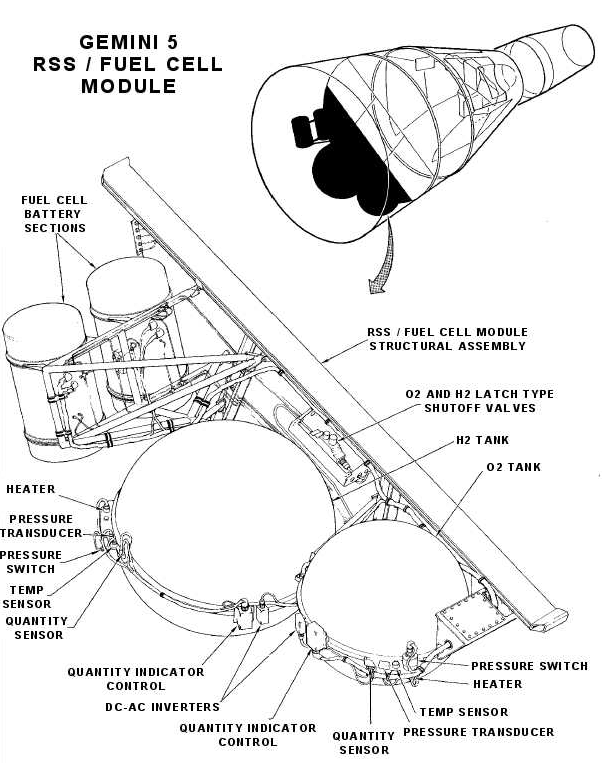
NASA diagram of the new Fuel Cells in the Gemini service module behind the capsule. The new fuel cells were a vast improvement over the chemical-reaction batteries used in previous spacecraft, and made the long-duration flight possible. 

The Radar Evaluation Pod. It was to be ejected in orbit, and used as a target for rendezvous practice.

After two hours in orbit, the crew ejected the REP (Radar Evaluation Pod). They would use the device to rendezvous with and maneuver, but Cooper detected a pressure loss in the Fuel cell. He shut it down while the craft was out of radio contact with mission control. It would mean that the rendezvous with the REP would have to be abandoned. After re-establishing contact, ground engineers calculated that the fuel cell could be turned back on and would not mean a cancellation of the rest of the mission objectives. On the ground, astronaut Buzz Aldrin calculated a new method for the orbiting crew to practice rendezvous by piloting to a fixed point in space.

Upper stage of the Titan II rocket, under recovery.
 
Down in the Atlantic, recovery crews located the upper stage of the Titan II rocket, which had kept floating due to the remaining gas in a nitrogen tank. It was recovered by the crew of the USS Dupont, and is on display today at the US Space and Rocket Center in Huntsville, Alabama. Meanwhile the crew continued on their mission to endure eight days in orbit.



 

Monday, August 17, 2015

Comet fires Thruster

Photo sequence showing the dust jet activating and then shutting down. ESA credit.

Comet 67P - Churyumov-Gerasimenko is acting like a spaceship that fires thrusters. The European Space Agency's Rosetta comet probe, currently orbiting the comet, caught a great view of a pocket of dust erupting from the surface of the comet. Since the comet itself is large, the relative movement effect of the short burst will not be very noticeable, but the spray will add to the comet's tail. Last week on the 13th, the comet reached its closest approach to the Sun (its perihelion) and will now be slowly heading towards the edge of the solar system.