Sunday, June 12, 2011

ISS Reaches new heights, docks Soyuz.

Soyuz TMA-02 on final approach to ISS.

NASA had some great footage of the docking of the Soyuz TMA-02 craft on Friday, June 10th. We could clearly see the thrusters firing as the pilot gently nudged the craft into the correct position to advance slowly and dock.


Soyuz view with data superimposed on tv image.

In fact for the first time I got a greater appreciation of just how many thruster firings are necessary to perfectly align with a docking port. At first I thought the pilot must be as bad as I am with a docking video game.

Yours Truly at Kennedy Space Center, attempting to virtually dock the Orion capsule to the ISS. MUCH MUCH harder than it looked!

Fortunately the Russian pilot was better at docking than I turned out to be. The Soyuz made a successful docking and the crew opened the hatches a couple of hours later after all systems had been set for the stay at the station.


Swallowed by the Earth's shadow, the Soyuz is feet away from the docking port.


The Gang's All Here. Expedition 28 crew is now complete.


View of Endeavour docked with ISS from departing Soyuz with Expedition 27 crew. The Eurpoean ATV "Johannes Kepler" is at the right end of the assembly.

More good news for ISS: It's orbit got boosted! During a series of maneuvers, the ATV cargo module (docked at the opposite end of the station from where the shuttle docked) used its thrusters and fuel surplus to accelerate the station and raise it into a higher orbit. This boosting will keep the station farther away from the thin traces of atmosphere which can actually cause enough drag to lower the station closer to the Earth. This boosting also means less fuel will be required to be transported to the ISS for future boosting, thus giving more room for experiments and supplies on future cargo runs to the station.

Thursday, June 9, 2011

50 YA: Discoverer XXIV Failure

Thor-Agena rocket at Vandenberg AFB, California. This was the rocket type used for the launch of Discoverer XXIV.

With the success of Alan Shepard's flight, the Space Race was really heating up. Meanwhile, the Cold War between the USA and the USSR continued at full speed. Advancements in space technology were eagerly sought by both sides to gain a military of intelligence advantage over the other. For the USA, the Corona spy satellite program still had its own teething problems. Discoverer XXIV was another in the series of secret Corona missions to fly a camera over the Soviet Union, take pictures of secret facilities, and send the film back to Earth.

Discoverer XXIV never made it to orbit.

I've been trying to find out a little more of the mission and why it failed, but no info so far. I do know that the rocket launched was a Thor-Agena B model, from Vandenberg AFB in California, on June 8, 1961 (although another date was also listed). The Corona version used was the KH-5 camera system. No reason for the failure has been found yet by me.

Wednesday, June 8, 2011

Expedition 28: Soyuz TMA-02M Blasts off for ISS

Crew Patch for mission TMA-02M.

The second half of the Expedition 28 crew lifted off in their Soyuz rocket from Baikonur at about 2:15 p.m. MDT yesterday. The crew consists of Soyuz Commander cosmonaut Sergei Volkov, NASA astronaut Mike Fossum, and Japanese astronaut Satoshi Furukawa. The rocket took off at night, making a brilliant display of rapid ascent to Earth orbit. Russian video being what it is, however, means we did not have great video of the stage separations. We did, though, get good video feed of astronaut preparations and views of the crew inside the capsule on their journey to space.


Russian Soyuz rocket on pad.

The crew started their trip with a traditional autographing of the doors of their rooms at Star City. Then, after suiting up, technicians adjusted their suits and they were transported to the pad. Notable was the presence of legendary cosmonaut Alexei Leonov, first man to walk in space. He looked to be in good health and spirit as he wished the crew well on their trip.


Astronaut Furukawa signs his door.


The crew leaves their quarters to go suit-up.


Astronauts take turns getting their suits adjusted for the flight. The position of the cosmonaut in the adjusting chair gives you a great image of how cramped they will be in their capsule.


Atop the rocket, the Capsule and escape tower.


Mike Fossum in the right seat (left in view). Waiting for launch.


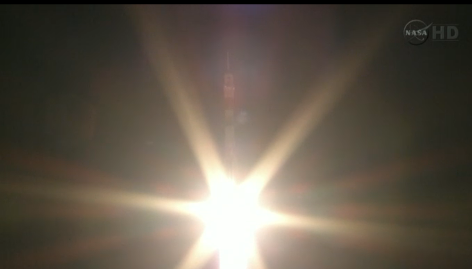
On their way! Glare from rocket flames makes it hard to see the rocket in the center.


Shaky Cam. Fossum gives a thumbs up during ascent.


Volkov in center seat, Furukawa to the right (left seat). Microgravity in effect, as witnessed by the pen floating above the checklist.


Russian mission control outside of Moscow. The Soyuz will dock with ISS on Thursday.

Monday, June 6, 2011

Expedition 28: Second Group Readies for Flight

Reinforcements for Expedition 28 outside a Soyuz capsule.

Three more crew for Expedition 28 get ready for their flight this week to the ISS. In the picture you'll see astronaut Mike Fossum (left) then cosmonaut Sergei Volkov, and on the right is Japanese astronaut Satoshi Furukawa. Volkov will be the Soyuz commander for the flight to the ISS. They will join Commander Andrey Borisenko, Alexander Samokutyaev, and American Ronald Garan who are already manning the station. The Soyuz flight should take place Tuesday, with a docking at the station on Thursday.

Friday, June 3, 2011

Expedition 28: View from the Cupola

Astronaut Ronald Garan at the entrance to the Cupola.

What's the largest window ever used in space? That would be the Cupola on the International Space Station. Built by the European Space Agency (ESA) and installed on the ISS during mission STS130 in 2010. The purpose of the cupola was to give a fantastic viewing area for the operation of the robotic CanadArm-2, operations outside the ISS, docking of visiting spacecraft, and of course a magnificent view of the Earth, the stars and the universe.


View of Docked Progress, and at end of structure, the ATV cargo ship. To the left is the Rassvet science module. on the bottom from left to center is the Zarya, followed by Zvesda .

During the recent mission STS134, astronaut Ron Garan got some help making a 360 degree pan through the many windows of the cupola.


2nd Window. Leonardo module. Much of the station is hidden behind the foreground structure.

3rd window. Destiny, harmony and Kibo modules. The Endeavour is docked to the Harmony Node 2 module.


4th. End of Japanese Kibo module with the experiment "porch."


5th. Looking along the length of the Truss segments to the solar panels.


Aaaaand... we're back where we started.

One more module remains to be attached to the ISS, and that is the Russian Nauka Multipurpose Laboratory Module. It is scheduled to be launched from Kazakhstan in 2012.


Now look up.... Wow!


Endeavour is so big you have to look through the top window to see the engines and stabilizer.

Thursday, June 2, 2011

STS135: Atlantis Roll Out

From inside the VAB: Atlantis heads for the pad.

A few hours before shuttle Endeavour touched down on the long runway at Kennedy Space Center, the great doors of the Vehicle Assembly Building (VAB) began to open. For the last time, a space shuttle was taking the long drive on the giant crawler out to the launch pad. Held firmly in place by giant clamps, the crawler moved Atlantis out of the building and along the trackway at a stately rate of less than a mile per hour. The trip would take about six hours to cover the 3.4 mile journey.


Earlier in May: Atlantis lifted up to attach to the stack.

While the media focus had rightly been on the last launch of shuttle Endeavour and the adventures of mission STS134, the shuttle Atlantis was driven to the VAB. Clamped into a giant lifting cradle, the orbiter was lifted up and oriented 90 degrees to vertical, then slowly brought to its position on the "stack"; that is the External Tank (ET) with its attached Solid Rocket Boosters (SRM's). Once all attachments were complete, systems checked, and safety tests confirmed, it was time for the rollout.

Once in place on Launch Pad 39A, the crawler disengaged from the launch platform itself and began the return trip back to the VAB area. If there are any problems or dangers, as from a hurricane, the crawler will return to the pad and bring the shuttle back. However, that is a very rare event.

The shuttle is scheduled to launch July 8th.

Wednesday, June 1, 2011

STS134: Touchdown!

Infrared camera view of Endeavour about to land.

STS 134 came to an end this morning at 12:34 a.m. MDT when Endeavour landed perfectly on the giant runway built for shuttles at the Kennedy Space Center. This was the final landing for Endeavour, which will now be retired to a museum.

This great shuttle, built to replace the loss of the Challenger, has completed a remarkable series of 25 missions since 1992. The mileage rackup just for this mission is impressive: 6,510,221 miles around the Earth in low orbit, preforming science and helping to build the ISS.
The total mileage for all of its missions now stands at a whopping 122,883,151 miles. Wow!

In addition to mileage, Endeavour has completed 299 days in space, making 4,671 orbits around the Earth. Its next numbers goal will be how many visitors it will receive in a museum.