Sunday, April 4, 2010

Soyuz docks w/ISS; Discovery ready

Expedition 23 gathered together.

The hatch to the ISS opened at a little after 1 am Utah time yesterday, allowing the three space travelers to exit the Russian capsule and enter the recently expanded space station. The crew has little time to prepare the ISS for the docking of another spacecraft! Shuttle Discovery is set to visit the iSS this week.

Discovery set for launch from Pad 39A.

STS 131 is go for launch from the Kennedy Space Center tomorrow, Monday April 5th at about 4:21 a.m. Utah time. You can watch the blast-off on the news, but full coverage is of course found on NASA TV at www.nasa,gov.ntv. Commander Alan Poindexter will lead the mission to bring supplies for the ISS's many experiment racks. There are expected to be three spacewalks during this mission. There will only be three shuttle flights to the station after this mission.

Thursday, April 1, 2010

50 YA - Tiros 1: First Weather Satellite

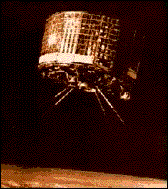
Tiros 1 as it would appear in orbit.

On April 1, 1960, NASA launched a Thor-Able rocket carrying the world's first weather satellite, Tiros 1. Tiros stands for Television InfraRed Observation Satellite. It wasn't known yet if satellites could play an important role in Earth observations. One of the main questions to answer would be if photos from space could save lives on the ground. Tiros proved itself successfully. With photos and data from space, weather forecasting took a giant leap forward.


Tiros 1 photo of a hurricane.

For the first time, observations from space of hurricanes out at sea gave weather forecasters enough time to warn people to evacuate and protect property in time. Analysis of weather fronts helped farmers save crops. Ships at sea could be radioed to go around dangerous weather.

For 50 years now, we've benefited from those friendly watchful eyes in space. Every time you watch a weather report on TV, you benefit from the technology developed from this first Tiros satellite.

Tiros 1 continued broadcasting pictures and data until June 15, 1960 when an electrical problem shut down the satellite. It's still up there in orbit, though, slowly rotating, preserved in the vacuum of space.

Rocket Ready for Expedition 23

Russian Soyuz TMA-18

Reinforcements for the current Expedition 23 on the ISS are preparing for liftoff at around 10 a.m. (Kazakhstan time). Engineers Alexander Skvortsov, Tracy Dyson, and Mikhail Kornienko will join the original 3 Expedition members: Oleg Kotov (commander), TJ Creamer, and Soichi Noguchi.

I had originally thought of doing an April Fool's joke on the blog, when I realized I was too late: the joke is on us, the American space-program supporters. With the cancelation of an actual planned space program, the Obama administration is forcing us to buy rides from the Russians for many years until we (hopefully) get our engineering brains in gear. Enjoy the ride, folks.

Thursday, March 18, 2010

Expedition 22 Completed

One of several Russian helicopters flown to the landing site. It looks cold... BRRR.

With the landing of the Soyuz TMA-16 spacecraft in Kazakhstan this morning, Expedition 22 of the ISS has come to a successful end. Jeff Williams and Max Suraev arrived safe and sound.

Russian rapid transit in the steppes.

Actually they arrived in the freezing steppes in Winter. NASA's photo of the day showed a capsule landing in a giant frozen field of snow. Watching the Russian camera footage, one really gets a feel of how different our two space programs really are. The Russian program works, and works well, but at times it almost seems comical or amateurish. Mostly this is because the Russian cameraman did not do a good job. As the space voyagers were carried from their capsule to waiting chairs, the camera view constantly cut off people's heads, he could not for the life of him think of getting both crewmen in the same view, and at times didn't even bother to aim the camera at anything other than the ground- and upside down.

Get used to this view, folks... Once the shuttle retires and all we have left are overpriced trips on the Russian rockets, we won't see our high definition, good quality camerawork that we are used to. We'll be dependent on landing our astronauts in frozen or desolate wastes, with poor Russian camerawork, and it will be a long time until we return to the American way.

ISS in orbit. View of the Central Truss and solar panels.

Meanwhile, ISS Expedition 23 begins with the Soyuz departure. The change of command ceremony was held yesterday, and Russian Commander Oleg Kotov takes over. There are currently three ISS members, and they will be joined by three more on April 4. The Expedition 23 expansion crew will arrive by a Russian Soyuz. The shuttle Discovery will launch to the ISS on April 5th to bring up more equipment.

Friday, March 12, 2010

50 YA: Pioneer V Launches

Thor-Able rocket system ready for launch.

On March 11, 1960, NASA successfully launched a Thor-Able rocket from the Cape Canaveral launch pad complex. On board was the Pioneer V space probe. Its mission was to explore the nature of space between the orbits of Earth and Venus. Instruments aboard the spacecraft would detect cosmic rays, meteorite particles, solar radiation, and the magnetic fields between the planets.

Pioneer V attached to the Able stage.

The rocket was traveling over 24,000 mph when the satellite was separated from its final stage on March 11th. It successfully reached escape velocity and passed the orbit of the moon on March 12th. It eventually reached an orbit around the Sun, at about a distance of 74 million miles. The satellite had 4 solar power panels to help power it, containing some 4,800 solar cells - remarkable for that time. All the instruments and equipment fit in a sphere of 26 inches and weighed about 144 pounds.


Model of Pioneer V on display in 1964 at the Ohio Parade of Progress Show.

Signals from the Pioneer V would continue to be received until June of 1960. It's still out there, orbiting the Sun, and should stay there for another 100,000 years.

Wednesday, March 10, 2010

The team of STS-131 at Pad 39A

While NASA prepares for the flight of space shuttle Discovery on mission STS-131 in April, politicians around the country are arguing both for and against the new directives and budget from the White House.

Senators and congressmen scramble to propose legislation to force a different outcome. Even today, the "Human Spaceflight Capability Assurance and Protection Act" was introduced in the House of Representatives. This bill, if successfully passed, would extend the ISS mission till 2020 (as does the current proposal), compel NASA to keep flying the shuttle (which is scheduled to be shut down after this year), and accelerate the construction of a "next-generation NASA space vehicle." Unfortunately the bill does not provide (in my opinion) sufficient funding to achieve such goals. Not likely to pass- it also lacks enough direction.

In the meantime, commercial space providers continue to push forward. Space X attempted a test-firing of their new Falcon 9 rocket (at Canaveral station in Florida). An unfortunate glitch shut down the engine just as it almost started. They will try again in a few days. The Falcon 9 will be used to send robotically controlled cargo ships to the ISS, and eventually, human capsules.

Monday, February 22, 2010

Endeavor Lands at night


STS-130 began with a night launch and ended with a night landing. The mission saw a successful installation of the Tranquility module into the ISS structure, followed by the placement of the observation cupola onto the Earth-facing side of the module. Should the ISS project continue to 202 as recommended by the White House, the cupola will give space workers many wonderful views of the earth from their orbital perch.

With the ending of mission STS-130, there are now only four missions left in the life of the shuttle program. The next mission is STS-131 on shuttle Discovery. The launch is scheduled for April 5th. Discovery will carry science modules and equipment to the ISS.

I didn't get to see as much of this last mission as I would have liked. Work schedule plus my attendance at the BYU SF/F symposium kept me fairly busy.